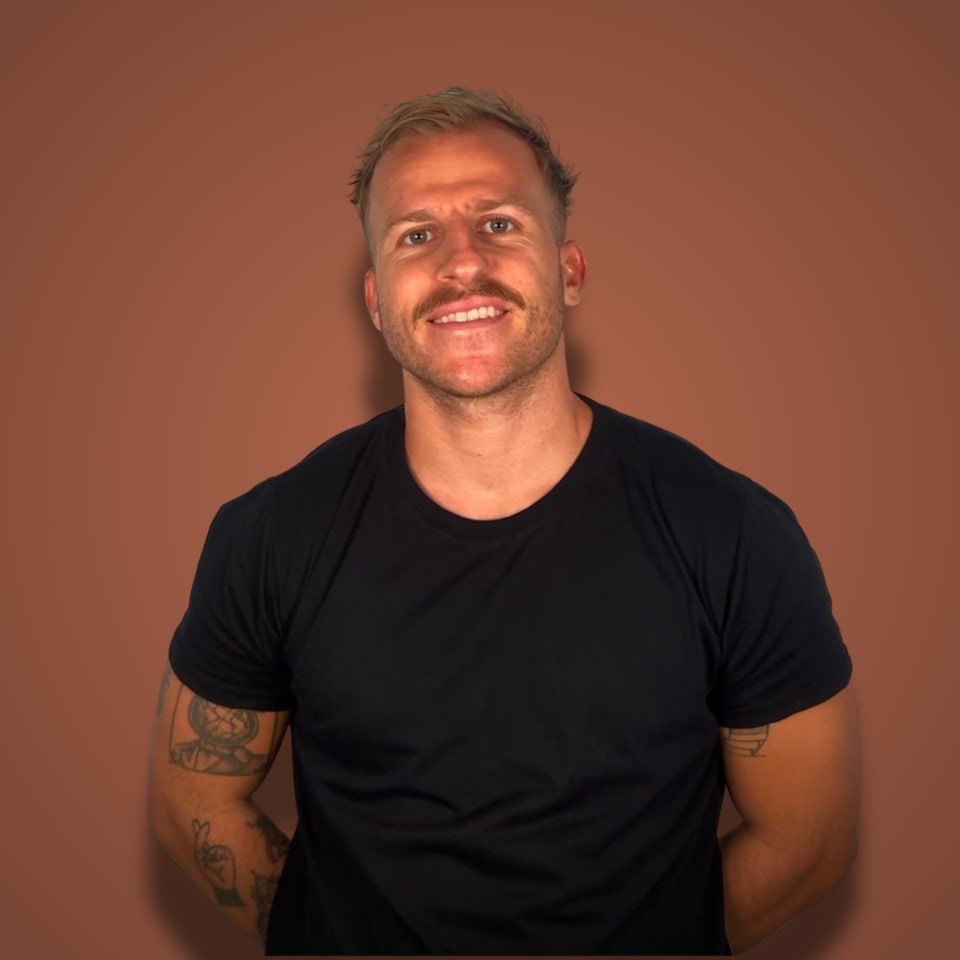
Sam Parr's companies make over $10 million a year.
He sold The Hustle to HubSpot. He runs Hampton, a private community for founders. He co-hosts My First Million.
And his daily system is almost embarrassingly simple.
No 4am cold plunge. No 47-step productivity stack. The guy rides a rinky dink scooter to work and eats an Oreo at 10:30pm.
Starter Story got him to walk through a full day, hour by hour. I pulled the video apart because there are about 6 things in there that actually explain the $10M/year, and none of them are what productivity YouTube sells you.
Here's the whole thing, with the parts worth stealing.
The morning: phone in a box, weights, breakfast with the kids
Sam wakes up between 6 and 6:30.
Black coffee from the Nespresso, a splash of whole milk, and he's in the gym 20 to 30 minutes later. Heavy weights or sprints, roughly 6 days a week. On rest days he stretches "like a madman."
Then breakfast with his kids. Every day, without fail.
The interesting part is the phone.
He doesn't sleep with it in the bedroom. He doesn't look at it until right before the workout. He used to lock it in a timed KitchenAid container, until the day he needed it so badly he smashed the container open.
(That detail alone tells you he's a normal addicted human like the rest of us.)
Now he uses Brick, a physical device that locks apps until you tap it again. He tested Opal first, then stuck with Brick for over a year.
His reason for avoiding Twitter in the morning is worth writing down. He's talked to thousands of entrepreneurs and a handful of billionaires, and he's seen behind the scenes of most of the businesses people brag about.
His conclusion: everyone has complaints, and everyone sometimes wishes they were doing something else. The feed only shows you the highlight reel, and comparing yourself to it is poison.
→ Nine times out of ten, staying focused on your one thing beats bailing to start something new.
The 5-year journal that exposes your fake plans
Before work, Sam writes in a 5-year journal. One entry per day, and you can see what you wrote on that exact date one year ago, two years ago, and so on.
More than once he's caught himself about to complain about something, looked up, and seen the identical complaint from the same day the year before.
Same frustration. Twelve months apart. Zero progress.
His takeaway is brutal: he considers himself someone who makes things happen, but unless he sets up an actual system, nothing changes. Complaining you're out of shape means nothing if you didn't hire a coach.
I love this because most founders (me included) confuse being annoyed by a problem with working on it.
If you've complained about the same thing twice, you don't have a frustration. You have a missing system.
One or two things a day. That's it.
Sam calls himself lazy. A procrastinator.
So the only things that get done are things that are time bound and specific.
Every morning he does what he calls active planning: write down what needs to happen ("come up with 3 podcast ideas"), then go to the calendar and give it a time slot.
And his cap, learned over years of running companies: one or two real things a day. Not seven. Not a color-coded Notion board.
One or two.
If a guy with companies doing $10M+ a year plans 2 tasks a day, your 14-item to-do list is fiction. It's a wish list wearing a productivity costume.
This is the same trap that burns founders out at $10K MRR. I wrote about how that spiral works in SaaS founder burnout: why it hits at $10K MRR.
The podcast system (and the AI doing his prep)
Sam records every Monday and Wednesday.
His prep is now partly automated: he built a Claude skill that reads his calendar, sees who the guest is that day, and automatically researches them. He reads that research, maybe skims a book on the topic, and walks in 10 minutes before recording.
That's a $10M/year founder handing an entire research workflow to an AI agent and trusting the output. The same pattern works for almost any repeatable prep work in your business. If you want a map of what's worth automating first, this breakdown of business automations is a solid place to start.
What keeps him in love with podcasting is also a warning for anyone making content. Every time he starts chasing numbers, picking topics because they'll get views instead of because they interest him, he ends up disliking the show for weeks.
The joy comes back when a guest breaks his frame. Someone who raised money in a weird field, someone who bootstrapped where everyone said you couldn't.
→ His #1 takeaway from all those conversations: there are way more paths to where you want to go than you think. That's where his confidence comes from.
The zebra calendar: how he brute forces 0 to $10M
This is the part I'd tattoo on every early-stage founder's forearm.
From $0 to somewhere around $5-10M in revenue, Sam says he is pure blunt force. He runs what he calls a zebra calendar: a 15-minute customer meeting, a 5-minute break, another meeting, another, all day. Stripes on a calendar.
He makes the website. He writes all the copy. He does the design work himself.
No strategy retreats. His actual operating system is: "What's next? Go. What's next? Go."
To him, 0 to 10 million is only two problems: get more customers and make the product better. Everything else is decoration.
If you're pre-$100K MRR and spending more time on your brand guidelines than on customer calls, that's the correction. Stack the calls. I broke down the tactical version of this in how to get your first 100 SaaS customers.
He backs it with a study he loves. A pottery class was split in two: one group graded on making as many pots as possible, the other on making one perfect pot. The quantity group ended up happier AND made better pots, because every rep taught them something.
→ If you're chasing your first million, ceaseless action beats perfect planning. Volume is the strategy.
Then the hard part: letting go
Here's where it gets uncomfortable for the control freaks.
Once a company passes $5-10M, Sam says you have to delegate and hire. And when he does, he genuinely doesn't know what to do with his hands.
His fix is a sandbox: a small side project he's allowed to tinker with so he doesn't break the main thing.
"When you have something that's compounding and working, you let it go and you don't mess with it."
He also walks the office after recording, looks through windows, and asks people what's wrong until someone admits a problem, then goes and solves it. His team made him put frosted glass on the windows because it was creepy.
Obsessive? Yes. But he says he can't sleep knowing something is broken, and that sense of urgency is the trait he sees in every high achiever.
Know which founder you are
Sam's framework for picking what to work on splits founders into two types.
If you need encouragement and momentum: just act. Start on anything, get a small result, pivot from there. Motion first, direction second.
If you have a track record, if you've already proven you're (his word) a terminator who hits goals: slow down and plot. Pick the project at the center of what he pronounces "eeky guy" (ikigai): what the world wants, what it will pay for, what you're good at, what you love.
One more thing he's seen over and over: cool stuff seems dumb at first.
His first year on The Hustle, successful people asked "okay, but what are you actually going to do?" His friends asked how he'd pay the bills. A newsletter looked like a joke of a business. Then it sold to HubSpot.
If everyone immediately gets your idea, you're probably late.
The evenings are boring on purpose
Home between 5:30 and 6. Sushi or home cooking with the kids, music on. Daughter down at 8:30, which he calls his favorite moment of the day.
Then: eBay. The man spends 8:30 to 10 hunting for treasures on eBay, and while listings load he asks Claude questions about life. His words: "It's like therapy time."
10 to 10:45, reading. He reads in what he calls semesters, 5 to 10 books on one topic. Current semester: serial killers. Before that: shipwrecks, the Kennedys, New York history.
And around 10:30, the Oreo. "Calories don't count if it's after 10pm."
No revenue dashboard before bed. No Slack. A $10M/year founder ends his day with eBay and a cookie.
The lesson underneath the whole video is his last line, and it has nothing to do with scheduling: enthusiasm and mindset crush obstacles. He loves working out because it's hard. He loves building companies because it's hard.
The routine isn't the moat. The energy is. The routine just protects it.
FAQ
What is Sam Parr's daily routine?
Wake at 6-6:30, black coffee, gym within 30 minutes (weights or sprints, 6 days a week), breakfast with his kids, a 5-year journal entry, then active planning: 1-2 time-bound tasks on the calendar. He records podcasts Monday and Wednesday, gets home by 6pm, and ends the day with family dinner, eBay, and reading until about 10:45pm.
How does Sam Parr limit his phone use?
He keeps his phone out of the bedroom and doesn't check it until right before his morning workout. He uses Brick, a physical device that locks distracting apps. He tested Opal before that, and once smashed a timed lockbox to get his phone out.
What is a zebra calendar?
Sam's term for a calendar striped with back-to-back 15-minute customer meetings separated by 5-minute breaks. It's how he brute forces companies from $0 to around $10M in revenue: maximum customer conversations, minimum ceremony.
What companies does Sam Parr run?
Sam founded The Hustle (a media newsletter acquired by HubSpot in 2021), co-hosts the My First Million podcast, and now runs Hampton, a private community for founders. Combined, he says his companies make over $10 million a year.
How many tasks should a founder plan per day?
Sam plans one or two. His rule: write down what needs to get done, put it on the calendar with a specific time, and accept that anything beyond 2 real tasks a day probably won't happen.
Sam's edge is that he talks to people ahead of him constantly. That's the whole game.
It's also exactly what I do on the Profitable Founder Podcast: bootstrapped SaaS founders making $100K to $10M a year, walking through their real numbers and systems.