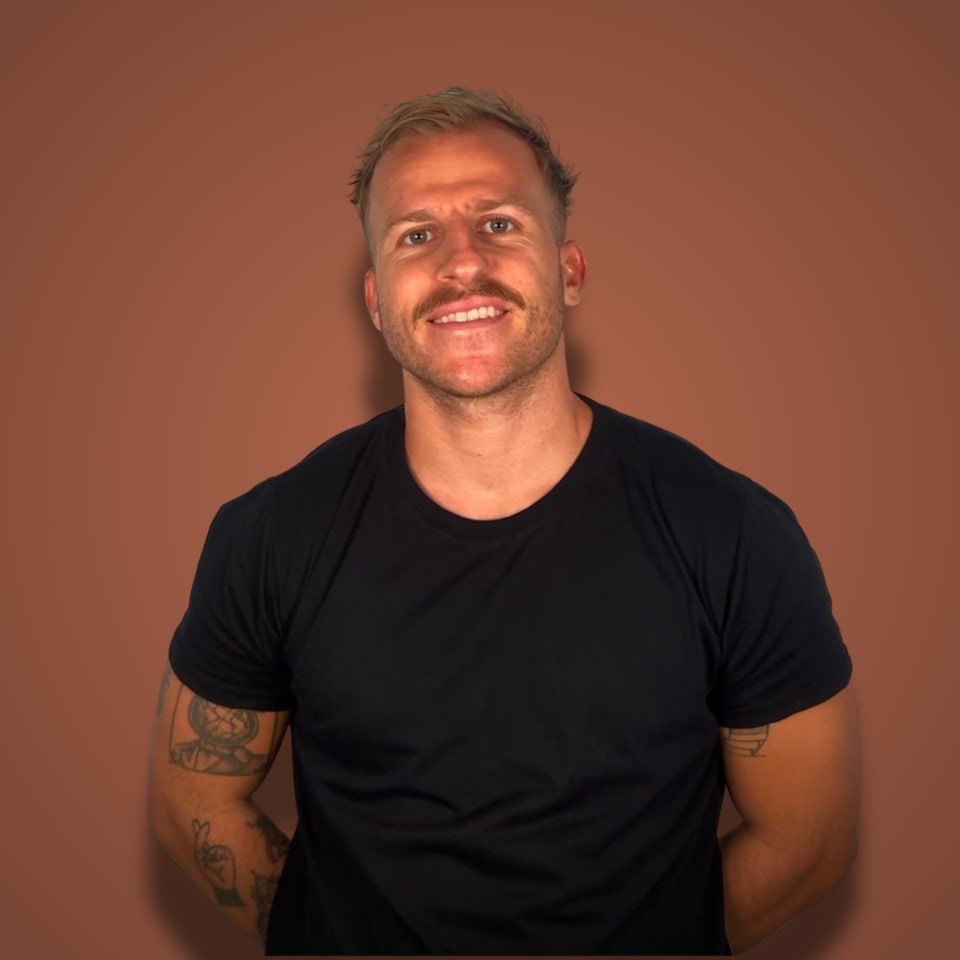
A guy who was waiting tables three months earlier made $110,000 in one month posting TikToks for a cologne launch.
Not his cologne. Someone else's.
That someone is Rob the Bank. He sold his supplement company, The Genius Brand, for $30M+ in his early twenties. Then he spent years failing, a cookie company and a protein bar company both went under. Now he's back with Evil Goods, a beef tallow skincare brand he runs with YouTuber Jake Tran. It did $1M in revenue in month three. At 30 to 40% margin.
Brett Malinowski sat down with him for almost 90 minutes and Rob laid out the whole system. I took notes so you don't have to.
Here's the full conversation:
Who is Rob the Bank?
Rob started selling on Amazon in 2013, before anyone was talking about FBA.
The spark was painfully simple: a friend sold his company for $4 million, and Rob thought "if I could do that, I'd never work again." (His words: obviously wrong, a million ain't that much.)
So he disappeared for two years. Stopped going to the gym, lost all his muscle, sat behind a computer and read everything Google had on Amazon's A9 algorithm.
It worked. He built The Genius Brand, a supplement company with a name he couldn't believe was still trademarkable, and sold it for eight figures in his early twenties.
Then came the part nobody puts in the highlight reel.
He started four businesses after the exit. Three failed. A cookie company went under. A protein bar company went under. The one that survived was Top Shelf, his coffee brand.
And Top Shelf is where he found the cheat code.
The moment TikTok Shop clicked
Top Shelf was doing around $150K a month. Solid, not spectacular.
Rob put a young operator on TikTok Shop creators. For five or six weeks, nothing. Then the creators started going viral.
$150K a month → $800K a month. In about two months.
So when his partner Jake Tran (the YouTuber who makes those "evil corporation" exposé videos) came to him after falling down a rabbit hole on how bad most skincare actually is, Rob didn't hesitate. Beef tallow as a natural moisturizer was starting to trend on Amazon. They branded it Evil Goods and pointed the same creator machine at it.
Month three: $1M in revenue.
Rob says they pulled 100+ million views on TikTok in a single 30-day stretch. Not from one big account. From dozens of small ones.
Funny detail: Brett opened the episode by telling Rob his girlfriend had bought Evil Goods on her own, from TikTok, the morning of the recording. She had no idea who Rob was. That's what discovery at that scale looks like.
The formula: TikTok buys, Amazon repeats, PE pays 20x
This is the part that made me sit up.
Rob's mental model for physical product brands right now:
→ TikTok Shop = your first-time buyers. The algorithm hands you discovery for free. A brand new account can post one video and get 10 million views. Followers barely matter.
→ Amazon = your repeat buyers. Once someone knows the brand, they reorder where they already shop.
→ Private equity pays roughly 20x on repeat buyers. That's the exit math. Repeat purchase behavior is the asset, everything else is marketing.
First-time buyers are a spike. Repeat buyers are enterprise value. The whole game is moving people from column one to column two, which is classic lead nurturing applied to a $12 tub of moisturizer.
Rob's framing for the window we're in: "We're going to look back at this like Amazon FBA in 2013." He was there for the first one. I'd take him seriously.
The creator army (and why it's not influencer marketing)
The strategy traces back to Oliver Brocato and Tabs Chocolate.
Oliver's insight: instead of paying one influencer with a big following, get 20 kids to make brand accounts and post content optimized for TikTok every single day. If 2 out of 20 videos go viral, the whole thing pays for itself many times over.
Evil Goods runs 40 to 50 creators like this. They get a brief, they know the brand, they know what works in the algorithm, and they post daily.
The talent comes from Creators Corner, run by Jimmy Farley, who happens to be Oliver's old roommate and is Rob's business partner on all of this. Rob says around 80% of his best-performing creators come through Jimmy's program. Trained, managed, guaranteed a placement with a real brand. Rob calls it "college for a corporate job," except everyone actually makes money.
I broke down Jimmy's side of that machine in my piece on TikTok Shop affiliates. Rob is literally the guy backing it.
How creators get paid: usually a small retainer plus commissions on what their videos sell. That's how a waiter ends up making $110K in a month during a cologne launch. The incentives are so aligned it almost feels unfair.
If you're wondering whether this only works for physical products: the same creator-volume playbook is printing money for apps too. Nicole runs 200+ creators for her $150K/month apps, I wrote that one up in the UGC creator system story.
How Rob picks products
This is the most stealable section of the episode.
1. The 3% rule. Rob borrowed it from Virgil Abloh: you only need to make something 3% better to add real value. One of his students wanted to compete with Hostage Tape, the $20M gorilla in mouth tape. His 3%? Lavender-scented tape. Same supplier, found through Import Yeti (a free tool that shows you who manufactures for existing brands).
2. Triangulate demand. Rob never trusts one data point. He checks what's trending on Amazon, uses a tool called Magnet to compare search volume against how many products are actually being sold, and cross-references Exploding Topics.
3. Hunt bad reviews on viral products. If four mouth tape brands are going viral on TikTok Shop and their reviews are horrible, that's not a red flag. That's your opening.
4. Respect the margin math. Rob went under on a cookie company because of this. Cookies at 60% net margin sound great until you realize a $4 CPC on a $12 product destroys you, while the same click on a $100 supplement is nothing. Dollar margin per order beats percentage margin. He learned that one the expensive way.
5. Branding is cheap now. The woman on the Evil Goods can? AI-generated. Rob used to run design contests for weeks in the Amazon days. Now it's Midjourney prompts, then a designer to finish it.
What happens after the spike
Virality decays. Rob is blunt about it: Evil Goods can spike, dip for two or three months, then reignite when a new angle or a cultural moment hits. "When you go viral, it's free money." The rest of the time you run a normal, healthy business.
His answer to the decay:
→ Keep the creator community warm in Discord, because creators follow the money and will drift to other brands.
→ Feed them new products under the same brand, so every launch restarts the machine with a trained army instead of from zero.
→ Meanwhile, Amazon quietly compounds the repeat buyers. You can even email past customers through Amazon itself (templated, limited, but it works).
That's the machine. TikTok makes the spike, the community sustains it, Amazon banks it, and private equity buys the result at 20x.
What I'd steal from this if I were you
Most people reading this build software, not skincare. Doesn't matter. The lessons travel:
→ Distribution windows open and close. Amazon 2013, TikTok Shop now. When one is open, speed beats polish.
→ Volume of small bets beats one big bet. 20 creator accounts posting daily beats one influencer deal, the same way 20 small content experiments beat one launch post.
→ First purchases are marketing. Repeat purchases are the company. Whatever you sell, the retention number is the one an acquirer will actually pay for.
→ You don't need a new idea. You need an existing demand curve and a 3% improvement.
Rob failed with three companies after a $30M exit. The system he has now came out of those losses, not the win.
FAQ
Is TikTok Shop still worth starting a brand on?
Rob's bet is yes, and he compares the moment to Amazon FBA in 2013, when small players could still blow up with very little money. The discovery algorithm doesn't care about your follower count, so a brand new account can reach millions. Windows like this close, though. The whole thesis is built on moving fast while organic reach is still cheap.
How do TikTok Shop creators get paid?
In Rob's system, creators typically get a small monthly retainer plus commission on sales their videos generate through TikTok Shop. The commission side is uncapped, which is how one of his creators, a waiter three months earlier, made $110K in a single month during a product launch.
Do you need a big audience to launch a TikTok Shop brand?
No. That's the point of the brand-account strategy: dozens of fresh accounts run by paid creators, posting daily content optimized for the algorithm. Evil Goods hit $1M in month three with zero existing audience of its own. The views came from 40 to 50 creators, not from a founder with a following.
What made Evil Goods different from other skincare brands?
Product-wise, it rode the beef tallow trend early with a clean, natural positioning (Jake Tran's research angle). Brand-wise, the "evil corporations lied to you" story fits Jake's entire YouTube catalog. And distribution-wise, it had a trained creator army from day one. Product, story, distribution. Most brands show up with one of the three.
Every week I sit down with bootstrapped founders doing $100K to $10M a year and pull playbooks like this out of them. If this saved you a 90-minute watch, the podcast will save you years of trial and error.