
A tiny SaaS podcast with 300 monthly downloads reportedly charged $60 for one host-read mid-roll. That works out to a $200 CPM, well above the $18 to $50 range often used for podcast ads. Here are five SaaS podcast sponsor pricing template options, with the right fit for each type of founder-focused show.
1. Profitable Founder Podcast: Founder-focused sponsorship packages
The Profitable Founder Podcast model fits sponsors that want direct access to bootstrapped SaaS founders. Each week, the show interviews SaaS founders making between $100K and $10M a year. That gives a sponsor a clear audience story, even when raw download totals are still modest.
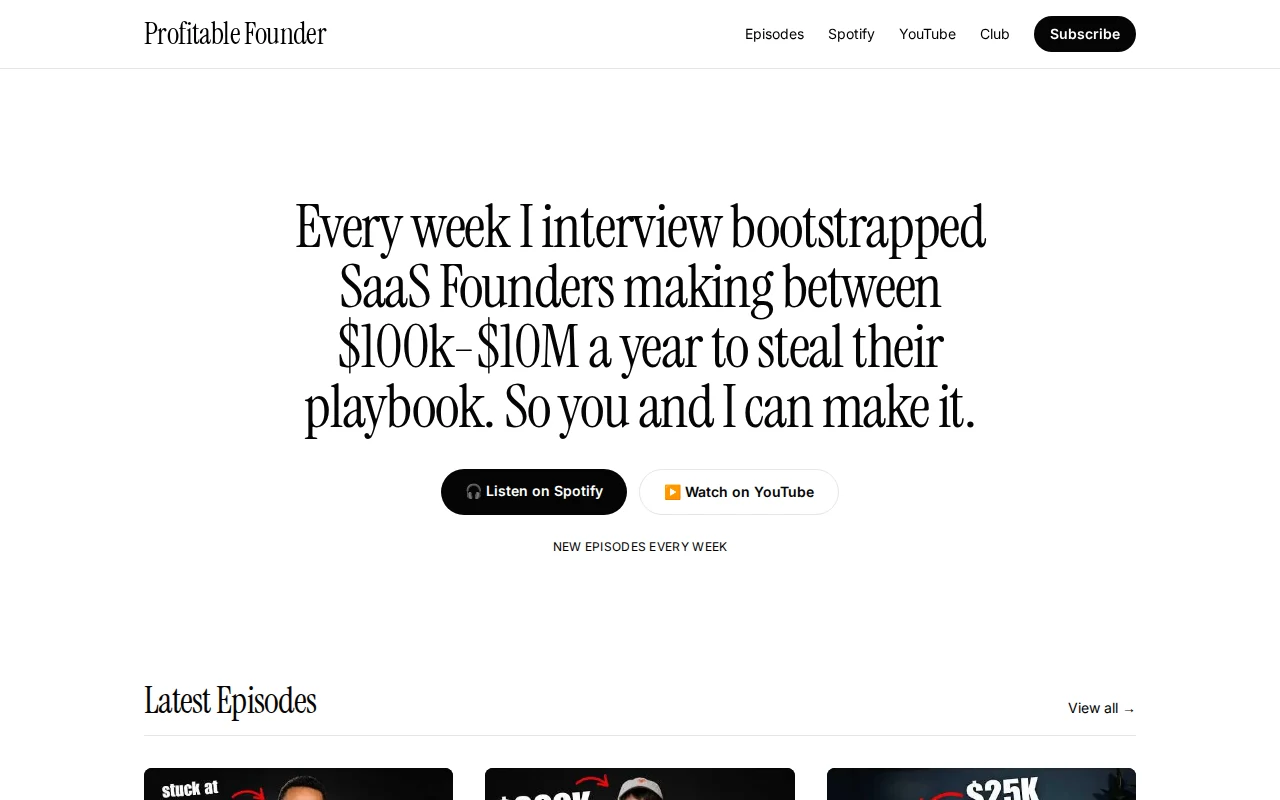
This is our top pick for a sponsor package because the audience has a defined business stage. A sponsor can frame its offer around founders who already have traction, rather than paying for broad technology reach. That distinction belongs near the top of your pricing sheet.
A useful package can include one host-read mid-roll, the episode topic, the listener profile, and the sponsor's main call to action. Keep the promise narrow. For example, the host might explain one workflow problem the product solves, then point listeners to a short landing page.
The Profitable Founder Podcast also has the Profitable Founder Club, a private mastermind for SaaS founders doing between $5K and $50K MRR. That community context can help a sponsor judge fit, but it should not be presented as guaranteed reach. List the podcast audience and the mastermind audience as separate lines.
Use a one-page media sheet. This SaaS founder podcast sponsor deck template can help you lay out audience fit, ad formats, pricing, and proof without turning the deck into a sales brochure.
The limitation is simple: a niche audience needs honest proof. Show average downloads per episode at a stated time point. Add completion data when available. If you cannot prove a number, leave it out and sell the host's relevance instead.
2. SaaS Podcast CPM Rate Card Template: Best for audience-size-based pricing
A CPM rate card is the cleanest SaaS podcast sponsor pricing template when sponsors want to compare audience size. CPM means cost per thousand impressions. The basic formula is ad cost divided by downloads, multiplied by 1,000.
Start with one download number. Use average downloads per episode at 30 days, not your biggest episode. Then add a separate row for each ad position. A host-read mid-roll should not share the same rate as a short pre-roll or a post-roll mention.
- Average downloads per episode at 30 days
- Ad position and expected length
- CPM used for the quote
- Fee per episode
- Number of episodes in the package
For a working benchmark, the supplied market research places host-read mid-roll pricing around $25 to $50 CPM for niche SaaS shows. It also records one bootstrapped show with 300 monthly downloads charging $60 per episode. The math is $60 divided by 0.3 thousand downloads, which equals a $200 CPM.
That single example should not become a market rule. It does show why a strong niche can change the price. A founder who hears a trusted host explain a painful problem may be worth more than a casual listener in a much larger feed.
For example, 2,000 downloads at a $50 CPM produces a $100 episode fee. If the show has only 300 downloads, the same calculation produces $15. A niche show can still ask for more, but it needs a clear reason. Audience role, buying power, and host trust belong in the rate card.
The weak spot is false precision. CPM makes two shows look comparable when their listeners may have very different intent. Use the formula as a starting point, then add a short audience-fit note beside the number.
3. SaaS Podcast Flat-Fee Package Template: Best for simple sponsor offers
A flat-fee package keeps a SaaS podcast sponsor pricing template easy to approve. The sponsor pays one known amount per episode or month. The host commits to a defined placement, read length, campaign window, and delivery date.
This model works well for smaller shows. At low download counts, CPM math can produce a fee that feels too small for the work involved. A flat fee accounts for host prep, sponsor review, recording time, payment handling, and the value of the audience match.
Keep the package plain. A sample structure might include one mid-roll per episode, a two-episode test, and a short report after the campaign. Do not promise conversions. Promise the agreed placement and the reporting you can actually provide.
Write the terms before recording. Confirm the episode dates, ad position, key talking points, approval rules, payment timing, and cancellation window. A written email agreement may be enough for a first test, but both sides should know what happens if an episode is delayed.
Flat fees also make renewal talks easier. You can ask whether the sponsor wants another two episodes, a longer run, or a different placement. Keep the first test small enough that both sides can learn without guessing what caused the result.
The tradeoff is weaker comparison across shows. A sponsor cannot judge efficiency without download data. Add average downloads, audience profile, and the effective CPM as an information line, even when the deal itself uses a flat fee.
Choose this format when the sponsor wants budget certainty or the show has a small but focused audience. Keep the offer easy to explain in one email.
4. SaaS Podcast Hybrid Pricing Template: Best for combining reach and deliverables
A hybrid pricing template combines a base sponsorship fee with a measurable action or extra deliverable. It can include a flat payment plus a tracked referral fee, or a podcast fee plus a newsletter placement. The point is to split payment between access and response.
This model fits SaaS products with a clear trial or demo path. Give the sponsor a unique landing page or promo code. Track the action the sponsor cares about, such as trial starts or booked demos. Agree on the attribution window before the campaign begins.
The fixed part protects the host from doing unpaid work. The performance part gives the sponsor a reason to test the channel. Neither side should assume that every listener will convert after one mention.
Keep the offer narrow:
- Base fee for the host-read placement
- Extra payment tied to one agreed action
- Campaign dates and attribution window
- Rules for refunds, duplicate leads, or existing customers
For a founder-led show, the host's read is often the main value. The supplied research found a mid-roll host-read as the only format in its disclosed example. That supports a simple design: charge for the trusted introduction first, then add performance pay only when tracking is clean.
Do not attach a commission to vague outcomes such as brand awareness. Pick an event that can be counted. A sponsor might track a new trial through a dedicated URL, while the host reports the sponsored episode's downloads after the agreed period.
There is a legal detail too. Paid endorsements need clear disclosure so listeners understand when a recommendation has a material connection to an advertiser.
The drawback is admin work. If nobody owns the tracking sheet, the hybrid deal will create more arguments than insight. Use it only when both sides agree on one metric and one source of truth.
5. SaaS Podcast Value-Based Sponsorship Template: Best for reaching qualified founders
A value-based SaaS podcast sponsor pricing template starts with audience quality instead of download count. It asks what a qualified founder is worth to the sponsor, then builds the package around access to that buyer.
This approach suits products with high monthly contract value, founder-led sales, or a narrow customer profile. A show may have fewer listeners but still reach people who can buy, refer, or influence a software purchase.
Do not make a vague claim such as “premium audience.” Put the evidence in plain terms:
- Founder role and company stage
- MRR range when the audience data supports it
- Common problems discussed on the show
- Ad format and host involvement
- Action the sponsor wants listeners to take
The Profitable Founder Podcast has a strong fit for this model because its stated audience is SaaS founders. A sponsor selling a tool for retention, billing, analytics, or growth can explain why those listeners may care. That is a positioning argument, not a promise of sales.
| Pricing angle | Best evidence | Main risk | Use it when |
|---|---|---|---|
| CPM | Verified episode downloads | Ignores buyer fit | The sponsor needs a media comparison |
| Flat fee | Clear placement and campaign dates | Harder to judge efficiency | The sponsor wants a fixed budget |
| Hybrid | Trackable trials or demos | Attribution disputes | The product has a clean funnel |
| Value-based | Audience role and purchase fit | Can sound subjective | The audience is small but highly focused |
For outreach, lead with fit before price. A concise SaaS podcast sponsorship outreach email can keep the first message short and focused on the audience match. Send the full rate card after the host or sponsor shows interest.
The caveat is proof. Value-based pricing gets weak when the host cannot describe the audience beyond “SaaS people.” Use the narrowest honest profile you have, then review the package after the first campaign.
FAQ
What is a SaaS podcast sponsor pricing template?
A SaaS podcast sponsor pricing template is a repeatable sheet for quoting ad placements. It usually includes downloads, CPM, placement, episode count, campaign dates, and sponsor terms. The best version also explains audience fit, since a founder-focused show may justify a different fee than a broad technology podcast.
How much should a SaaS podcast charge for a sponsor?
A niche SaaS podcast can start with a host-read mid-roll benchmark of about $25 to $50 CPM, based on the supplied research. Smaller shows may prefer a flat fee because CPM produces a tiny number. Quote from verified downloads, then adjust for audience fit and the work required.
Is CPM or flat-fee pricing better for a SaaS podcast?
Flat-fee pricing is often easier for a small SaaS podcast, while CPM is better when download data is steady. CPM helps sponsors compare reach. A flat fee protects the host from underpricing production and host-read work. Many shows can show the effective CPM while selling a flat package.
What should a podcast sponsor rate card include?
A useful rate card includes average downloads per episode, the measurement period, ad positions, read length, episode count, fee, audience profile, and campaign terms. Add a clear action for the sponsor, such as a landing page visit. Keep it to one page so a busy founder can judge fit quickly.
Can a small SaaS podcast charge a premium CPM?
Yes, a small SaaS podcast can charge a premium CPM when its audience has strong buyer fit. One disclosed example used 300 monthly downloads and a $60 mid-roll, which implies a $200 CPM. Treat that as one data point, not a normal market rate. Explain the niche value and show the math.
Conclusion
For most founder-led SaaS shows, start with a flat mid-roll package and show the effective CPM beside it. If your audience data is strong, test value-based pricing with a clear buyer profile. Build a one-page rate card, send it to a small group of well-matched sponsors, and revise the offer after the first campaign.
Editorial Notes
The pricing example in this article comes from one video reviewed on August 9, 2026. No podcast name or extra pricing tiers were provided, so the $200 CPM example should be treated as a niche case rather than a market average. The templates above turn that limited data into usable pricing choices without pretending the market is more transparent than it is.