Most podcast sponsorship pitches get deleted in under five seconds. The host skims the subject line, sees a wall of text, and moves on. If you're a bootstrapped SaaS founder trying to land a podcast deal, you don't need a longer pitch. You need the right resources to write a shorter, sharper one. Here's everything: templates, subject line formulas, pitch decks, discovery tools, and follow-up scripts.
What Makes a SaaS Podcast Sponsorship Outreach Email Actually Work
The emails that land deals are short. Four sentences, sometimes five. They name the show specifically. They include one number that proves the audience fits. And they end with a single, low-friction ask.
The emails that get ignored sound like press releases. They open with company background, list every feature, and ask for a "strategic partnership opportunity." Podcast hosts are not procurement managers. They're creators with full inboxes.

What separates a working outreach email from a dead one comes down to three things. First, specificity: you name an episode, a guest, or a stat from the show itself. Second, relevance: you connect your SaaS product directly to what that podcast's audience actually does for work. Third, a clean ask: one yes-or-no question, not a 45-minute demo request.
There's also the personalization gap that most founders skip. Generic emails that could apply to any podcast signal that you didn't do the homework. Hosts notice. A single specific line, something like "your episode on pricing with [guest name] is exactly why I think [your tool] fits your listeners," does more work than three paragraphs of company history.
Personalization and a clear value proposition are the two factors most associated with higher response rates in unsolicited outreach. That holds in podcast sponsorship just as much as in sales.
One more thing: don't attach your media kit to the first email. Attach it after they reply. An unsolicited PDF from an unknown sender often triggers spam filters. More importantly, a reply means they're interested. That's when detailed assets matter.
Resource #1: Cold Outreach Email Templates for SaaS Podcast Sponsors
These templates are built for founders pitching directly to podcast hosts, not through ad networks. They're short on purpose. The goal of the first email is a reply, not a yes.
Template A: The Direct Fit Pitch
Subject:[Their show name] + [Your company] , quick sponsorship idea
Hi [Host name],
I run [Your SaaS], a tool that helps [specific audience] do [specific thing]. Your show reaches exactly that audience , I noticed your episode on [specific topic] got into the weeds on [pain point], which is precisely the problem we solve.
We average [X] in monthly recurring revenue and are looking for a [mid-roll / pre-roll] sponsor slot on a show where the listeners actually build software products.
Would you be open to a quick 10-minute call this week to see if there's a fit?
Template B: The Competitor Listener Angle
This one works when you know the show's audience uses competing tools. It signals research without being presumptuous.
Subject: Sponsorship idea , your listeners might actually use this
Hi [Host name],
[Your SaaS] is a [category] tool used by bootstrapped SaaS founders to [outcome]. I've been listening to [show name] for a while, and your audience profile matches our users almost exactly , founders at [$X] MRR trying to [goal].
We're in budget for two to three podcast partnerships this quarter and your show is at the top of the list.
Happy to send a one-pager. Would that be useful?
Notice what both templates don't include: a pricing ask, a media kit, a feature list, or a mission statement. Those come later. The first email earns a reply. Everything else is premature.
If you're still building your targeting list before you draft anything, the guide on finding podcast sponsors for a bootstrapped SaaS podcast walks through how to pull your episode download data and build a shortlist of 15 to 20 target companies before you write a single word.
One honest caveat: these templates are starting points. If you send them word-for-word to 50 shows, they'll stop working fast. The specific detail you add about each individual show is what makes them land.
Resource #2: Subject Line Formulas That Get Podcast Hosts to Open
The subject line is the whole game. A bad one and the email never gets read, no matter how good the body is. For podcast sponsorship outreach, hosts get pitched by brands with real budgets. To compete as a bootstrapped founder, your subject line has to feel specific, not promotional.
Formulas That Work
- [Show name] + [Your company] , quick sponsorship idea(direct, no hype, specific)
- Sponsorship for [show name] , [your SaaS category] fit(names the category so hosts know what they're getting into)
- [Episode title or guest name] made me think of this(shows you actually listened)
- [Your SaaS] → [show name] listeners: a fit?(the question format lowers resistance)
- Quick note on sponsoring [show name](plain language, no pitch energy)
Formulas That Kill Open Rates
- "Exciting partnership opportunity for [show name]" (corporate, vague)
- "[Your SaaS] wants to sponsor your podcast!" (exclamation points signal desperation)
- "Following up on our sponsorship proposal" (implies a prior conversation that never happened)
- "Grow your podcast revenue with [Your SaaS]" (puts the value frame backwards)
The pattern across working subject lines: they name the specific show, they stay under ten words, and they don't promise anything they can't deliver in the email body. Hosts are smart. Over-promised subject lines create distrust before the email even opens.
For founders pitching SaaS-adjacent shows in the tech and business space, the "[Show name] + [Your company]" format consistently outperforms clever wordplay. Plain is fast. Fast gets opened.
Resource #3: Sponsorship Pitch Deck and One-Pager Templates
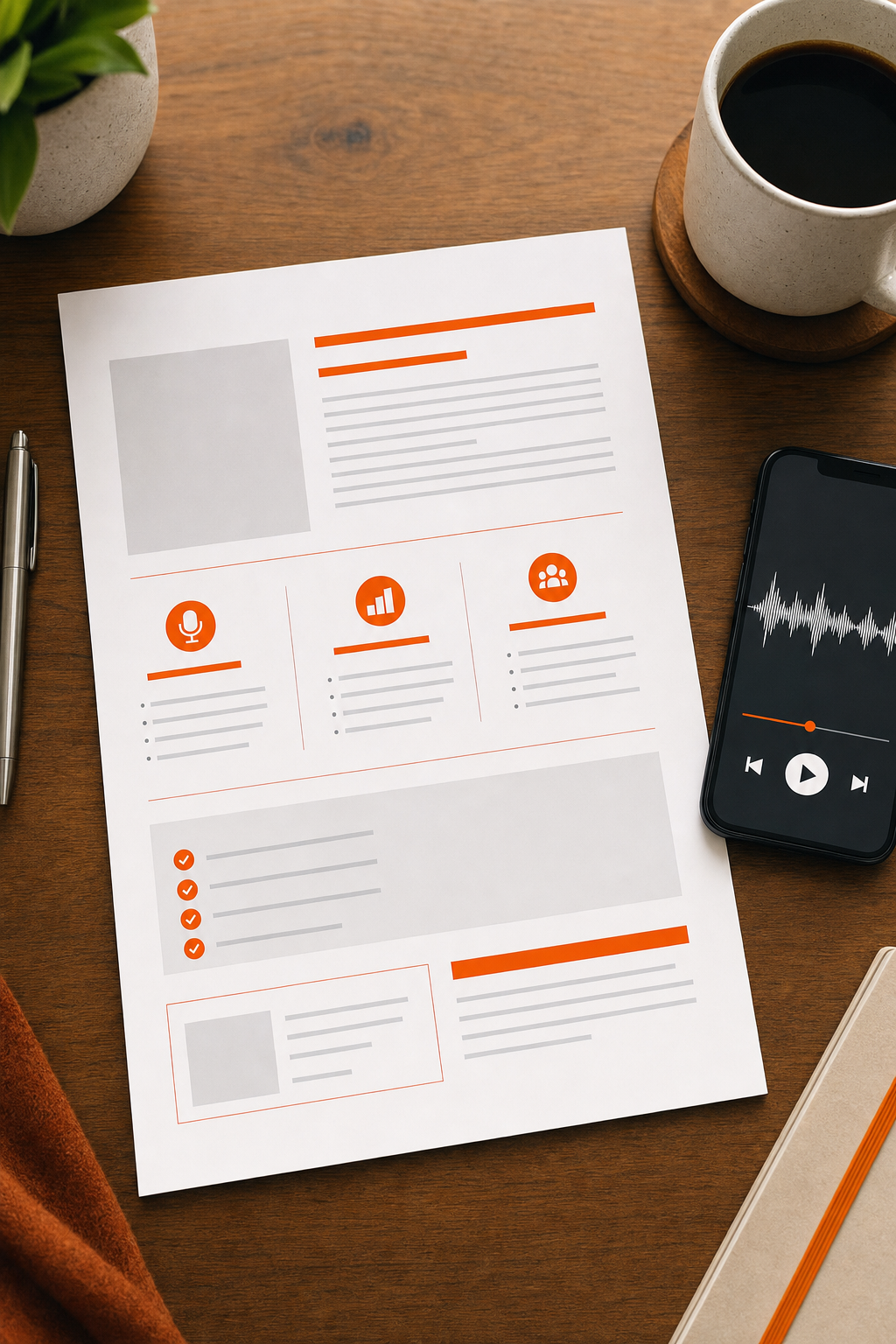
Once a host replies, you send the asset. Not before. The asset's job is to answer every question they'd ask on a call so they can say yes without scheduling anything.
The One-Pager (Most Effective Format)
Keep it to a single page. One PDF. Hosts get dozens of pitches. A six-page deck signals you don't know what matters to them. Your one-pager needs exactly five elements.
- Show or product description: One sentence on what your SaaS does and who it's for.
- Audience match: Why your customers look like the podcast's listeners. Use job titles, MRR ranges, or specific use cases.
- Ad format options: Host-read mid-roll (60 seconds), pre-roll mention (15 seconds), or newsletter mention if applicable. List the price next to each.
- Your metrics: MRR, active users, or a growth stat that signals you're a real business worth associating with.
- Social proof: Two or three credible signals. A notable customer, a press mention, or a guest appearance on a well-known show.
For the pitch deck version (used when going after larger shows or when a host asks for more detail), add a slide on campaign results from any past podcast sponsorship. If you have a promo code redemption rate or a CAC from podcast-driven signups, that data is more persuasive than any feature list.
Build the one-pager in Canva or Notion. Export as a PDF. Host it on a shareable link rather than attaching it, since attachments often get flagged by spam filters on the first follow-up. The Profitable Founder Podcast community has shared working one-pager formats inside the Profitable Founder Club mastermind, where SaaS founders at $5K to $50K MRR give each other feedback on real outreach materials.
One honest limitation here: a beautiful one-pager with weak audience data won't save a mediocre show. Your download numbers and listener demographics are the real pitch. Design is just how you present them clearly.
Resource #4: Podcast Discovery Tools to Find the Right Shows to Pitch
You can write a perfect email and send it to the wrong show. That's still a dead end. The research step matters as much as the writing step. Here are the tools and methods that actually surface the right shows for SaaS sponsorship outreach.
The fastest shortcut: listen to three or four shows your ideal customer already follows. Write down every sponsor you hear. Those brands have active podcast ad budgets. They're not skeptics. Your pitch to them isn't "would you like to try podcast ads?" It's "here's why your current spend is reaching the wrong founder."
For SaaS-specific discovery, search terms like "bootstrapped SaaS," "product-led growth," and "indie hacker" in any podcast directory surface shows with the right audience profile. Then check recency. A resource that stopped publishing is no longer a live channel. Half of all podcasts go quiet after a few months. Confirm the show published an episode in the last 30 days before adding it to your list.
Build a list of 20 to 30 candidates before you start cutting. Then filter to 10 real targets. Fifty generic pitches produce fewer deals than ten targeted ones. The Profitable Founder Podcast is a good example of a niche show worth studying: every episode features a bootstrapped SaaS founder between $100K and $10M ARR, which means the listener base is highly specific and sponsors can pitch with precision.
If you want to go deeper on monetizing the sponsorship relationship once you've found a show, the breakdown on SaaS podcast monetization strategies covers how to turn a single sponsorship into a recurring revenue stream rather than a one-off deal.
Resource #5: Follow-Up Email Scripts for Podcast Sponsorship Outreach
Most deals don't close on the first email. A single follow-up, sent five to seven days later, is normal and expected in this channel. Two follow-ups total is the maximum. After that, move on and keep the contact warm for next quarter.
Follow-Up Script A: The Simple Bump
Hi [Host name],
Just bumping this up in case it got buried. Happy to send a quick one-pager if helpful , takes 30 seconds to review.
[Your name]
That's it. Under 30 words. The brevity signals confidence. A long second email with new features and arguments signals desperation.
Follow-Up Script B: The Value Add
Use this when you have something new to add since the first email. A recent result, a relevant guest mention, or a timely hook tied to something the host just published.
Hi [Host name],
Saw your episode last week with [guest] , the conversation on [specific topic] connected directly to what we're working on at [Your SaaS]. Still think there's a real fit for your listeners.
Quick one-pager attached if you have two minutes. No pressure either way.
[Your name]
One thing worth noting on timing: don't follow up on the same day of the week as the original email. If you sent Monday, follow up Thursday. Hosts tend to batch their inbox on certain days, and hitting a different window increases the chance of a fresh read.
Track every outreach in a simple spreadsheet. Columns you actually need: show name, host name, email sent date, follow-up date, response status, and outcome. Fifty targeted outreach emails over four weeks, with proper follow-ups, will get you more deals than waiting on a podcast ad marketplace for a full quarter. The guide on how to get sponsors for a SaaS podcast goes deeper on structuring that outreach tracker and knowing when to archive a contact versus when to circle back.
Personalization and a clear value proposition are the two factors most likely to generate a reply on a cold sponsorship email. Keep both front and center across every touchpoint.
Legal note worth flagging: once a host says yes, get the key terms in writing before you record anything. It doesn't need to be a formal contract. An email thread that confirms episode dates, ad copy approval process, exclusivity (if any), and payment terms is enough for a first deal. Exclusivity clauses in podcast sponsorships, for instance, can prevent you from sponsoring competing shows in the same category. Know what you're agreeing to before the episode goes live.
FAQ
How long should a podcast sponsorship outreach email be?
Keep your first email under 150 words. Four to five sentences is the target. One sentence on who you are, one on why your product fits the show's audience, one key metric or credibility signal, and a single ask. Hosts read short emails in full. Long emails get skimmed and archived. Save the detail for when they reply.
What metrics should I include in a SaaS podcast sponsorship pitch?
Include your MRR or ARR to signal you're a real business, your target customer's job title and company stage, and any podcast-specific metric like past promo code redemption rates if you've run podcast ads before. If you're pitching as a sponsor, the host wants to know your product fits their audience and that you can pay. Lead with audience fit, then business credibility.
Should I offer a free trial instead of cash to sponsor a podcast?
Free trials work as an add-on, not a replacement for cash. A host with a small but engaged audience may accept a hybrid deal: a reduced cash rate plus extended free access to your SaaS for their listeners. Frame it as a listener perk, not a discount. Never lead with a free trial offer in the first email. That signals you don't have budget and lowers your perceived value immediately.
How do I find the right contact at a podcast to send my sponsorship email?
Go directly to the host first. Most independent podcasts are run by one or two people, and the host makes the sponsorship call. Find their name on the show's website or LinkedIn. If the show lists a separate producer or business email, use that instead of a generic contact form. Avoid info@ addresses. A direct name gets opened; a generic inbox gets ignored.
How many follow-ups should I send after a podcast sponsorship pitch?
One follow-up, sent five to seven days after the initial email. Two total contacts maximum. After that, move the contact to a "circle back next quarter" list. Podcast hosts who didn't reply aren't always uninterested. Budget cycles reset. Priorities shift. A contact you pitched in January may become a deal in April if you reach back with a fresh, brief note tied to something new.
Conclusion
The resources above cover every stage of a podcast sponsorship outreach sequence: the cold email, the subject line, the one-pager, the discovery research, and the follow-up. Use them as a starting kit, then customize each piece for the specific show you're targeting. If you want to see what real bootstrapped founders are doing at $5K to $50K MRR to land these deals, the Profitable Founder Podcast covers exactly that. Start with your download data and a list of 10 target shows, write your first email today, and send it by Friday.