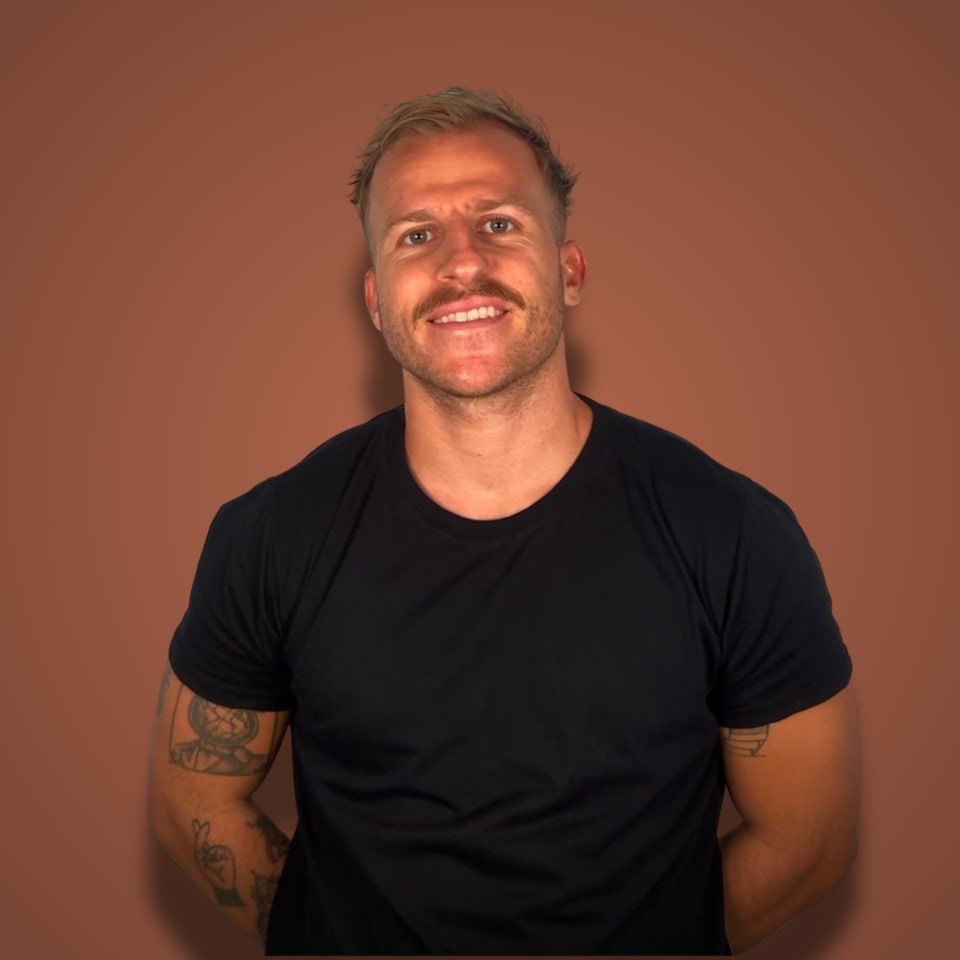
A year ago, Josh Suggs googled "ROAS" in the middle of a sales call because he didn't know what it meant.
Last month he did $218,000.
He's 22. He's a solo founder who turned into a team of 32. And the whole thing started because a friend paid him $2,000 a month to walk up to strangers in London and ask them dumb questions on camera.
I love this story because it breaks every rule we tell ourselves about why we can't start.
No product. No code. No audience. No clue what direct response marketing even was.
Just a guy with a road mic and a backpack, walking 35,000 steps a day.
Here's how Josh built 203 Media into a $200k+/month agency in about a year — and the parts that actually transfer to you, even if you're building software.
The $2,000 gig that got him fired
Josh didn't set out to build an agency.
His friend Oliver Piccado — one of the early Tabs guys — asked him a favor while Josh was abroad. "Could you do some street interviews for my SaaS? Ask people what's the worst grade they ever got, that kind of thing."
Oliver would post the clips on the company's Instagram. The deal: about $2,000 a month for ~40 videos.
Josh's math was simple. $2,000 to go talk to 40 strangers? Sign me up.
Then he actually did it.
He was in London. He was awkward. He was, in his own words, horrible at it. Londoners do not want to be stopped on the street by a nervous American with a microphone.
Oliver fired him after about a month and a half.
Most people stop there. The proof was in: he sucked at this, the market rejected him, the one customer let him go.
Josh saw something else.
The wedge nobody else was working
Back in the US, about to start a corporate internship, Oliver said one more thing to him: "Bro, brands would probably pay you to do this."
And Josh connected a dot.
He'd been Tabs' first employee. He watched every ecom brand on the internet try to copy the Tabs playbook — UGC, creators, content that doesn't feel like a commercial.
Street interviews were the next level of that. The most authentic-looking ad format there is. People are sick of brands throwing commercials in their face. A real human reacting on a real sidewalk doesn't read as an ad at all.
So he picked the wedge: the street interview flavor of UGC. Not "we do video." Not "we do ads." One weird, specific format almost nobody was selling.
That narrowness is the whole reason it worked. A brand owner already has five agencies. Josh wasn't competing with them — he was the one new flavor on the menu.
If you're building, this is the lesson before any of the money stuff: don't try to be another option in a crowded category. Find the one angle that makes you a no-brainer add-on instead of a replacement.
Sleeping on a couch, 40,000 steps a day
The early days were not glamorous. At all.
Josh slept on his friend Matt Epstein's couch in New York from Tuesday to Sunday. Every single day he'd walk the city interviewing strangers about random brands — caffeine gum, hydration packets, three or four products you've never heard of stuffed in a backpack.
Sunday night he'd fly back to Syracuse and sit in his classes Monday and Tuesday. Then back to the couch.
He did that for over a month.
35,000 to 40,000 steps a day. A broken road mic. A videographer carrying the backpack.
He didn't know what creative strategy was. Didn't know what direct response meant. On one of his first sales calls a brand asked what kind of ROAS he typically saw, and he had to quietly Google "ROAS" mid-conversation — he didn't even realize his videos were being run as paid ads.
This is the part I want every founder reading this to sit with.
He was unqualified, broke, and bad at it, and he started anyway. The competence came after the reps, not before.
For outreach, he kept it just as scrappy. He went on Twitter and started DMing brand founders directly. Where he had a mutual connection, he'd lead with it. Where he didn't, he'd show them what he'd already made for someone else.
No fancy funnel. The only "system" was a Calendly link to book a demo call and a follow-up habit so warm leads didn't go cold. (If you want the boring-but-it-works version of that, here's a breakdown of simple lead-nurturing strategies that turn a "maybe later" into a paying client.)
The no-brainer offer
Josh's pitch on the demo call was almost insultingly simple.
"Here's what the videos look like. You want 20 of them? That's $3,000."
That's it.
For a brand already spending five figures a month on ads, $3,000 for 20 pieces of authentic creative is a rounding error. No-brainer. They don't even have to think.
Early on his retainers ranged from a couple hundred bucks to $4,000 a month for around 20 videos. As the work got proven, the same package became $5,000 to $10,000.
And the margin was absurd. Josh paid his editors cheap, did the interviews himself, and the guy who helped him build the operation was a friend he dropped out of college with.
98% margin. No product cost. No inventory. No ad spend of his own.
By August — he started in June — he'd worked with 85 brands and banked his first $100,000 in cash profit.
Three months. From couch-surfing to six figures saved.
How he duplicated himself
Here's where most service businesses die: the founder is the product.
Josh hit that wall fast. He was the only one who could do a good street interview. So he asked the real question — is this a me thing, or a trainable thing?
He grabbed people to play the "stranger" in his videos and tried to teach them to run interviews. They all sucked at first.
So he treated it like coaching. He'd stand off to the side, watch them work, and give tiny corrections. Keep your shoulders open. Don't say it like that. Small reps, over and over.
It worked. New York is full of actors and comedians waiting tables, and the job is fun and pays. Seven people quit their hostess and bartending gigs to become full-time street interviewers for him.
Then he solved the back end the same way. A friend was running Meta and TikTok creative for brands and struggling to sell it. Josh had the opposite problem — more demand than he could handle. So he plugged that team in: eight or nine editors plus creative strategists, dropped straight into his pipeline.
That's what let him scale from doing $3,000 jobs himself to a 32-person operation doing $200k+ months.
The pattern, if you're taking notes:
→ Do the unscalable thing yourself until you understand it cold.
→ Break it into a role someone else can be trained into.
→ Coach by watching reps, not by writing a 40-page SOP.
→ Bolt on a team that already has the skill you don't.
That's not an agency secret. That's how a solo SaaS founder goes from doing every support ticket to running a real company too.
The bet underneath all of it
The thing I keep coming back to is Josh's actual thesis.
His whole agency is a bet that as AI floods the internet with synthetic ads, people will crave proof that a real human was there. Raw emotion. A real sidewalk. A real reaction nobody can fake.
"No one's going to trust an AI ad," is basically the whole company in one sentence.
You don't have to agree with the bet to respect that he has one. He's not just selling videos — he's selling against a trend he believes is coming.
Most of us start the other way around. We build the thing first and look for the story later. Josh found the wedge, formed a sharp opinion about where the world was going, and pointed everything at it.
This is the exact kind of story we dig into on the UGC and content side of building — and if you want the app-flavored version, here's how founders market a viral app with UGC using a lot of the same authenticity playbook.
FAQ
Who is Josh Suggs?
A 22-year-old solo founder who built 203 Media, a street-interview ad agency. He went from a $2,000/month gig he got fired from to roughly $218,000 in a single month inside about a year, with a team of 32.
What does 203 Media actually do?
They produce "street interview" style ads — real people stopped on the sidewalk reacting to a brand on camera. The pitch is that it's the most authentic-looking format in UGC, because it doesn't read as a commercial at all.
How does the agency make money?
Monthly retainers. It started as low as a few hundred dollars and $3,000 for ~20 videos, then climbed to $5,000–$10,000 packages as the results got proven. Margins ran as high as 98% because there's no product cost — just talent, cameras, and editors.
How did he find his first clients?
DMing brand founders on Twitter, leaning on mutual connections, and showing them work he'd already done for other brands. The entire sales motion was a Calendly link and a demo call.
What's the takeaway for a SaaS founder?
Pick a sharp wedge instead of being one more option in a crowded category, make the offer a no-brainer, do the unscalable work yourself until you understand it, then turn it into a trainable role so you can step out of the product.
One last thing
Josh's edge wasn't talent. He was bad at the job for months.
His edge was that he started before he was ready, picked one weird angle, and kept walking — literally — until it worked.
That's the same thing I see in almost every founder I talk to who actually made it. They were unqualified at the start. They just didn't wait to feel ready.
If you want more raw, number-by-number breakdowns like this one — founders telling you exactly what they charged, what broke, and what they'd do again — that's the whole point of the Profitable Founder Podcast.
Listen to the Profitable Founder Podcast →
Go pick your wedge. You're more ready than Josh was.