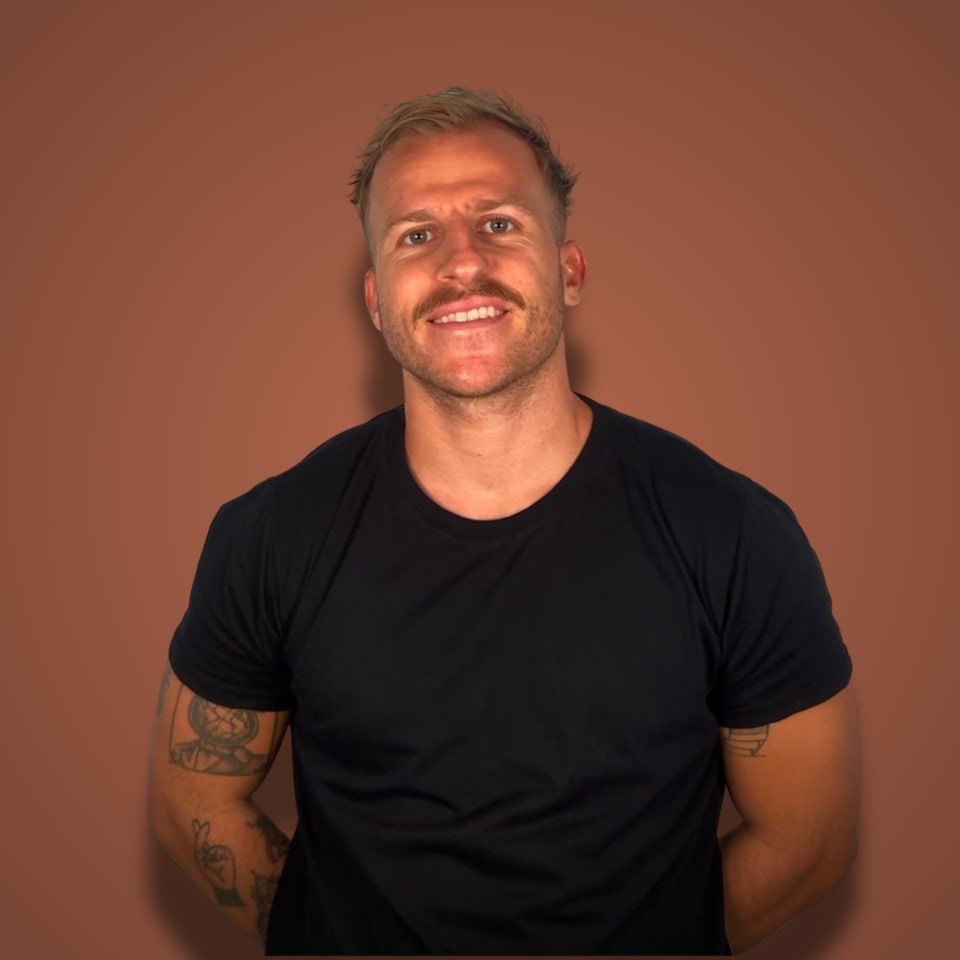
Cody grew an email list by 3,500 subscribers in 30 days. From a Twitter account with 7,000 followers. With one tiny tweak after every post.
He's built more than 20 profitable businesses generating millions in revenue. He's run print-on-demand, agencies, Chrome extensions, and now graph.com, an AI data analyst for go-to-market teams.
And he thinks the best distribution channel you can build in 2026 is a podcast. Not because podcasts are trendy. Because of what one podcast turns into: 150 pieces of content a week, an email newsletter, and a sales cycle that's basically already closed before you get on the call.
I sat down with Cody on the Profitable Founder Podcast. Here's the full playbook.
Why a podcast is the ultimate trust machine
"People think podcasts are saturated," Cody told me. "Please keep believing that, because I'll just keep doing it and it'll keep working."
Here's the math that hooked me. If 100 people show up to listen to you talk for an hour every week, over a 90-day period that's roughly 12 hours they've spent with you.
By the time they hit a sales call, the trust is so deep they're already buyer-ready. They believe your principles. They understand your thesis. They're bought in. They're just ready to execute.
"This is what really good marketing actually is in B2B," he said. People dress it up and call it account-based marketing. It's a dumb name. It's content marketing. It always has been.
The cold DM that gets a 10-20% response rate
The genius move is who you put on the show. You don't need an audience yet. You need experts in your industry, and they want to be hosted.
Cody's exact template, roughly:
→ "Love the content you're posting on LinkedIn."
→ "Can I host you on X show? It gets emailed out to 5,000 people."
→ "I'll give you clips for social. Interested?"
That template pulls a 10-20% response rate. Why? You're not coming empty-handed. You're offering free PR plus 8-10 clips they can post and share internally with their team.
One story stuck with me. A friend's product studio had been chasing a CTO for 18 months. Eleven LinkedIn DMs, nothing. They sent that exact podcast invite. The CTO replied yes in seven minutes.
"People want to do this," Cody said. "It's an ego-stroking activity. They want to talk about their expertise."
One podcast → 150 posts: the content flywheel
This is where it compounds. One long-form episode becomes the source material for everything.
→ Run the transcript through Claude: "list 10 insights related to growth marketing."
→ Turn each insight into a clip, a LinkedIn post, a Twitter thread, a blog post.
→ Bundle the episode into an ebook, gate it behind a Tally form, and grow the newsletter.
→ Pull clips where a guest names a painpoint your product solves, then use them as paid-ad hooks.
That last one is sneaky-good. You take the clip of someone describing the exact pain in their exact words, then cut straight to your pitch. It's customer research and ad creative in one.
And if a clip has a great idea but a weak hook? Re-record it. Drop the transcript into Claude, ask for hook-then-insight scripts, and read them yourself. Derivative content off the good ideas.
Cody runs this in about 90 minutes of his own mental energy a week. He hands it to an editing team (one person, $1,600/month) who schedules everything. Solo, you could do it with Riverside and Descript for around $80/month.
This whole copy-the-good-ideas approach is the same instinct behind building a focused micro-SaaS by remixing a proven playbook. Find what works, then do more of it.
Podcast SEO and the 3,500-subscriber month
Podcasting is a long-term commitment. But there are levers to speed it up.
Lever one: name the show for search. Apple Podcasts and Spotify are search engines. A friend's show is literally called the "Biotech Startups Podcast" so it ranks for "biotech," "startups," and "biotech startups." Get downloads, put the keyword in the title, description, and show notes, and you rank.
Lever two: the newsletter hack. Cody ran a test about 18 months ago on a 7,000-follower Twitter account. After every tweet, an hour later, he'd reply with a thread: "Want my 2025 AI for content marketing guide? Link below." It took them to a form, they downloaded, they joined the list.
30 days. 3,500 new subscribers. Free social traffic on a small account.
"Simplicity wins," he said. People overcomplicate this. What matters is doing it continuously for the next 24 months.
Lever three: cheap jumpstart traffic. On Twitter you can target the whole world at a one-cent max CPC bid from a normal-looking profile, posting "just watched X podcast, learned Y, crazy tbh." Link clicks come in around 0.3 cents. Enough US and European clicks convert that you can take a YouTube channel from zero to 1,000 subscribers cheaply.
Make content for the algorithm, not your ego
At Rupa Health (Cody was employee nine or ten), they sold to functional-medicine practitioners. They tested show formats: protocols, business advice, industry news.
Only one thing got consumed: protocols. How to treat SIBO, IBS, chronic eczema. That's why practitioners got into medicine, to help people. They didn't care about the business side.
"Once you see that in your data, you have a content format you make repeatable," Cody said. From that moment, every episode was a protocol.
His warning: stop forcing media onto an audience that isn't receptive. The algorithm is smart. It knows what people want to consume. "Remove all ego and just make the thing people want to consume."
The podcast is the top of the funnel. Entertainment with a cross-section of education and a soft sell underneath. You sell in the newsletter, where the trackable ad dollars are 100x bigger than podcast sponsorships anyway.
Don't start a podcast for your first customer
Here's the part founders need to hear. "If you're like, yo, I need customers tomorrow? Facebook ads, Google ads, cold DMs, cold email. The podcast is a long-term investment."
The timeline he gave me: first 90 days you feel nothing. At 6 months it's clearly working. At 9 months you absolutely feel it. At 12 months you wish you'd started two years ago. Then it compounds, because someone binges all 52 episodes and has spent 52 hours with you.
Cody's reason for content marketing at all: CPCs only go up. Every space with VC money sees CPCs spike (AI SEO software keywords near $16, AI business intelligence around $11). Content lets you build branded search and organic discovery so you're not fighting for generic keywords forever.
But to get there, you have to survive. "Patience, persistence, and compound interest," a mentor told him. Show up longer than everybody and do things that compound.
One more maxim, and I love this one: when it's working, don't touch it. He's watched startups with perfect pipelines tinker out of boredom and break the machine. If it's not broke, don't fix it. Get out of its way.
I interview founders like this every week → Watch the Podcast
Frequently Asked Questions
Who is Cody and what does he do?
Cody is a bootstrapped founder who has built more than 20 profitable businesses generating millions in revenue, spanning print-on-demand, agencies, and software including a Chrome extension that's paid his rent for eight years. He now runs graph.com, an AI data analyst that builds data pipelines, warehouses, and visualizations for go-to-market teams.
How long does it take a podcast to get results?
According to Cody, the first 90 days you feel nothing. At six months it's clearly working, at nine months you definitely feel it, and at 12 months it's compounding hard. It's a long-term bet, which is why he says to use direct response like paid ads and cold email to get customers fast in the meantime.
How do you grow an email newsletter from a podcast?
Turn each episode into a gated ebook ("I sat down with X, here are 5 things I learned, link below for the full PDF") behind a Tally form to capture emails. Then add a call-to-action after every tweet. Cody used that exact method to add 3,500 subscribers in 30 days from a 7,000-follower account.
The cheatcode isn't the podcast. It's that one hour of conversation, sliced into a hundred pieces, that quietly does your selling for you.
Related SaaS podcast guides
This guide supports the main best SaaS founder podcasts ranking. For narrower angles, compare the best indie hacker podcasts, SaaS marketing podcasts, and how to start a SaaS podcast.