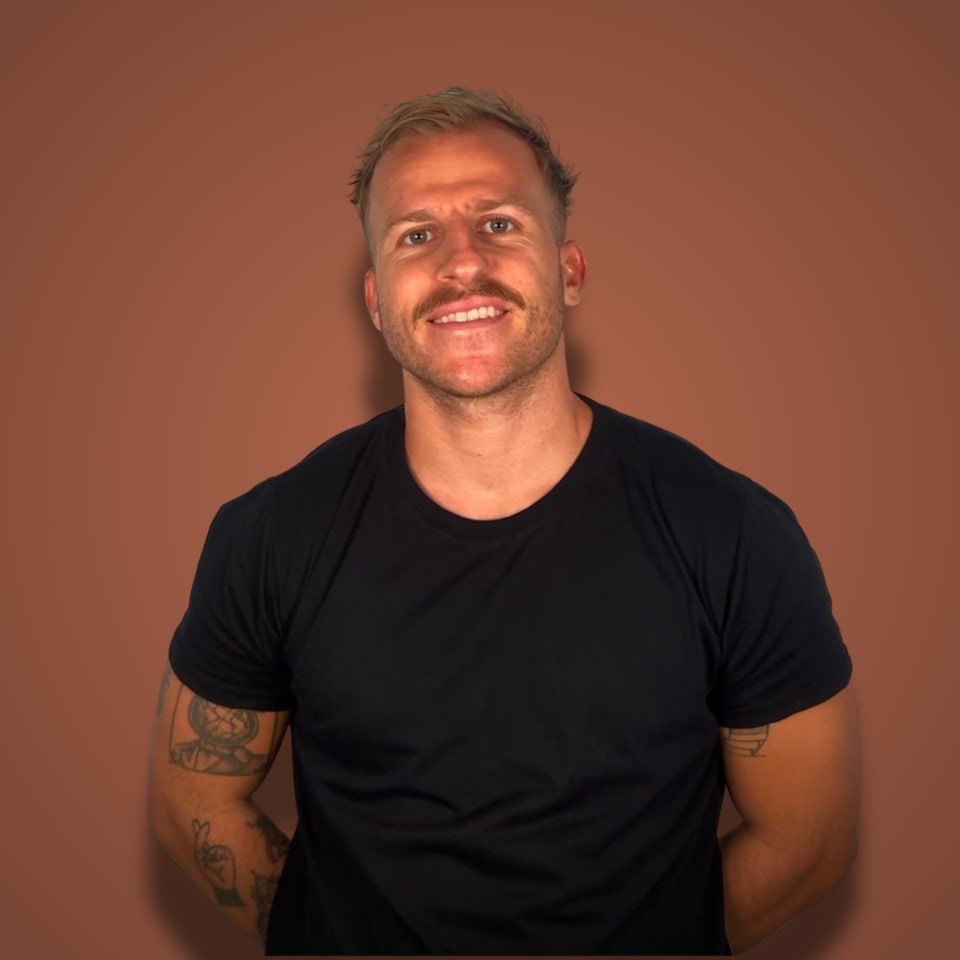
Tibo failed for four years straight. Then he built two startups, sold them for $8 million, and went again.
Today he runs five businesses making more than six figures a month. One of them, Outrank, crossed $200K monthly. And it's not even his biggest one.
What changed? Not his skills. He still calls himself "just a developer." The shift was mental, and it's almost embarrassingly simple.
I sat down with Tibo on the Profitable Founder Podcast. Here's the full playbook.
The four-year failure (and the one thing that flipped)
For years, Tibo built startups to impress people.
"I was doing everything I could to just feel good at a family dinner, to boost my ego," he told me. Twenty employees. VC money raised. "Hey, everything is going in the right direction."
The problem? "Nothing really works behind the scene. There's no client, there is no real traction."
So in 2021 he started over. No employees. No VC money. Just him and his co-founder, trying to make a decent living instead of chasing the next Facebook.
"It honestly changed everything."
Same co-founder he'd failed with for years, by the way. A marketing guy who used to run ads at a small agency in Canada. They gave themselves a brutal rule: ship one new product every week until something sticks.
→ 8 or 9 products flopped
→ Product #11 was Tweet Hunter
→ It took off fast
The one-feature MVP that became a $8M exit
Tweet Hunter started as something Tibo built for himself.
Twitter was the channel that got him his first users for every product. So he wanted to win there. He got early GPT-3 access, downloaded tons of viral tweets, and clustered them by topic right in his terminal.
Just reading those tweets gave him better content ideas. So he turned it into a product.
The launch version? "Basically a search bar where you could just write something like marketing or startup, and it was then displaying a list of viral tweets." One feature. That's it.
They went live on Twitter and Reddit with that. Behind that tiny search bar sat a full AI clustering engine, which was rare in those early GPT-3 days. Everyone was generating content with AI. Almost nobody was using it to analyze content.
It grew to about $3K MRR with just the two of them. This is the kind of one-feature, build-it-for-yourself approach I keep seeing work, and it's the heart of how to build a micro-SaaS that actually gets traction.
The GK Marina launch: $3K to $20K in two weeks
Then came the move that changed the trajectory.
Tibo was cold DMing big influencers, fairly randomly. One of them, GK Marina, replied: "Okay, I want in."
Not as a promoter. As a co-founder. "This is exactly the methodology I'm praising in my Twitter course. I want to build that with you."
They gave him 25% of the product. A big chunk, Tibo admits. But it worked.
→ September 2021, GK Marina ran his own launch
→ Two weeks: revenue went from $3K to $20K/month
→ Almost nobody churned afterward
→ Then 20% month over month, from $20K to $200K over a year and a half
The hidden lesson here was about marketing. At first they sold features: "Twitter gives you inspiration for better content." Surface level.
Then they connected the dots. Better content gets you more followers, a better personal brand, more leads, more sales, more money. "By just changing a little bit our marketing, it worked 10 times more."
The influencer flywheel
GK Marina worked so well that Tibo systematized it.
He recruited a group of about 15 high-caliber Twitter influencers. Each got 0.1% of Tweet Hunter, meaning 0.1% of profits and 0.1% of the exit.
The ask was easy on purpose: "We'd love if you talk about us, we'd love if you give feedback, but you'd have no obligation at all."
Around 80% said yes. So every new feature launch came with 15 big accounts spreading the word.
Hard part nobody talks about: the API meltdown. When Elon took over Twitter, they went from a free API to paying $42K a month overnight. One day they got cut off for 48 hours. Users couldn't post. Competitors pounced. Every Twitter contact Tibo had kept getting fired.
They survived it. And eventually sold Tweet Hunter and Taplio to Lemlist's team for $8 million.
The new model: five startups, zero of them his idea
After the exit, Tibo didn't buy a Lambo. He'd feel "guilty" spending money he wasn't earning. So he went back to building.
But the model is different now. He's the distribution guy. He partners with five different "co-makers" who are the developers.
And here's the counterintuitive part: he doesn't push his own ideas. He works on theirs.
"If you hire a developer to work on your project, the motivation will go down. But if you reach out on an existing project, it's his idea. The guy is going to be crazy motivated."
His framework:
→ Find someone with a good idea and decent execution
→ Who's stuck around $200-300/month, not knowing how to break out
→ Revamp the product on core things
→ Test with 10-20 users for a few weeks to find what makes it sticky
→ Then go broad: his audience, newsletter, SEO, ads
Take Outrank, his all-in-one SEO tool. It started as a blog post generator. Good quality, but nobody came back. "People don't have the discipline to go back every day and create a new blog post."
So they flipped it. The software now publishes one blog post per day automatically, whether you show up or not. "If you don't come, it's going to be published anyway." Retention jumped, churn dropped.
Outrank now researches keywords, finds competitors, ranks the easy wins, writes a post a day, and publishes to your CMS. It even cross-links users together for backlinks. It crossed $200K/month. And his biggest earner, Revid, makes even more.
I interview founders like this every week → Watch the Podcast
What he'd never do again
The exit didn't feel good. Tibo's new rule: no exits.
Because Tweet Hunter had high churn and platform risk, most of the $8M was earnout-based. They got 25% up front, 75% tied to hitting revenue milestones over two years.
To protect that, they insisted on staying hands-on and keeping control. Which, ironically, stopped the buyer from helping promote the product. "I felt salty. I was mad at them," he said, before admitting it was really their own fault for clinging to control.
If he ever sells again: no earnout, three-month transition max.
His advice to anyone with an idea? Stop showing it to your mom and dad. "When you have an idea, you can just build it very fast. Put it in the hands of people who are relevant to use it." Two days of building beats a piece of paper every time.
Frequently Asked Questions
Who is Tibo and what did he build?
Tibo is a French founder who co-built Tweet Hunter and Taplio, two AI tools for Twitter and LinkedIn content, and sold them to Lemlist's team for $8 million. He now runs five startups including Outrank, Revid, Feather, SuperX, and Postinker, working with separate developer co-makers on each.
How much money do Tibo's startups make?
His five startups make more than six figures a month combined. Outrank, his all-in-one SEO tool, has crossed $200K per month on its own. Revid, which he keeps quieter about due to competition, makes even more than that.
How did Tweet Hunter grow so fast?
Tweet Hunter launched as a one-feature search bar for viral tweets. A partnership with influencer GK Marina, who took 25% and ran his own launch, took it from $3K to $20K MRR in two weeks. After that it grew 20% month over month for a year and a half.
The lesson Tibo keeps proving: stop building to impress, start building to earn. The day that flipped, everything else followed.