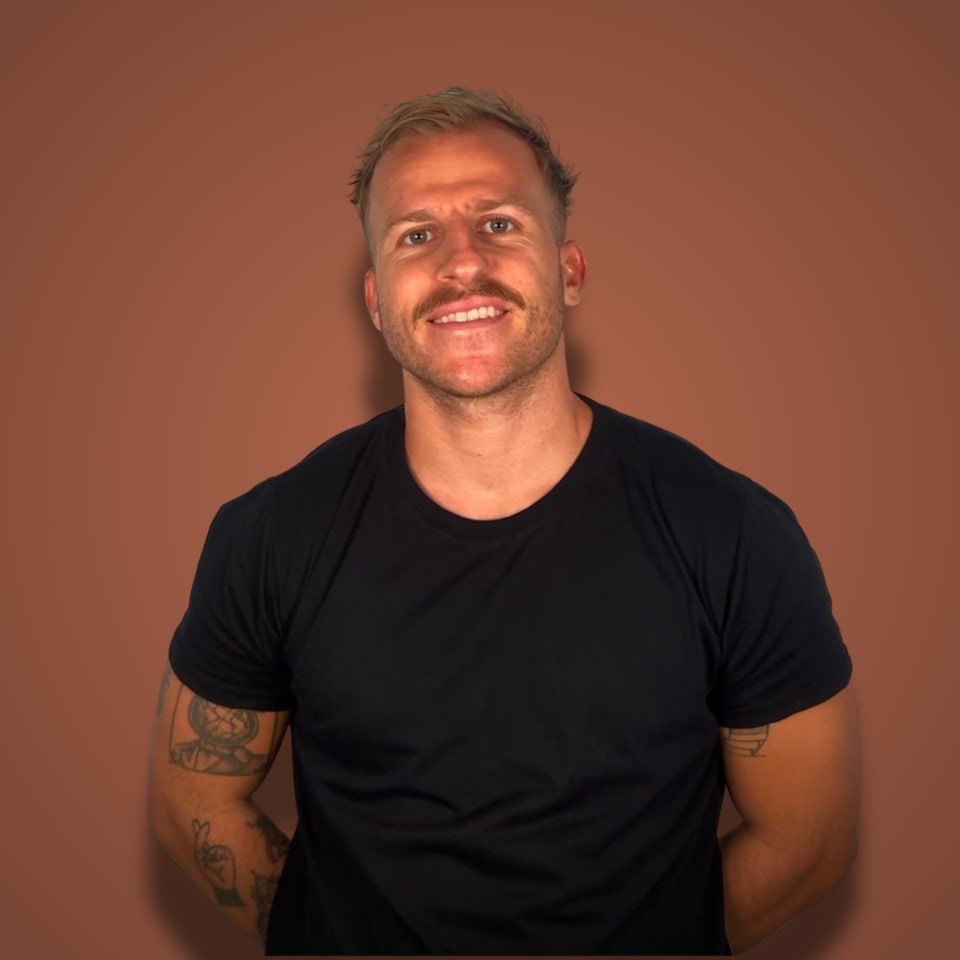
$61,000 in monthly recurring revenue. In 53 days. From zero.
That's what Rob Hoffman did with Kleo, his AI content tool. And he told me it could have been even faster if he hadn't deliberately slowed it down.
Rob runs three companies with his co-founders Jake, Lara, Cameron and Caleb. Two SaaS products (Kleo and Mentions) plus an SEO agency called Contact. Combined, they do around $400,000 a month. All bootstrapped. All profitable.
He came on the show with one thing: the exact 7-step playbook he uses to launch a profitable bootstrapped SaaS. The same one he was using right then to take Kleo public on January 22nd.
I sat down with Rob on the Profitable Founder Podcast. Here's the full playbook.
Step 1: Find a problem you actually have
Rob's rule: be your own first customer.
The first version of Kleo wasn't even a SaaS. It was a free Chrome extension Jake built for himself over a weekend. He modeled it on what Taplio and Tweet Hunter did for X, but for LinkedIn, where nothing like it existed.
Jake used it. Sent it to Rob and a few friends. They were hooked. They started passing it around. The validation came purely from people using it.
His other example floored me. Rob's dad, 64 years old, vibe-coded a tool called Comply My Notes on Lovable, fully set up with Stripe, to solve a compliance headache in his own industry as a financial adviser.
If a 64-year-old can ship a working product, the "I can't build it" excuse is dead. This founder-led, copy-what-works approach is exactly the kind of thing I dig into in my guide on how to build a micro SaaS.
Step 2: Validate with a waitlist before you build
The biggest mistake Rob sees? Founders building something only they want.
His fix is a waitlist, and he gave me the actual numbers to aim for.
→ Goal: more than 1,000 waitlist signups
→ Convert roughly 10% into paying customers
→ 100 customers at $50/month = $5K MRR. At $100, that's $10K.
He showed me real screenshots from launching Mentions, their AI search SaaS. That waitlist hit 3,624 people. They converted around 20% on a $50 tool. That's roughly 360 to 400 people paying $50. About $20K a month, day one.
Timeline? 30 to 60 days to build the waitlist. Call it six weeks. But he wants to see movement inside the first 30 days. Their tool of choice was Loops, though he was clear: the tool barely matters.
Step 3: Create content that turns attention into emails
"But you already have an audience." Rob hears it constantly. His answer: everyone starts somewhere, and audience size matters less than it used to.
Proof? He started a brand-new X account in August with barely any followers. A few months in, one post hit 7 million impressions. Not because of his audience (he had maybe 9K followers), but because he knew how to craft content that converts.
His content system runs on three silos:
→ Story-driven, founder posts (top of funnel, a person front and center in the photo)
→ "Edgy selling" posts that break down a complex topic step by step
→ Genuinely useful posts (agendas, workflows) with the tool slipped in subtly
The magic is the subtle sell. Jake takes a topic like SEO, breaks it into level one, level two, then product-places the tool almost like an ad you can barely spot. No hard selling. Just trust, then a soft CTA.
And the hook. Rob's formula has three ingredients: social proof, curiosity, and a promised benefit. "We hit 62K MRR in 53 days" is the proof. "A single meeting that defines our next 90 days" is the curiosity. "Here's the exact agenda" is the benefit.
His co-founder Lara gave him the line that stuck with me: "Stop creating selfish content." Nobody cares that you woke up and had a coffee. Make it about the audience, every time.
Step 4: Use an early bird discount to launch
Rob is a firm believer in charging from day one. Free tools, he says, attract the wrong people.
So he opens the product to a closed beta cohort of 500 users. The first 500 get a 50% discount. The trick is constraining supply against demand.
He showed me the exact emails. "Only 239 spots left." Then follow-ups: "300 spots left," "200 spots left," value inside, secure your spot now.
But the beta cap isn't just a sales gimmick. Slam a new SaaS with 10,000 users and it breaks. You can't support them. You can't talk to them. Starting at 500 lets you stress test, bug bash, and actually delight people.
Step 5: Run a webinar on launch day
Same goal: squeeze maximum conversions out of that hard-won email list. A webinar is one-to-many, so it scales better than DMing every signup.
Here's how Rob runs a 10-out-of-10 webinar:
→ An exclusive offer only for attendees (coaching calls, community access, lead magnets)
→ Cap how many people are eligible (3 to 10 spots), then count them down live
→ Announce every purchase out loud to trigger FOMO and social proof
→ A live demo of the tool (the main event)
→ A live testimonial, where you interview a real customer on the call
That last one was Lara's move. She surprised the team by bringing a customer on live. Rob called it the most baller thing you can do on a webinar. For models, he pointed me to Russell Brunson and Alex Hormozi, who sold $100 million on the back of his.
Step 6: Talk to 50 customers
Rob took this straight from Jason Lemkin of SaaStr. Not 30. Not 40. Fifty.
So they stacked the calendar with back-to-back 30-minute calls. The point is three things at once:
→ Make customers feel appreciated (this drives retention)
→ Surface bugs and the features people most want, then road-map them
→ Turn customers into super fans who refer friends and give testimonials
His tactical tip: record every call. He used Aoma, fed all the transcripts into Claude, and asked for the most-requested features, the reported bugs, and even an ideal customer persona built from real users. That same customer language becomes your landing page copy.
Rob gives his personal phone number to every customer. His WhatsApp is destroyed. He says it's worth it, because without them you're nothing.
Step 7: Rinse and repeat the launch cycle
Final step is the simplest. You just run the cycle again.
For Kleo, that meant two beta launches then one public launch. First cohort of 500 gets the steepest discount for trusting the earliest version. Second cohort of 500 a month later gets a slightly smaller discount. Then the public launch on January 22nd.
Three launches total. Each one builds hype, scarcity and urgency, and pulls more customers onto the platform. Launches, Rob says, are one of the fastest ways to get customers.
I interview founders like this every week → Watch the Podcast
The mistakes and the mindset
I asked Rob the biggest mistake to avoid. His answer: know when to quit.
If you've got 100 people on your waitlist after two months, don't grind through all seven steps. He quoted Marc Lou: "Ship fast, but also quit fast." The biggest L is continuing a project that was never validated.
On being everywhere, Rob and his team now spend around $30K a month on content, and want to spend more. But in the early days? He and Jake had under 10,000 LinkedIn followers, renting Airbnbs in Colombia, and Jake would be at the kitchen table cranking out posts at 5 a.m. Content has to be a priority before it can be a budget line.
They split work by superpower. Rob and Jake even built a spreadsheet plotting their time in percentages, time-blocking days for content, product and meetings. The whole thing is run on Trello with morning and night standups.
Frequently Asked Questions
Who is Rob Hoffman and what is Kleo?
Rob Hoffman is a bootstrapped founder who, with co-founders Jake, Lara, Cameron and Caleb, runs three companies doing around $400K a month. Kleo is their AI content partner that helps you write content optimized for LinkedIn and X. It started life as a free Chrome extension Jake built over a weekend.
How fast did Kleo grow to $60K MRR?
Kleo went from zero to $61,000 in monthly recurring revenue in 53 days. Rob says it could have been faster, but they deliberately capped growth using a beta cohort of 500 users so they could talk to early customers, fix bugs, and stress test the platform before opening up further.
How big should my waitlist be before launching a SaaS?
Rob aims for more than 1,000 waitlist signups, built over 30 to 60 days. Convert roughly 10% into paying customers and at a $50 price point you reach about $5K MRR. Their Mentions launch had 3,624 signups and converted near 20%, landing around $20K MRR in month one.
The whole playbook comes down to one thing Rob kept circling back to: validate before you build, charge from day one, and talk to the humans who pay you.