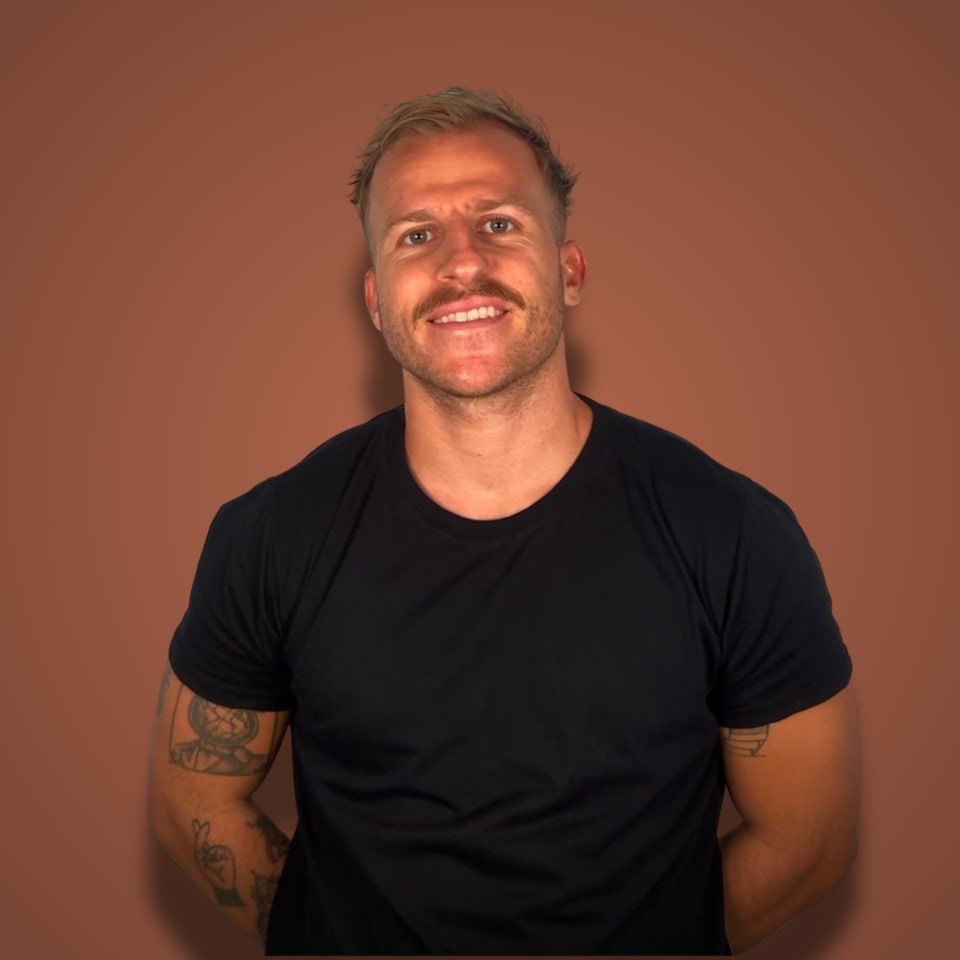
Rob quit his job, packed a backpack, and flew to Rio de Janeiro with no return ticket. He had about 4,000 followers and zero dollars coming in.
One year later he's at $14,000 a month, 35,000+ followers on X, and co-running a product with Tibo Maker (the guy who sold Tweet Hunter for millions).
But here's the part nobody talks about. For 7 months he rebuilt a broken product, living out of a backpack, making roughly $1,500 total in that entire stretch. He doubted himself nearly every single day.
I sat down with Rob on the Profitable Founder Podcast for the longest episode I've ever published. Here's the full playbook.
The airport video that changed everything
Back up to August 2023. Rob had been failing for a full year. No money. Just burning through savings.
Then a post about that failure went viral. Someone commented that he should start a dev agency with his skills. He launched it the next day, landed a $3,000 client through X, then another, then another.
That agency built his savings back up. It also taught him something: there is real money on X.
So in January 2025 he posted THE video. Filming himself in the airport, flying to Rio with no return ticket, going all in. The comments were full of "you're going to get mugged, you're going to get kidnapped."
He had about 4,000 followers. That one post got him 5,000 more in 24 hours.
→ He doubled a year and a half of growth in a single day.
The 90-day plan to grow on X
Rob is now an X growth guy. So I asked him: if you had to start from zero with 90 days, what would you do?
His answer started with the boring stuff most people skip.
→ Profile picture of your actual face (real photo, not AI). The #1 thing you're fighting in 2026 is AI slop.
→ A bio that says what you're doing in one or two lines.
→ A pinned post that's your elevator pitch. Pick a goal and commit to it publicly.
His own pinned post for a year said: "My goal is to build a SaaS business to $10,000 a month and document the process." People landed on his profile, saw the goal, scrolled down, saw the progress, and followed to watch him hit it.
For content, he runs a loop of four styles, over and over:
→ Entertaining (a funny video, a meme, a dancing product demo) to go viral and warm up the algorithm.
→ Educational (a thread giving real value) served to all the people the algorithm now shows you.
→ Convincing (soft selling SuperX, free trial in the footer).
→ Inspirational (screenshot the win, tie it back to your story, go viral again).
Then you reconnect the loop. Most people post randomly with no framework. That's why they quit.
Treat X like a party, not a black box
Rob's best line: stop intellectualizing the algorithm.
"X is a giant networking event of infinite size. You walk in, nobody's looking at you, everyone's deep in conversation."
What do you do? You don't shout from the rooftops. You walk over to one person, shake their hand, introduce yourself. Then another. You find the people talking about the stuff you care about.
If you've got social skills, you've got social media skills. He and I literally met that way. If he'd treated our first conversation as a transaction, we wouldn't be doing this podcast.
On authenticity, he quoted Robert Greene: authenticity is a performance. Nobody is purely "authentic." So pick three inspirations, copy them, and your own style emerges from the mix. For Rob it was Marc Lou, Daniel Dalen, and Peter Levels.
The trick is taking a small piece of yourself and posting it unfiltered, like you're texting a group chat. He was genuinely terrified in that airport. He posted that. That's what reads as real.
The part nobody sees: 7 months of fires
Here's where the dream gets ugly.
SuperX wasn't built from scratch. It started as a Chrome extension by a developer named Hugh. Tibo Maker acquired it after exiting Tweet Hunter and Taplio. Hugh and Tibo eventually split, Tibo bought out the rest, and posted looking for a full-stack maker to rebuild SuperX as a web app.
Rob applied. After a one-week trial period (which happened to be his week in Rio), Tibo picked him over the other finalist.
Then reality hit. SuperX is a monster: five repositories, four servers, a Chrome extension, an SEO tool, a vectorized embeddings database. Rob had to learn and rebuild all of it.
→ Migrate the X API from v1 to v2.
→ Move the embeddings database to the cloud when it couldn't handle the load.
→ Move media uploads to Cloudflare R2.
→ Migrate the entire billing system from Lemon Squeezy to Stripe by hand, writing scripts to copy subscriptions, free trials, and the correct card per customer. He lost MRR when the first batch failed.
"I'd put out one fire and ten more would ignite," he told me. He spent January to July rebuilding, and in that whole stretch he made about $1,500. The product hovered between $600 and $1,000 a month.
In March, Tibo asked over Slack if he still wanted to keep going. Rob nearly broke. But he never quit, because he believed there was a real path. If you've ever wondered what it actually takes to build a micro-SaaS, this is the unglamorous version.
From $1,200 to $14k a month
He launched in July at around $1,200/month. The numbers from there:
→ Added ~$1,000 MRR in the first 24 hours. Doubled it.
→ Hit $6,000/month in 45 days off back-to-back viral videos.
→ Then churn pulled it back down to ~$7,000.
→ Crept up to $8,000, then $10,000.
→ A viral post about hitting $10k MRR pushed it to $13,000.
→ Now sitting at $14,000 a month.
His viral feature ideas come from one place: consuming the X feed constantly and watching what already went viral. He saw an algorithm simulator do millions of views, so he built his own and it got 100,000+ views. He noticed "cursive" trending, built "Cursive for Tweets."
The secret is evergreen formats. The famous "new MacBook, what should I install first?" post goes mega-viral every few months because people forget. Post a proven format two or three months later with your own spin and it works again.
When churn dragged him down, he did the unglamorous thing: he talked to the users who left. It hurt. People told him his product sucked. But every friction point is lost revenue, and that critical feedback is gold dust.
I interview founders like this every week → Watch the Podcast
Frequently Asked Questions
Who is the founder of SuperX?
SuperX is run by Rob, a full-stack maker who took over development after Tibo Maker acquired it. It started as a Chrome extension built by a developer named Hugh. Rob rebuilt it into a full web app to help people grow on X, and co-owns the product alongside Tibo, who previously built and sold Tweet Hunter.
How much does SuperX make per month?
SuperX is at $14,000 a month in recurring revenue as of late 2025. It started around $800/month as a Chrome extension, dipped to $600, then hit $6,000 within 45 days of the July web-app launch. A viral post about crossing $10k MRR pushed it past $13,000.
How did Rob grow to 35,000 followers on X?
Rob grew through one viral airport video (5,000 followers in 24 hours), then a daily-video series documenting his journey from $1,000 to $10,000 a month. He posted a video every single day for 131 days, ran a four-part content loop, and showed his face constantly so people recognized him.
Rob's whole story comes down to one line he kept repeating: if you know there's a path, stick to it. Trust your gut, be kind to yourself, and don't give up.