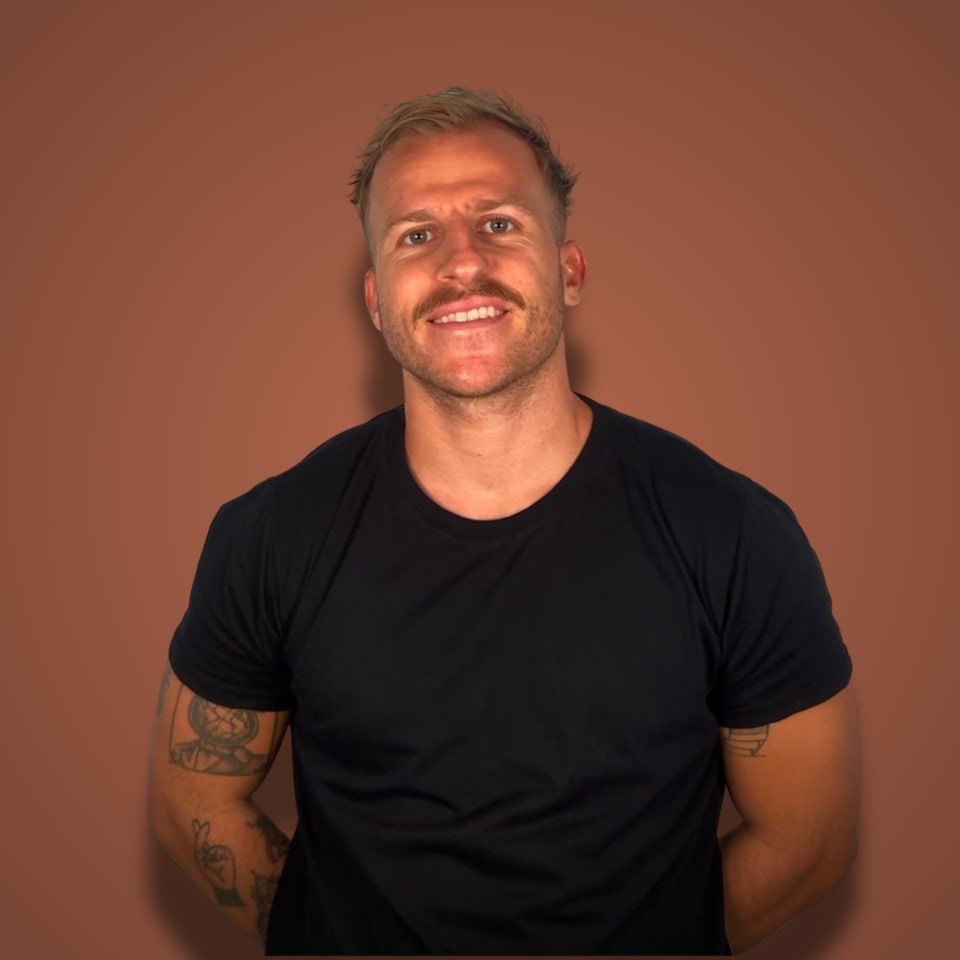
His goal was $5K a month. He wrote it in a Notion doc and thought he'd never hit it. Today he and Tibo Maker run Outrank at $200K MRR.
His name is Gin. Ukrainian, moved to Poland at 17, worked KFC and waited tables while studying logistics he hated.
For three years he tried to build something as an indie hacker. He couldn't even ship. His first real app made exactly $0.
Then one DM changed everything.
I sat down with Gin on the Profitable Founder Podcast. Here's the full playbook, the failures included.
Three years of shipping nothing
Gin taught himself HTML, CSS and JavaScript for a year, landed a front-end dev job pre-COVID, and kept a quiet itch the whole time: he wanted something of his own.
So he built on the side. Or tried to.
"For three years I tried to build something and it was so embarrassing for myself," he told me. "I couldn't even ship something."
He'd pick huge ideas. A full website builder. Then freeze, overwhelmed, staring at Figma mockups he couldn't turn into code. This was 2021. No AI, no Cursor.
Most indie hackers think their problem is distribution. Gin's problem was building. He even wrote a post on Indie Hackers admitting he'd failed because he couldn't ship anything.
The first product that made $0 (and why it mattered)
When ChatGPT exploded, Gin made himself a promise: this time, you ship.
The result was Lunali, a Chrome extension to chat with any web page. He copy-pasted code straight out of ChatGPT to build it. It went live. It made zero dollars.
"I'm really proud that I made it," he said. "I made the project from zero to one and it's now live. It will make zero, but my second, third project will probably make money."
He was right. Because he'd built in public, a random person DM'd him about a chat-with-PDF tool called Document. Gin joined as a co-founder.
→ Document was already doing ~$100-200/mo when he joined
→ Three co-founders: two devs, one marketer
→ They grew it to $3.5K MRR, his first real money online
It was painful. Conflicts, hard conversations. But Document taught him two things that mattered more than the money: how to build something people pay for, and SEO. That second lesson became his next company.
From $300/month to a wall
While running SEO for Document, Gin tried every AI article tool out there. None of them solved his problem. So he built his own with ChatGPT, no Cursor yet, just paste and pray.
He called it Content Pie.
→ Price: $49/month
→ Paid users: 7-8
→ MRR: around $300
→ Channel: AI directories and a bit of Twitter
Then he hit the same wall as always. Two directions, no clarity, no new customers. "I was stuck again," he said. He started thinking about giving up.
This is the moment that separates the founders who break through from the ones who don't. Gin's instinct wasn't to push harder alone. It was to find another brain. If you've ever felt this exact stuck, it's worth understanding why the right people around you change the game more than any tactic does.
The DM that built a $200K SaaS
Gin DM'd four or five indie hackers. Nothing clicked. Then, waiting on a food delivery, it hit him: DM Tibo.
He'd known Tibo since 2021, back when Tibo built Tweet Hunter and Gin was a paying customer reporting bugs. He'd helped Tibo long before he ever asked for anything.
The pitch was almost embarrassingly simple: "Hey, I have this product. I make like 400 bucks. Do you want to work with me?"
Tibo said yes. And before they even agreed to partner, he confirmed the problem was painful and pushed hard for one direction: full automation. Build it so the app does everything for the user.
What followed was the hardest stretch of Gin's life.
→ Two-plus months of heads-down rebuilding
→ Content Pie renamed to Outrank (the name was about ranking on autopilot)
→ New onboarding, a content planner, built-in keyword research, full automation
→ Price raised from $49 to $99
→ V0.1 shipped to 5-7 beta customers, buggy but validated
People paid $100 for a rough version. That's when they knew it could be a real business.
The "magical product" that hit escape velocity
Gin's biggest lesson from those months is brutal and simple: you need a better product. "If you think your problem is only distribution, rethink it."
The word he kept using was magical. A product so good people are amazed, so good they'll 100% pay. Once you have that, marketing gets easy.
At $13K MRR they built the feature that broke everything open. Outrank already wrote content automatically. But content alone doesn't rank, you also need domain authority. So they let users grow their domain rating by sharing backlinks with each other.
They solved the two hardest parts of SEO at once: content and backlinks, both automatic. That's the magical product.
→ They announced the feature on Twitter
→ Launched on Product Hunt and landed #1
→ Jumped to ~$7K in new MRR in a couple of days
→ Tibo amplified it: X, newsletter, every channel
From there: affiliates, SEO, content creators, more channels stacked on top. The mind shift never stopped. $15K felt like nothing. $1M ARR felt like nothing. "It's crazy how mind-shifting," he said.
And the smaller goals were the trick. Gin never aimed at $1M. He aimed at $5K so he wouldn't overwhelm himself, then kept moving the line.
I interview founders like this every week → Watch the Podcast
Frequently Asked Questions
Who founded Outrank?
Outrank was founded by Gin, a Ukrainian developer based in Poland, who built the original version as a tool called Content Pie. He later partnered with Tibo Maker (of Tweet Hunter fame) as co-founder, rebranded it to Outrank, and grew it to $200K MRR.
How much money does Outrank make?
Outrank reached $200K MRR. It started at roughly $300/month as Content Pie with 7-8 paid users at $49, climbed to $10K-15K MRR after the rebrand and price increase to $99, and crossed $1M ARR after a #1 Product Hunt launch.
How did Outrank grow so fast?
Two things. First, a "magical" product that automated both SEO content and backlinks, the two hardest parts of ranking. Second, distribution: a #1 Product Hunt launch, Tibo's X audience and newsletter, plus affiliates and content creators layered on after.
The shortcut Gin almost forgot to mention: the right co-founder and the right painful problem. Everything else is just pushing harder than you think you already are.