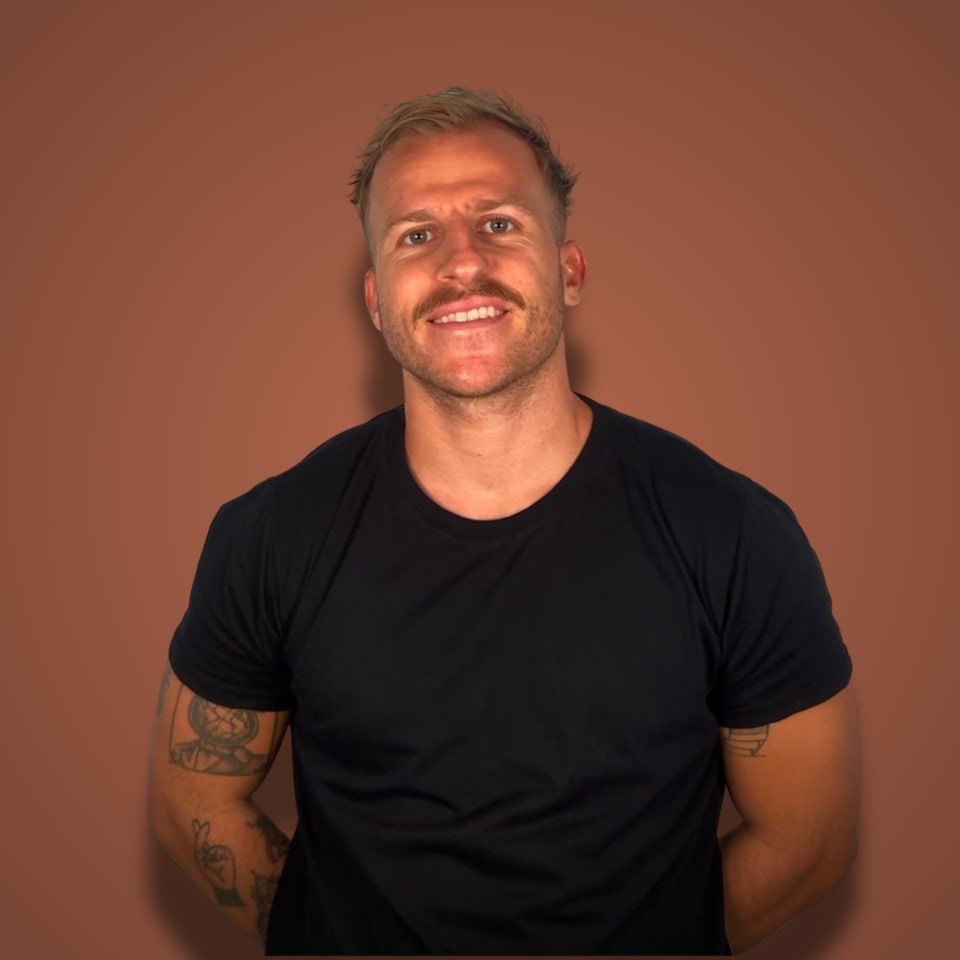
$1M a year. From letting people drag a PDF into a box and get a link back.
That's Tiiny Host. Elston built it as a side project to teach himself marketing, while holding down a full-time job at one of the biggest banks in the US and London.
The domain has two eyes ("tiiny") because the single-eye version cost $300 and he only wanted to spend $30. That's how lightly he took it.
Six years later it's hit $1M ARR, pulls 70,000 users a month on autopilot, and never raised a single dollar.
I flew to Bali, grabbed a scooter, and showed up at his house to ask him exactly how. Here's the full playbook.
He took a 30-year-old industry and made it simple
Tiiny Host's strapline: the simplest way to share your work online.
Think the simplicity of WeTransfer with the power of Dropbox. You drag and drop over 100 file formats and get a clean link in seconds. Custom domains, analytics, password protection, QR codes.
Elston didn't reinvent anything. (That's the whole point.)
→ Web hosting has been around 20-30 years → He took that validated problem space → Modernized it, simplified it → Made it accessible to non-technical people
The audience is wild. Restaurants hosting a menu as a QR code. People who built something on Claude or GPT and have no idea how to put their HTML online. One customer told him she found Tiny through Claude and assumed it was a scam because it looked too good to be true.
Tiny was idea number three or four
Before this, Elston was a software engineer who made every beginner mistake in the book.
First startup: he spent six months building, convinced it was the best idea ever. Showed it to friends, who said "wow, when's it launching?" He launched. Crickets. Pin-drop silence on the App Store.
The other mistakes pile up fast:
→ Too many "co-founders" → friends jumped on, only one or two ever did anything → Chasing YC and investors instead of users → Holding too tightly to a vision the market never wanted → Second idea (B2B) had a great tech stack but he never cracked distribution
His verdict on the whole thing: spending too much time building product is still the biggest, most common mistake he sees, especially from engineers.
If you've ever wondered whether to copy a hot playbook or build your own thing, his take on niching down on a simple tool is the answer.
The first money came from Reddit, then Product Hunt
Tiny launched in 2019 as a barebones WeTransfer-style widget. You couldn't even pay or log in.
His first users came from Reddit. Not spamming, just "hey, I built this, what do you think?" Honest posts that pulled real feedback.
The monetization trick: when people asked for a feature, he put it behind a paywall. Custom domains? Paywall.
The first paid customers came from Product Hunt six or seven months later. The price was originally $18. He kept cutting it until someone finally bought at around $12.
Then his core belief kicked in: if you can find one, you can find 10. Find 10, you can find 100.
The boring channel that built the whole thing
Everyone wants the viral video that brings 10 million customers and early retirement. Elston chose the boring path. YouTube and SEO.
On YouTube he made faceless tutorials. "How to upload a PDF online." "How to upload a React app." Some videos took a YEAR to start ranking, then hit 100,000 views.
His pitch for YouTube: it's evergreen (unlike TikTok spikes), it's high-trust, it converts hard (someone watching a how-to is about to go try it), and most competing videos are low quality. Just film a better one.
Then SEO became the foundation. His process:
→ Use Ahrefs or Semrush for keyword research → Hunt low keyword difficulty (close to zero) with real search volume → Build around jobs-to-be-done: nobody searches "web hosting," they search "how do I upload a CV" or "host a restaurant menu" → Landing pages for bottom-of-funnel action keywords (upload PDF, share PDF as link) → Blog posts for the broader topic content → Build domain rating through links and genuinely good content → Nail the technical stuff (page speed, first contentful paint, Lighthouse scores)
SEO takes three to six months to show baby results, then compounds. Today Tiny still gets over 100,000 visitors a month from search, even in the ChatGPT era. He now has three people working that channel alone: links, keyword analysis, and content.
Two and a half years to quit the job
He got stuck at $70 MRR for a while. Building on the side, only a few hours a day. (He says the constraint helped. It forced laser focus on what actually mattered.)
It took about two and a half years to make enough to leave the bank. He's risk-averse, so he waited until he hit around $8K MRR plus a buffer before jumping.
From there it roughly doubled every year.
The growth lever between $8K MRR and seven figures wasn't one magic feature. It was user-driven development plus a hundred tiny improvements.
The PDF moment is the perfect example. He noticed people uploading PDFs that had been converted to HTML. So he let them just upload the PDF directly. Built it in a weekend. Three to four months later, the SEO kicked in and PDF hosting became one of his top use cases, unlocking a whole new customer base.
The bootstrap advantage: infinite runway
Tiny started as HTML hosting. Then PDF hosting. Now HTML is back, because vibe coders using Claude and Gemini produce more HTML than ever and need somewhere to drop it.
A full-circle moment, and Elston says it's pure bootstrap luck. A VC-backed company might have shut shop waiting for that trend. When you're bootstrapped with effectively infinite runway, you just hang around until the market aligns, then you blow up.
The proof is in the numbers: last year Tiny grew 3-4% month over month. This year, with the vibe coding wave, it's growing 20-30%.
His superpower is saying no. No to going deep like Vercel or Netlify. No to chasing every competitor on X. The flow on day one was drag, drop, get a link. It's still basically that.
Watching trends fire one product after another can feel lonely, which is why he leans hard on a founder community in London for honest feedback and a mentor just a step ahead.
I interview founders like this every week → Watch the Podcast
Aim to be successful, not Steve Jobs
I dug up an old Medium article of his with that exact title. His point: there's only one Steve Jobs, only one Zuckerberg. Their success comes from qualities you don't have.
What you want instead is founder-market fit. What's unique about you that translates into a product?
For Elston, it's taking complex technology and making it simple. That's his edge, and it's stamped all over Tiny.
His other big lesson: don't idolize the titans, find a mentor just ahead of you. If you're at $10K MRR, learn from someone at $30-40K, not Jeff Bezos. The game has changed since the biographies were written. And never DM someone "will you be my mentor." Just ask a sharp question, show you've done the work, come back with results.
What he'd buy next
Elston says zero to one is the hard part. If he started again, he'd rather buy a company already doing $1K-5K MRR and grow it.
The first things he'd look for: a product where he can simplify the design and UX, and a deep SEO play the previous owner gave up on. Those are his two proven weapons.
His parting honesty: being a founder is just constant, diverse problem solving. DDoS attacks at 1am, hiring, roadmaps, debugging. You have to stay dead inside emotionally so the daily roller coaster doesn't wreck you. The first million is the hardest. After that, it gets easier.
Frequently Asked Questions
Who founded Tiiny Host and how much does it make?
Tiiny Host (tiiny.host) was founded by Elston, a software engineer who previously worked at a major US and London bank. He built it solo as a side project starting in 2019, with no co-founder and no investment. It reached $1M ARR by early 2026 and serves over 2 million signed-up users.
How does Tiiny Host get so much traffic?
Almost entirely through SEO and YouTube. Tiny still pulls over 100,000 visitors a month from organic search and around 70,000 users monthly on autopilot. Elston built it by targeting jobs-to-be-done keywords like "upload PDF" and posting faceless tutorial videos that rank for years.
How long did it take Tiiny Host to become profitable?
Elston built Tiny on the side while working full-time. It took about two and a half years to reach roughly $8K MRR, the point where he felt comfortable quitting his job. Revenue then doubled roughly every year, accelerating to 20-30% monthly growth during the vibe coding wave.
The lesson: pick a boring, validated problem, make it dead simple, and let SEO compound while everyone else chases the next viral hit.