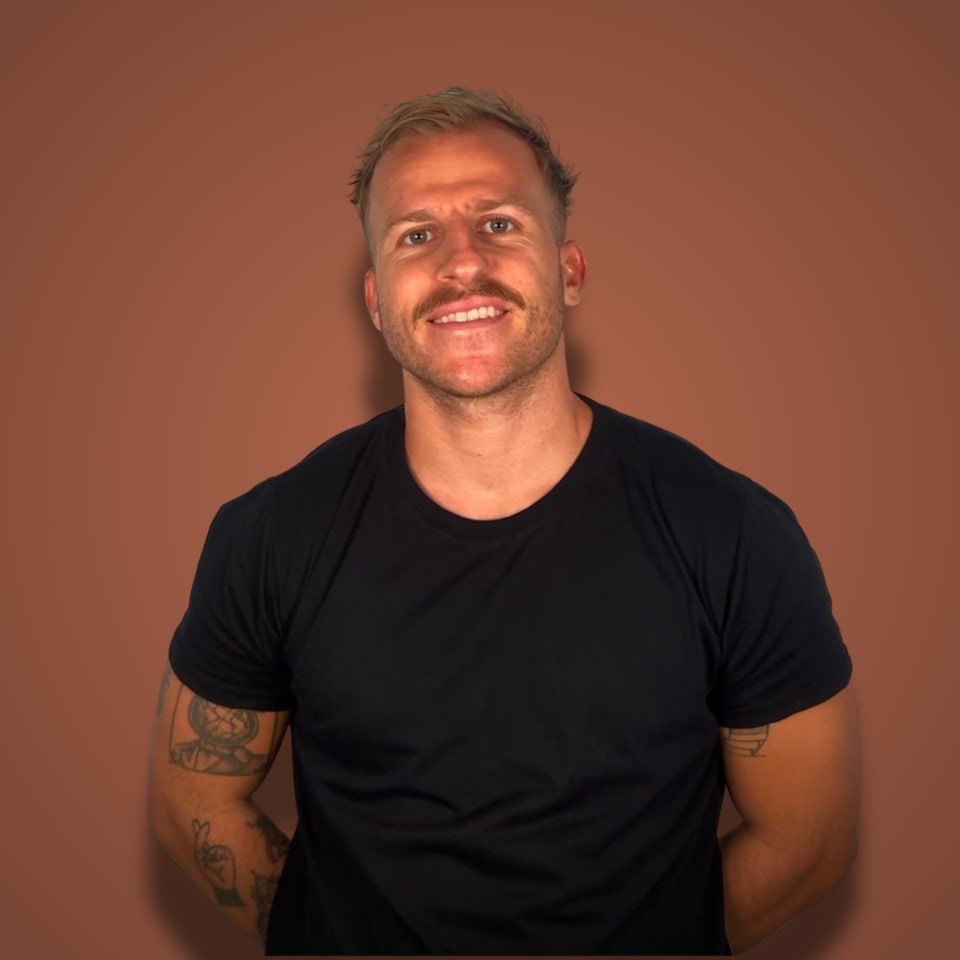
"By the time this podcast comes out, we will have hit $10 million a year." David said it like he was reading a weather report. He was right. Jenni AI crossed $10M ARR a few days later.
Eight years before that, David was working from his parents' bedroom, asking his mom for Chipotle money while his friends took high-paying jobs at Microsoft.
He failed for almost a decade. Then he found one idea that changed everything. Now he runs Jenni AI Group, where three separate products have each passed $1 million a year.
I sat down with David on the Profitable Founder Podcast. Here's the full playbook for how he'd build a $1M SaaS from zero in 2026.
Start with the wallet, not the product
If David started over tomorrow, he wouldn't write a single line of code first.
His first few weeks? Just talking to anyone who'd talk to him. The questions he'd ask:
→ "What's a role you're trying to hire for?"
→ "Of the people you've hired, what do you wish they did better?"
→ "What's a problem in your company?"
Then the closer: "If I solved that for you, would you pay me a few hundred a month?"
Nine out of ten times they say no. They're just complaining. But eventually you hit a problem so painful you can see the delight in their eyes. That person will say yes to $100, $200, even $1,000 a month.
And here's the part most people skip. David would make them pay before he built anything. "That's the best way to validate something," he told me.
The agency shortcut (that he hated)
Most people don't know Jenni AI started as an agency. David sold a service, then built a tool that replaced the service.
Would he do it again? Sort of.
"Running an agency is very painful. I would not wish it upon my worst enemy." But if you have no money, it's the fastest way to make $1,000 or $5,000 a month. You just have to be willing to get rejected a lot and do the work nobody else wants to do.
His honest take on his own early skills? "Pretty bad." He didn't know how to code. He found a technical co-founder who was a "wizard," and David carried the unglamorous parts. The two things he actually had: a high risk tolerance, and the resilience to do the shitty jobs.
This is the same lesson I keep hearing from founders who build a micro-SaaS the lean way. Sell the manual version first. Automate it once people are paying.
Seedstrapping: the middle path
David has done both. The full VC circus and the slow bootstrap grind. His verdict isn't what indie Twitter wants to hear.
He raised twice. A $100K angel round from Jason Calacanis, then a pre-seed. Before that money hit, the company had about $1,000 in the bank. They had to beg influencers to take a $100 or $300 sponsorship. One flopped sponsorship was a code red. That was 30% of their runway, gone.
His framing on giving up equity is the clearest I've heard:
"You sell maybe 10 or 20% of your company. So instead of making $100 million, you make $80 or $90 million. To me that's not a big difference. But if I have to spend another 1 to 3 years of my life in my 20s? That's really valuable to me."
So he did neither extreme. He seedstrapped. Take a little money to survive the painful early days, find product-market fit, then let revenue keep the machine rolling.
The day the first $100K hit the account, his whole family piled into a car, drove to his grandparents' house, and stared at his laptop together. "That was probably one of the best days of my entire life." Today the company spends around $500K a month.
His real secret: steal from other industries
Here's where David is different from every other founder reading the same Paul Graham essays.
"Me and all the Asian kids that look like me, talk like me, want to make companies like me, we've all read the same blogs. So we pump out the same stuff."
His edge is pulling tactics from outside SaaS entirely. Jenni AI was doing UGC marketing three or four years ago, when nobody in SaaS touched it. Only e-commerce brands did. The channel was sitting in public, ignored.
"There was this amazing marketing channel that very few SaaS founders understood or cared about. All you had to do was implement it into your vertical."
Today Jenni AI runs around 200 UGC creators producing content every single day.
The other move he pointed to: give an influencer equity instead of a flat fee. They become the face of the product, you get distribution for cheap. He pointed at Steven Bartlett launching a podcast platform with Flightcast as the obvious version of this. Borrow what works in another niche, drop it into yours.
If you want to go deeper on the paid-creator playbook, the Cal AI founder story breaks down how influencer UGC scaled an app to millions.
Why his new tools blow up faster than Jenni AI did
Jenni AI took 46 months to go from zero to $1M ARR. His latest tool did it in under 6 months.
Part of that is cheating, he admits. All his products live in edtech, his wheelhouse. He can't just grab a random B2B SaaS and repeat the trick.
But the real skill is this. As a generalist founder, he can visualize the distribution before the product exists. The TikTok that goes viral. What the comments look like. The landing page. The paywall. If he can see all that, he has a good read on whether it'll work.
One example stuck with me. A video went viral for one of their tools, but it featured a tiny side feature, not the main one. So they rebuilt the entire product around that small feature, redid the landing page, and locked in a viral video format. They let the audience reshape the product.
His most actionable rule: "If you're not able to monetize an idea really early on, let it go." Easy to hear. Hard to do.
I interview founders like this every week → Watch the Podcast
The worst year, then the comeback
A year ago David posted that he had enough money to afford a table for two anywhere in the world, but couldn't fill the other seat.
It was the worst stretch of his life. His co-founder left (amicably). His girlfriend of three years broke up with him because he worked too hard. A close friend died in a freak accident. He went to therapy for months.
"Everything that could have gone wrong went wrong."
Now? New CTO in place, a girlfriend who gets his ambition, his old co-founder thriving on a new startup that David invested in. "Time heals all wounds."
And the money still doesn't feel like he thought it would. Every milestone feels normal within weeks. "If 20-year-old me saw these numbers, I'd be running around the street naked. But the hedonic treadmill just speeds up."
Frequently Asked Questions
Who is David and what is Jenni AI?
David is the founder of Jenni AI, an edtech SaaS product that started as an agency and grew into a tool. By late December 2025 it crossed $10 million ARR, around $821K MRR. He now runs Jenni AI Group, where three separate products have each passed $1 million a year.
How much money did David raise for Jenni AI?
He raised twice and calls it "seedstrapping." First a $100,000 angel round from Jason Calacanis, then a pre-seed round. His very first investor was a stranger he pitched for three hours on a flight in 2018, who later sent a $10,000 cashier's check. David eventually returned that $10K when the investor asked for it.
What is David's main marketing strategy?
Stealing distribution tactics from other industries. Jenni AI ran UGC (user-generated content) marketing three to four years before other SaaS founders caught on, copying what e-commerce brands were already doing. Today the company works with around 200 UGC creators producing content daily.
The whole episode comes down to one line: don't build until someone pays, and find your edge outside the same blogs everyone else is reading.