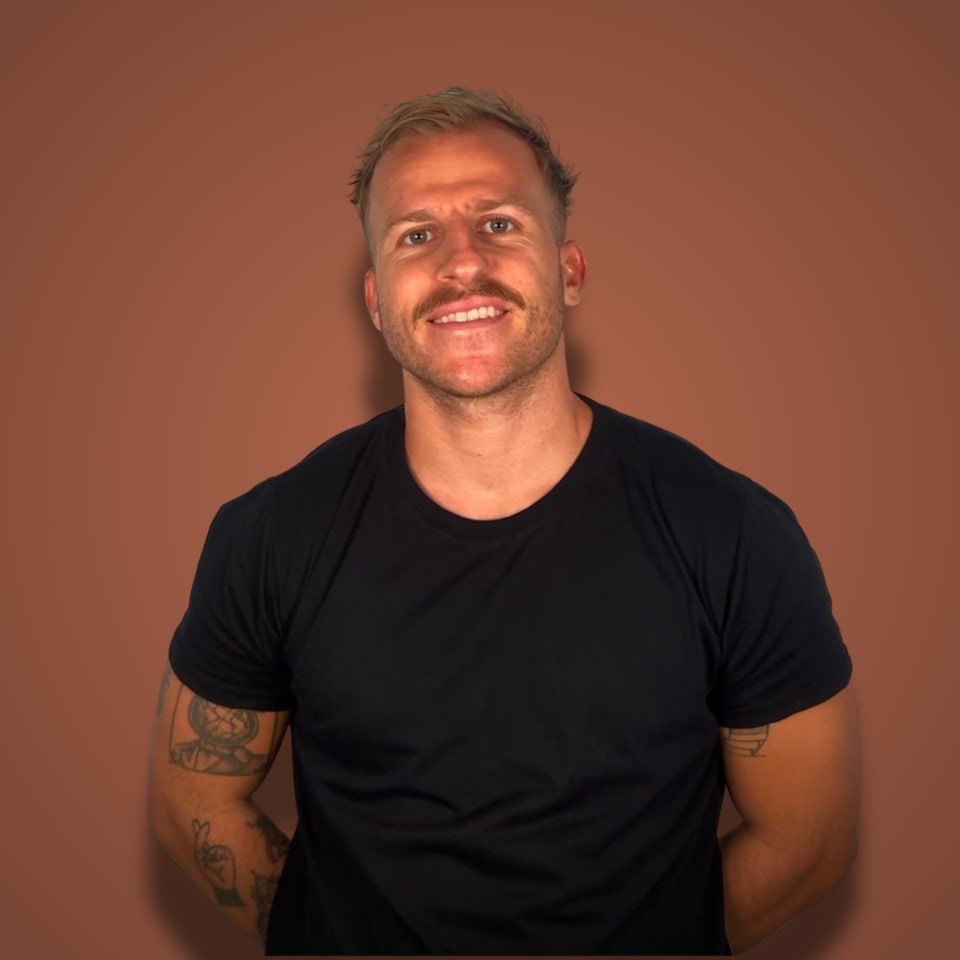
"None of it is built by me. I did not even write a single line of code. I did not even know something like this can be done by just talking to Telegram."
That's Bhanu, describing the AI agent army he built to run his $28k/mo startup empire. Not one assistant. A whole team of them, talking to each other, 24/7, all pointed at one goal: $1M ARR for SiteGPT.
This is the guy who built Feather and sold it for $250,000. Then grew SiteGPT to $18K MRR. Then built Mission Control HQ to $10K MRR on top of that.
And now he's handed the day-to-day of all of it to a lead agent he calls Jarvis.
I sat down with Bhanu on the Profitable Founder Podcast. Here's the full playbook. (I installed the same setup 24 hours before we recorded, and I was somewhere between crying and smiling the whole time.)
How it started: one agent that got confused
Bhanu ignored OpenClaw at first. "Just another tool," he thought. Everyone was buying Mac Minis to install it. He almost bought one too.
Then curiosity won. He spun it up on a server to test it before committing.
"It has so much more autonomy than anything I've seen before," he told me. So he started using it for everything. Personal life. Business. Coding. Marketing. Sales. SEO articles.
And that was the problem.
One minute he'd ask it to count the calories in his lunch. The next, fix a bug. The next, write an article. The context got messed up. It started forgetting things, because he was talking about ten different jobs in one chat.
So he asked a different question: can I create multiple agents, one per role, and make them talk to each other?
The fix: one specialist per job
He didn't spin up a new Mac Mini per agent. (I assumed you had to. You don't.)
One gateway. Many independent agents inside it. He just told OpenClaw to read its own documentation and figure out how to create them.
Here's the structure:
→ He talks to ONE lead agent, Jarvis, from Telegram
→ Jarvis creates every other agent and assigns the work
→ Brute is the retention specialist (reads customer emails, watches Slack, flags churn)
→ Fury is a research agent (pulls competitors, pricing, market data)
→ When a long task comes in, Jarvis spins up a sub-agent so it never goes silent on him
The retention agent didn't just "watch churn." It built its own scoring framework: query volume drops more than 50%, add 25 risk points. Zero queries for 7 straight days, add 30+ points. Bhanu didn't write that logic. The agent did.
If you've ever wanted to copy a proven setup instead of inventing one from scratch, this is the same instinct behind building a lean micro-SaaS. Find the one job, build the one specialist, repeat.
Mission Control: seeing what the agents say to each other
Once the agents were talking, Bhanu hit a wall. He had no visibility. He didn't know what they were saying to each other.
So he asked Jarvis to build a dashboard. A central knowledge base where every agent writes its findings and you can watch the conversation happen.
That dashboard became Mission Control HQ. The product now doing $10K MRR.
"I just described what I wanted in natural language, and it created this entire dashboard," he said. He even has a group chat view where you can watch agents collaborate live.
One agent asks: who are the competitors, what's the pricing? Another goes and researches, writes a document, hands it back. A third jumps in: "I already pushed fixes to GitHub, the PR is ready." A fourth: "We need use-case pages for this."
One mission. Many agents. They figure out the path together.
The real findings: what it caught that he missed
This is where it stopped being a toy for me.
Bhanu was getting 50,000 visitors a month. Only 50 of them started a free trial. The agent flagged the conversion problem on its own, then signed up as a real user to find out why.
→ It walked the entire signup flow and mapped where conversion was breaking
→ "Your pricing page only has one testimonial."
→ "I signed up and you never emailed me. You have no onboarding sequence. Here's email one, two, three, and the exact condition to trigger each."
→ It dug into his Chartmogul data, saw a September MRR spike that died in December, and traced it to an activation problem, not retention
Then it gave him email access (read-only, via a scoped Fastmail API key it told him how to create). It read through roughly 100,000 emails from the last 3 years and drafted follow-ups he'd promised but forgotten. It even put a number on it: "This is the money you're losing because you didn't do what you said you'd do."
Blunt. But right.
What it costs and what to watch out for
Total spend so far between Bhanu and his brother: around $600. A mix of API credits for other models early on, plus Claude subscriptions. He now runs Opus for every agent.
Why one model for all of them? "These agents talk to each other. If one agent's research is wrong, it affects the entire system." He compared it to building a team. You don't put C-players next to your A-players.
On safety, his advice was the same as mine: treat it like an employee.
→ Don't run it on your personal computer. Use a server or a Linux VM
→ Create a dedicated Gmail just for the agent (a tip I got from Alex Finn)
→ Run openclaw doctor and fix everything it flags
→ Give access in stages. Read the codebase first, then make changes on branches only, never the main branch
→ Give it scoped access. My YouTube Studio agent can see everything and publish nothing
"Just like how you build trust in an employee," Bhanu said. You learn what it can do, then you put locks in place.
The honest part: did it actually make money?
I asked him straight. Has the agent army made you more money already?
"Not exactly yet."
And I respect that answer. This isn't a button that prints revenue on day one. It's outsourcing your marketing to an intelligent system that already knows your customers, your activity numbers, your whole business. The onboarding sequences it designed? His brother is building them now.
The real unlock is different. "Previously I didn't even have one task to do. I didn't know where to start. Now I have too many things to do and I just have to choose which one."
Same for me. It built me a website, dug through my YouTube Studio, and now hands me a morning brief with a list of 15 bootstrap founders to invite onto the podcast. My job shrank to: pick five and message them.
Bhanu's line stuck with me. "AI is no longer an assistant to us. We became an assistant to it." If you want to go deeper on learning this stuff while it's still early, that's exactly why I run a podcast for SaaS founders.
I interview founders like this every week → Watch the Podcast
Frequently Asked Questions
Who is Bhanu and what has he built?
Bhanu is a serial SaaS builder. He built Feather and sold it for $250,000, grew SiteGPT to $18K MRR, and built Mission Control HQ to $10K MRR. His current goal is reaching $1M ARR with SiteGPT, which he's now pursuing using a team of OpenClaw AI agents.
How much does it cost to run an OpenClaw agent setup?
Bhanu spent around $600 total across himself and his brother. It's a mix of API credits for other models he used early on, plus Claude subscriptions. He now runs Opus on every agent for reliability, pausing when he hits rate limits and resuming when they reset.
How do you keep an AI agent setup safe?
Treat it like a new employee. Run it on a server or virtual machine, not your personal computer. Give it a dedicated Gmail account, run the built-in doctor command, and grant access in stages. Use read-only or scoped permissions so it can analyze but not delete, publish, or send.
The limit is no longer what AI can do. It's how much you can do. That's the part nobody warned me about.