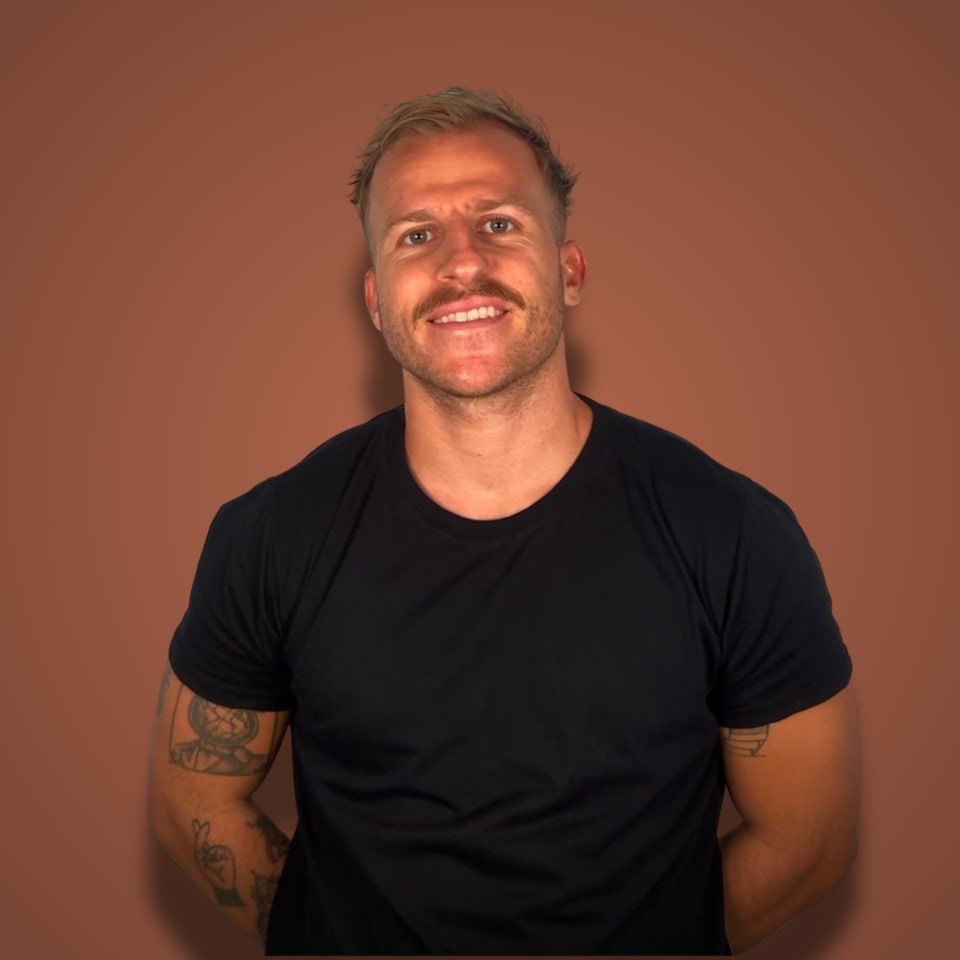
Greg Isenberg opened his latest episode with a confession.
"I'm a Grok convert. And I don't say it lightly."
This is a guy who has seen every model launch of the past three years. He invested in VidIQ back in 2013. He is not easily impressed anymore. Most of us aren't. We got numb.
Then his guest Nick, co-founder of Orgo, spent an hour showing him an AI co-founder in action. Not a chatbot. An agent with its own computer, its own email, its own phone number, that builds landing pages in 40 seconds and writes cold outreach sequences while you're on a podcast.
Total cost: about $300 a month.
I watched the whole episode so you don't have to (though you should). Here's the full breakdown.
The claim: a co-founder for $300 a month
Nick's agent is called Dewey.
Dewey is a Hermes agent (OpenClaw works too) running on a cloud computer from Orgo, with Grok 4.5 as the model underneath. Nick texts it on Telegram. He texts it on iMessage. It never sleeps because it doesn't live on his laptop.
That last part matters more than it sounds. Run an agent on your local machine and it dies the second you close the lid. Put it on a cloud computer (Orgo, Hostinger, Hetzner, whatever) and you have an employee that works while you sleep.
During the episode, Nick asked Dewey to spin up a brand new computer with a fresh Hermes agent installed and Grok 4.5 configured as the model.
It did it. Live. Box up, Hermes installed, API key injected, model pinned.
An agent provisioning other agents. Nick says he does this on customer calls: someone describes a use case, he texts Dewey, and the new agent exists before the call ends.
Why Grok 4.5 changed his mind
Nick's numbers from the episode:
→ Roughly 1/10th the cost of Claude Fable per task
→ 10 to 15x faster at completing the same work
→ Tasks that took GPT 5.5 around 30 minutes a month ago now finish in a couple of minutes
His analogy: we went from a Toyota Camry to a Ferrari. Except the Camry was the expensive one. "It'd be like an expensive Toyota, and now it's a cheap Ferrari."
Then Nick said the most honest thing in the whole episode: cheaper doesn't mean you spend less.
Nick bought the $300/month SuperGrok plan the minute Grok 4.5 dropped. He was already down to 24% of his quota when they recorded. By the end of the episode he was at 19%. He burned 5% of a $300 plan in one podcast recording.
Why? Because when a task drops from 8 hours to 1 hour, you don't take 7 hours off. You do 8x more work. Your ambition expands to fill the capacity. He calls himself a "token maxer" and honestly, same.
The 40-second landing page test
Greg wanted a head-to-head. So they raced Grok 4.5 against GPT 5.6 Sol (OpenAI's new lineup is Sol, Terra and Luna now, keeping up with the names is a full-time job).
Same prompt to both: build a one-page landing page for a startup idea.
Grok finished in about 40 seconds. Full page, decent copy, good design. Sol got there too, a minute or so later, and the result was genuinely nice. But Greg preferred the Grok page on both design and copy.
Two years ago this demo would have looked like magic. Now it's a Tuesday.
Speed by itself is a party trick. What matters is what speed does to your loops. When your agent can go idea → research → landing page → outreach in minutes instead of days, you can run that loop daily. Progress compounds at a different rate.
The stack: 9 tools wired into one agent
The model is maybe 30% of this. The rest is connectors. Dewey is wired into:
→ Orgo: the cloud computer it lives on
→ AgentMail: its own email address
→ AgentPhone: its own phone number for calls
→ Composio: the bridge to Google Docs, YouTube, web search, Perplexity
→ X MCP: reads trends, bookmarks, even DMs
→ Idea Browser: startup idea research with actual market signals
→ VidIQ: finds outlier YouTube videos and thumbnails
→ Latitude: observability, it literally detects when Nick sounds frustrated and suggests fixes
→ Linear: task tracking
Nick's rule: context is king. Give the agent everything. The same way you'd never hire an employee and refuse them an email address, don't run an agent with zero tools and then complain it's useless.
My favorite story from the episode: a personal finance creator with a big following DMed Nick on X wanting an agent built. Nick didn't paste a single thing. He told Dewey to read the DM thread and build the agent from that context. Dewey read the conversation, built the computer, configured the agent. The guy has been texting his new agent for two days and is losing his mind.
(How tf do you compete with a sales process where the product builds itself from the sales conversation?)
Then it built an entire business on camera
This is where the episode goes from "cool demo" to "okay, I need to rethink some things."
They asked Dewey for startup ideas. It pulled from X trends, Idea Browser, web search and Perplexity, then came back with a top 10. Three that stood out:
→ A voice receptionist that recovers missed calls for plumbers, HVAC and electricians
→ A security scanner for MCP servers (someone will build this and it will print)
→ A managed "AI employee" operating system for agencies, verticalized with templates
They picked the AI employee idea. Dewey then built, during the episode:
The landing page: "Hire an AI employee with a real desk, not another chatbot." With pricing it invented itself: $1,500 one-time for a 14-day pilot, $2,500/month per managed seat, $6,500/month for three seats. Plus a lead qualification flow.
The cold email sequence: full ICP breakdown, offer, sequence architecture, every email written, delivered as a Google Doc to Nick's Telegram.
The next-steps plan: book three design partner calls this week using the outreach doc, run the 4-minute script on the calls, land 3 to 8 pilots, then run competitive analysis and a money model.
A YouTube thumbnail: pulled outlier thumbnails via VidIQ, matched them against Nick's face and past content, generated it.
That's an idea, a website, pricing, an outreach system and a go-to-market plan in one podcast recording. This is the kind of thing that used to be a quarter of work, and it's exactly where business automations are heading for normal companies too, not just AI-native ones.
What I'd steal from this episode
I run 11 AI agents across my own projects, so none of this is theoretical for me. Three takeaways I'd act on this week:
1. Get your agent off your laptop. The unlock isn't the model, it's persistence. An agent you can text at 11pm that's been working all day is a different species from a chat window. I covered the desktop version of this in my Hermes agent breakdown, and the cloud version is strictly better.
2. Stop being precious about model loyalty. Nick shows zero loyalty. Grok for speed and cost today, something else tomorrow. The stack (Hermes + connectors + your context) is the asset. Models are cartridges. When Grok 5 drops, his whole business gets an upgrade overnight and he did nothing.
3. Connect the boring tools first. Email, docs, phone, your actual data. The demo magic came from context, not intelligence. An agent that can read your DMs and your YouTube stats beats a smarter agent that can't. I wrote about the skill side of this in managing AI agents, and it's aging well: the founders winning right now are the ones who treat agent management like people management.
And one warning label.
Dewey broke itself mid-episode and then fixed itself. That's charming in a demo. In production, with a customer on the line, it's less charming. These setups still need an operator who checks the work. Co-founder, yes. Autopilot, no.
FAQ
What is an AI co-founder?
An AI co-founder is an autonomous agent (built with harnesses like Hermes or OpenClaw) that runs on its own computer with access to your tools: email, phone, docs, social accounts and research tools. Unlike a chatbot, it executes multi-step work on its own: building landing pages, writing outreach sequences, researching markets and even provisioning other agents. You talk to it through Telegram, iMessage or a terminal.
How much does an AI co-founder setup cost?
Nick's setup runs on the $300/month SuperGrok plan, plus a cloud computer from a provider like Orgo, Hostinger or Hetzner. He argues a $200 to $300 monthly spend gets you what he calls an "AI employee co-founder workhorse." The catch: the faster and cheaper the model, the more work you'll give it, so budget for growing token usage, not shrinking bills.
Do you need to be technical to set this up?
Less than you'd think. Orgo has one-click templates that spin up a Hermes agent pre-configured, and Nick shared his personal stack as a template in the episode. For the connectors, his advice is to just tell the agent what you want connected and let it walk you through setup. If you can follow a recipe, you can do this in a weekend.
Is Grok 4.5 actually better than Claude or GPT?
Depends what you're optimizing for. Nick's case is about economics, not raw intelligence: roughly 1/10th the cost of Claude Fable and 10 to 15x faster on agent tasks, which matters when your agent runs hundreds of tool calls a day. In the live test, GPT 5.6 Sol produced comparable quality but slower and with hungrier token usage. For long agentic loops, speed and cost win. For your hardest reasoning, you might still reach for something else.
Hear how real founders actually use this stuff
Demos are one thing. Revenue is another.
Every week on the Profitable Founder Podcast I sit down with bootstrapped SaaS founders doing $100K to $10M a year and get them to open up the playbook: what they automated, what they killed, what actually moved MRR.