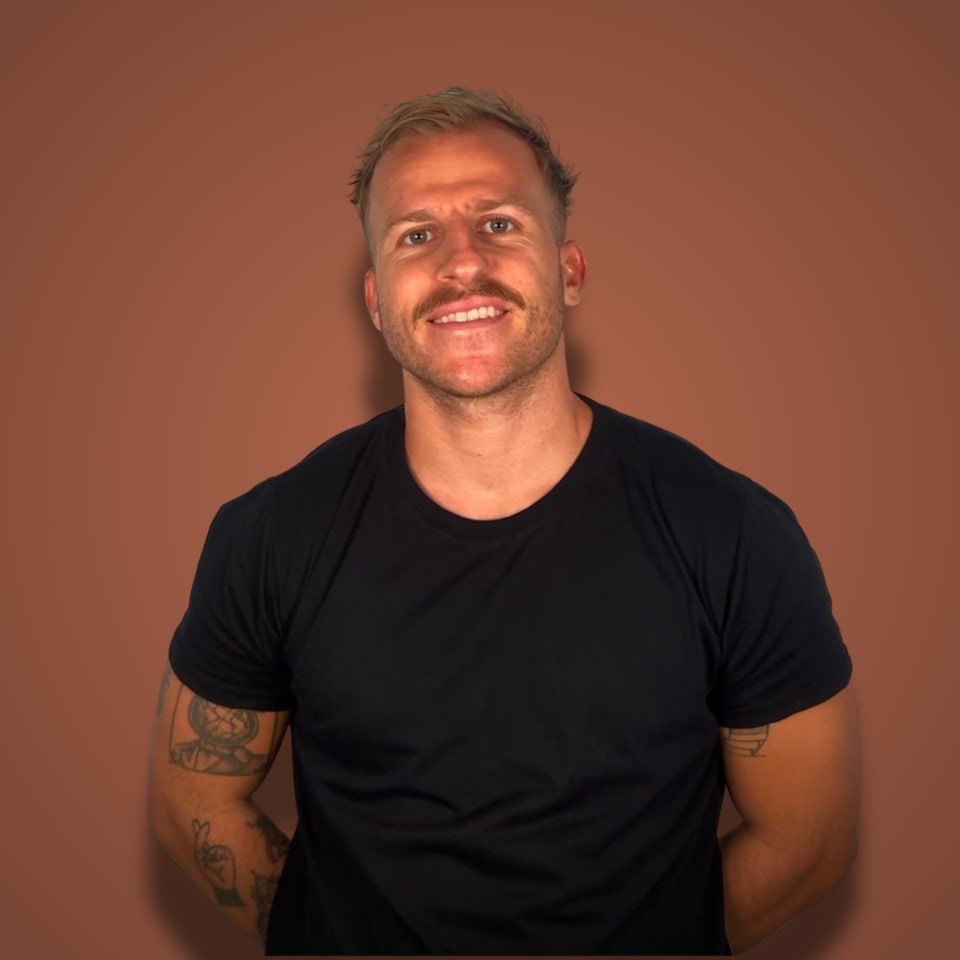
Youssef built an agency to almost a million a year. Then he sold it to go all-in on a SaaS that was stuck at $1,500 MRR.
(Stupid decision, right?) Except the SaaS hit $22.5K MRR and 15% month-over-month growth before LinkedIn nearly killed it overnight.
He's a completely non-technical founder. No code. Two sales guys and an Indie Hackers post. That's how Scalelist got built.
I sat down with Youssef on the Profitable Founder Podcast. Here's the full playbook for turning an agency into a B2B SaaS.
The agency that printed cash (and burned him out)
Youssef started in tech sales. Google, then AWS. In 2019 he launched a lead generation agency, The Scale Lab, with his co-founder Arno.
They met in China 13 years ago. The only two non-Chinese guys on a flight from France. Super random.
The agency did cold email, cold calling, and LinkedIn lead gen. They scaled it to "close to a million," peaking around $750K to $800K a year.
And it sucked.
"Honestly, I was tired of the agency," he told me. "You do a lot of repeated work. And as you scale an agency, you also scale agency problems. Staff churn. Client churn."
The whole time, one thing nagged at him. He came from tech. He wanted to build a SaaS. Valuations are more interesting, and it's just the business he wanted to be in.
How two non-technical founders found a builder
The agency gave them an unfair advantage most SaaS founders never get. They saw the same problem across dozens of companies.
That problem → building contact lists. Pulling leads off LinkedIn, then finding emails and phone numbers. Back in 2019 to 2022 there was no AI for it. People did it manually, or hired cheap labor to guess at emails.
So they built an internal tool to do it. The agency scaled on the back of it. Then clients started asking, "What's your stack? Can I use your tool?"
That was the signal. But there was one problem → neither founder could code.
For years they talked to developers. Friends of friends, tinkering CTOs, flaky freelancers. Over 50 conversations. Nothing clicked.
Then Youssef made a post on Indie Hackers. Here's where we are, here's the problem we already solve, we need someone who can build. A French founder named Charlie reached out, knew the industry, and helped them ship the first version.
If you're non-technical, his advice is blunt: "You don't need to know how to code yourself. But surround yourself with options. Freelance developers, a CTO, an agency, whatever. Just get started."
This whole story is the textbook way to build a micro-SaaS from a problem you already live every day.
The year stuck at $1,500 MRR
Here's the part nobody talks about. Scalelist sat at $1K to $1.5K MRR for about a year and three months. Flat. Stale.
Meanwhile the agency was still eating 100%, sometimes 150%, of their time. There was no cash pile to dump into the SaaS. They had to bleed time from the agency into Scalelist, slowly, while it grew.
So why not quit when growth was flat for over a year?
"It just sucks to have an agency," he said again, laughing. The pain of the old business kept him pushing on the new one.
And here's the mistake he warns every agency owner about → giving the SaaS too short a timeline.
"If you put yourself on a one-quarter timeline to decide whether to continue, that's too short. Especially if you're still running the agency. You're treating it like a side project, so you're not giving it a real chance."
YouTube: the channel that 10x'd everything
Outbound was their whole identity. They sold outbound for a living. So obviously they'd just blast emails and grow the SaaS, right?
It didn't work at all. One sale from all their outbound. Youssef's rule: outbound works when your deal size is at least four or five figures. Scalelist was a low-ticket product. Wrong channel.
So they tested YouTube. And it became 50% of their acquisition.
The best performing video in 2024? "A simple Loom with the worst mic I have ever had in my life." He'd forgotten his mic, recorded three minutes at his girlfriend's apartment on earbuds. 10,000 views.
The numbers that make YouTube work for them →
→ Lifetime value of about $750 per customer
→ Roughly every 250 to 300 views converts to one paid customer
→ One video a week, consistently
→ Keyword research with VidIQ, recorded on Tela.tv
The strategy was dead simple. Find keywords with low competition like "how to export leads from LinkedIn Sales Navigator." Look at what already ranks. Make it shorter and clearer. Show the exact steps, no promotion.
Then they stacked SEO on top, hired a Portugal-based agency for three months, and grew the top of the funnel that was already converting. If you want more founder breakdowns like this, the podcast drops a new one every week.
The cease and desist that nearly ended it
By early 2025 Scalelist was flying. 15% month-over-month growth. $22.5K MRR. Product-market fit, finally.
Then on a Saturday, right before a classical music concert, Arno called. "Did you see the email?"
LinkedIn compliance enforcement. A cease and desist.
LinkedIn had hired a compliance team to hit everyone pulling data off the platform. They went after giants like Seamless.ai and Apollo, but smaller companies got caught in the crossfire too.
"They just took the AK-47 and fired at everybody," Youssef said. Overnight, 100% of their revenue was threatened.
They chose to comply. Refusing meant losing their LinkedIn accounts, killing their distribution, and making the company unsellable. So they stabilized the revenue, took a hit, and pivoted.
The wild part of the timing → they'd raised money in January 2025 from TinySeed, a B2B SaaS accelerator. The cease and desist hit in April. They'd raised right before the floor fell out.
One TinySeed founder gave him advice he still repeats: "You've been building this for two years. If you're shifting to something else, you're in it for at least five more years. Make sure it's something you actually want to do that long."
The pivot, and the bet on AI
Their whole business was "pull leads from LinkedIn." Now they couldn't say that anymore. Marketing, positioning, onboarding, all of it had to change while support chat went crazy with confused users.
They repositioned as a data provider. Emails and phone numbers, with a genuine edge → strong data in Asia, where there's no Apollo-scale player. The business is registered in Singapore, Youssef is in Hong Kong, the team is in Asia.
Then came the real bet. Scalelist now ships an API and an MCP server, so you can drop a list of 10,000 people into Claude or ChatGPT and the LLM finds the emails through their infrastructure.
"I'm very bullish that your UI is not going to matter anymore," he told me. "If software gets taken over by the chat interface, you have to build infrastructure as a service."
His other moat? Compliance. "I'm becoming a data compliance nerd. GDPR, CCPA. A lot of competitors can't be compliant, so they get dismissed, and we sign deals through that."
One more thing changed three weeks before we talked. They hired a full-time head of YouTube. It turned out to be his wife. He figured it out on a hike in Hong Kong: "I live with the person we need to hire."
I interview founders like this every week → Watch the Podcast
Frequently Asked Questions
What is Scalelist and who founded it?
Scalelist is a B2B data provider for sales teams, offering email finding, phone finding, an API, and an MCP server for AI tools. It was founded by Youssef and his co-founder Arno, the same two who built the lead generation agency The Scale Lab. Both founders are non-technical, with backgrounds in tech sales.
How much did Youssef's agency make before he sold it?
The Scale Lab grew to close to a million dollars a year, peaking around $750K to $800K annually. Youssef and Arno sold the agency in September 2025 to recover 100% of their time and focus entirely on Scalelist, their SaaS. They had hired a managing director to run it before the sale.
How did Scalelist grow its customers?
YouTube became 50% of Scalelist's customer acquisition. Their best early video was an unedited Loom that hit 10,000 views. With a lifetime value around $750 and roughly 250 to 300 views converting one paid customer, they post one video a week using VidIQ for keywords and Tela.tv to record, later stacking SEO on top.
The lesson Youssef keeps coming back to: don't just build because building is easy now. Spend the time deciding whether it's a business you'll still want to run in five years.