Techstars wants 5% of your company plus a $200,000 uncapped SAFE. That is the standard deal in 2026: $220K total, with the 5% converting at your first priced round whether the program moved your numbers or not.
I ran that math and kept my equity.
If you are hunting for Techstars alternatives, you are probably in one of two camps. Camp one wants the money and the network on better terms. Camp two looked at the equity math and realized what they actually need is peers, accountability, and distribution, not a three-month sprint toward a demo day.
I am camp two. I paid $13,000 for a mastermind when I was making $15K to $20K a month. Stupid decision, right? Six months later I was at $75K a month. I later sold that SaaS, and I never gave an accelerator a single point of equity.
This list covers both camps. One option costs $97 a year. Another hands you $500K. If you are still weighing the original, I broke the full deal down in is Techstars worth it.
| Program | The deal | Equity | Format |
|---|---|---|---|
| Profitable Founder Club | $97/year | 0% | Remote, 12-week batches |
| TinySeed | $120K to $220K | 10% to 12% | Remote, 1 year |
| Y Combinator | $500K | 7% + uncapped SAFE | 3 months, San Francisco |
| Antler | $250K + $150K SAFE (US) | 10% + uncapped SAFE | In person, from day zero |
| 500 Global | $150K | 6% | 4 months, Palo Alto |
| On Deck (ODF) | Pay what you can (~$1,000) | 0% | 1 week SF + online |
| Founder Institute | $399 to $1,649 fee | Small pledge (~2.5% reported) | ~4 months, part time |
1. Profitable Founder Club
Full disclosure: this one's mine.
I built the Club because the thing that took me from $15K to $75K a month was not a curriculum or a check. It was a small group of founders slightly ahead of me who could look at my numbers and tell me where I was lying to myself.
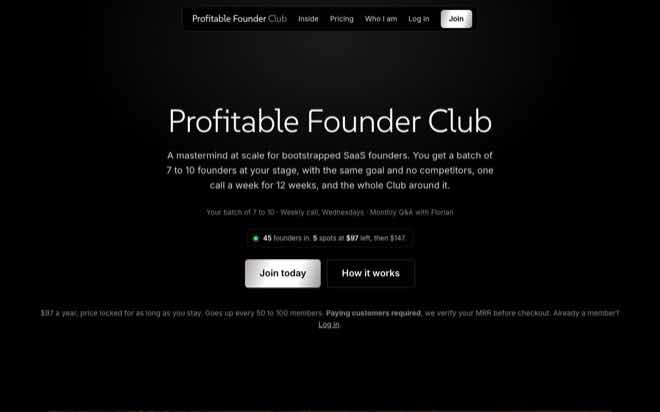
The Club is for bootstrapped SaaS founders with at least one paying customer. Any MRR above $0 qualifies, and it gets verified: a read-only Stripe or Lemon Squeezy key, or a revenue screenshot I check myself. If you are pre-revenue or still hunting for an idea, it is not for you yet.
You get placed in a batch of 7 to 10 founders at a similar stage, with no competitors in the same batch. One hour every Wednesday for 12 weeks. Each call runs two hot seats: 5 minutes of your numbers, 15 minutes of the group working your problem, 5 minutes of written commitments you answer for next week. Week 6 is a numbers review, week 12 is demo day. Plus a monthly live Q&A with me.
The price is $97 a year, locked for as long as you stay. It goes up every 50 to 100 members, and there is a 14-day no-questions refund. The Club takes zero equity.
The Club is full right now and runs a waitlist, so if this sounds like your camp, get on it.
Join the Profitable Founder Club waitlist
→ Best for: SaaS founders between first customer and $50K MRR who need peers and accountability, not a check.
2. TinySeed
TinySeed is what Techstars would look like if it stopped chasing unicorns.
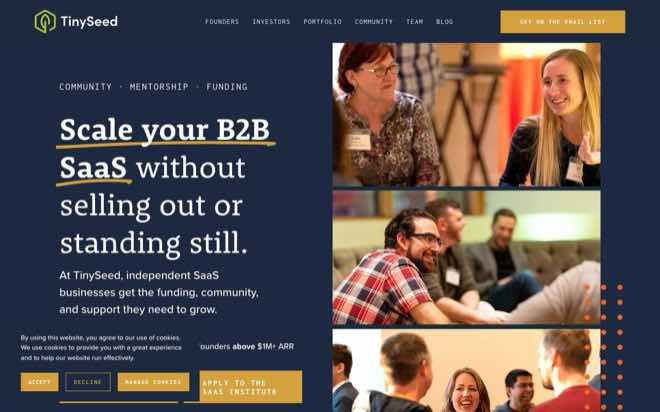
Rob Walling's accelerator writes checks of $120K to $220K for 10% to 12% equity, and the whole thing runs remote for a full year. Each batch takes 15 to 20 B2B SaaS companies, ideally under $1M ARR. You can use the money to pay yourself a salary, which tells you everything about the philosophy: they fund businesses, not lottery tickets.
The structure follows the deal Rand Fishkin raised for SparkToro. Nobody pushes you toward a Series A or a demo-day performance. If you exit at $5M or run the company profitably forever, TinySeed still wins, and so do you.
The trade-off is real: 10% to 12% is more equity than Techstars' 5% headline number. But there is no $200K uncapped SAFE sitting on your cap table waiting to convert, and the program is built around the outcome most bootstrappers actually want.
→ Best for: B2B SaaS founders who want funding without signing up for the venture treadmill.
3. Y Combinator
If you want the venture path, skip the middle tier and apply to the top of it.
YC's standard deal is $500K: $125K for a fixed 7%, plus $375K on an uncapped SAFE with an MFN clause. Compare that to Techstars' $20K for 5%. That works out to roughly $18K per point of equity at YC against $4K at Techstars, more than four times the cash for every point you give up.
Three months in San Francisco, the strongest alumni network in tech, and a brand that opens investor doors by itself. Acceptance is brutal and the program pushes hard toward growth and fundraising, so go in knowing what you are signing up for.
I compared the options in Y Combinator alternatives if YC itself feels out of reach or out of fit.
→ Best for: founders committed to venture scale who can be in San Francisco for three months.
4. Antler
Antler starts earlier than any program on this list: before the idea, and before the co-founder.
You join a residency with a few dozen other people, test co-founder matches, and pitch for investment once a team forms. In the US, Antler's current Disrupt deal is $250K for 10% on a SAFE, plus another $150K on an uncapped SAFE with an MFN clause. Terms vary a lot by country, so read your local page closely.
That is a heavy equity package. You are paying for the matchmaking and the forcing function as much as the money. If you already have a co-founder and a shipped product, Antler solves a problem you do not have.
→ Best for: solo operators with no idea and no co-founder who want structure from day zero.
5. 500 Global
500 Global is the closest like-for-like Techstars swap on this list.
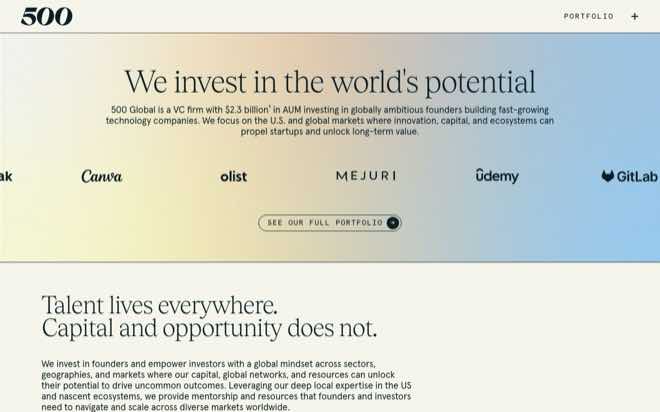
The flagship accelerator advertises $150K for 6%, runs about four months in Palo Alto, and sits on one of the largest early-stage portfolios in the world, with deep reach into markets outside the US. The terms land in the same neighborhood as Techstars, so the real comparison is the network you need: Techstars is strong in US cities and corporate partners, 500 is strong globally.
If your customers are in Southeast Asia, the Middle East, or Latin America, that difference matters more than a point of equity.
→ Best for: globally focused startups with early traction that want Valley access plus emerging-market reach.
6. On Deck (ODF)
On Deck is not an accelerator. It is a network that behaves like one.
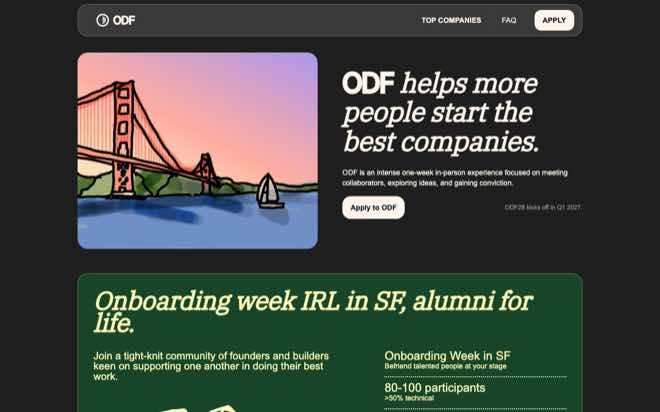
The Founders fellowship (ODF) runs pay-what-you-can with a suggested contribution around $1,000, takes zero equity, and gives you a one-week in-person kickoff in San Francisco plus a year-round online community of 3,000+ founders and over $800K in partner perks.
There is no funding and no curriculum. What you get is proximity: hiring leads, investor intros, and people one step ahead of you. The value scales with how much you put in, which is true of every community but especially true here.
→ Best for: founders who want the Techstars network effect without the Techstars cap table.
7. Founder Institute
Founder Institute is where you go before any of the programs above would take you.
It is a part-time, roughly four-month program you can run alongside a day job, built for people at the idea stage. The entrance fee depends on your chapter and signup date. 2026 listings range from $399 to $1,649. Graduates also contribute a small pledge to an equity collective shared with mentors and peers, reported around 2.5%, so read the current agreement at fi.co before you commit.
It will not fund you and it will not replace customers. What it gives you is deadlines, structure, and mentors while you still have a salary. For a working professional testing whether they are serious, that is the honest starting point.
→ Best for: pre-idea or idea-stage builders keeping their day job.
How to Pick Your Techstars Alternative
Ignore prestige. Match the program to the business you are building.
→ Bootstrapping toward $100K MRR with a paying customer? Profitable Founder Club. $97 against 5% of your company is not a close call.
→ B2B SaaS that wants funding without the unicorn mandate? TinySeed.
→ Swinging for venture scale? Y Combinator, and only then the Techstars tier.
→ No co-founder and no idea yet? Antler.
→ Global market, early traction? 500 Global.
→ Just want the network? On Deck.
→ Still employed, still exploring? Founder Institute.
FAQ
What is the best Techstars alternative for bootstrapped founders?
A founder community or mastermind beats an accelerator for most bootstrappers. Techstars' deal costs 5% plus a $200K uncapped SAFE, which only makes sense on a venture path. Profitable Founder Club gives you peer accountability, verified-revenue batches, and weekly hot seats for $97 a year with zero equity. TinySeed is the funded alternative if you need a check.
How much equity does Techstars take?
Techstars' standard 2026 package is $220K: $20K for 5% of your company, plus a $200K uncapped SAFE with an MFN clause that converts at your next priced round of $1M or more. Some regional programs use different amounts, so confirm the terms for your specific program before applying.
Are there Techstars alternatives that take no equity?
Yes. Profitable Founder Club ($97 a year, bootstrapped SaaS founders with verified MRR) and On Deck's founder fellowship (pay what you can, around $1,000 suggested) both take zero equity. Founder Institute charges a fee plus a small equity pledge, so it sits in between. Everything else on this list trades money for ownership.
Is an accelerator worth it for a SaaS founder?
It depends on your target outcome. If you want a $5M to $20M profitable business you control, giving up 10% or more early is expensive, and peer groups get you most of the benefit for a fraction of the cost. If you want venture scale, YC's $500K deal is the strongest offer. Run the equity math at your realistic exit, not the fantasy one.
I interview bootstrapped SaaS founders making $100K to $10M a year every week, and the pattern repeats: the founders who grow fastest rarely have the most funding. They have people around them who already solved the problem they are stuck on.
That is the whole pitch. If you have a paying customer and you are serious about $100K MRR, get on the Profitable Founder Club waitlist.
