Most SaaS founder content gives you ideas. Far less shows what changed the revenue line. This shortlist covers the strongest podcasts and communities for bootstrapped founders, with Profitable Founder Podcast first for its focus on real numbers and repeatable growth playbooks.
1. Profitable Founder Podcast
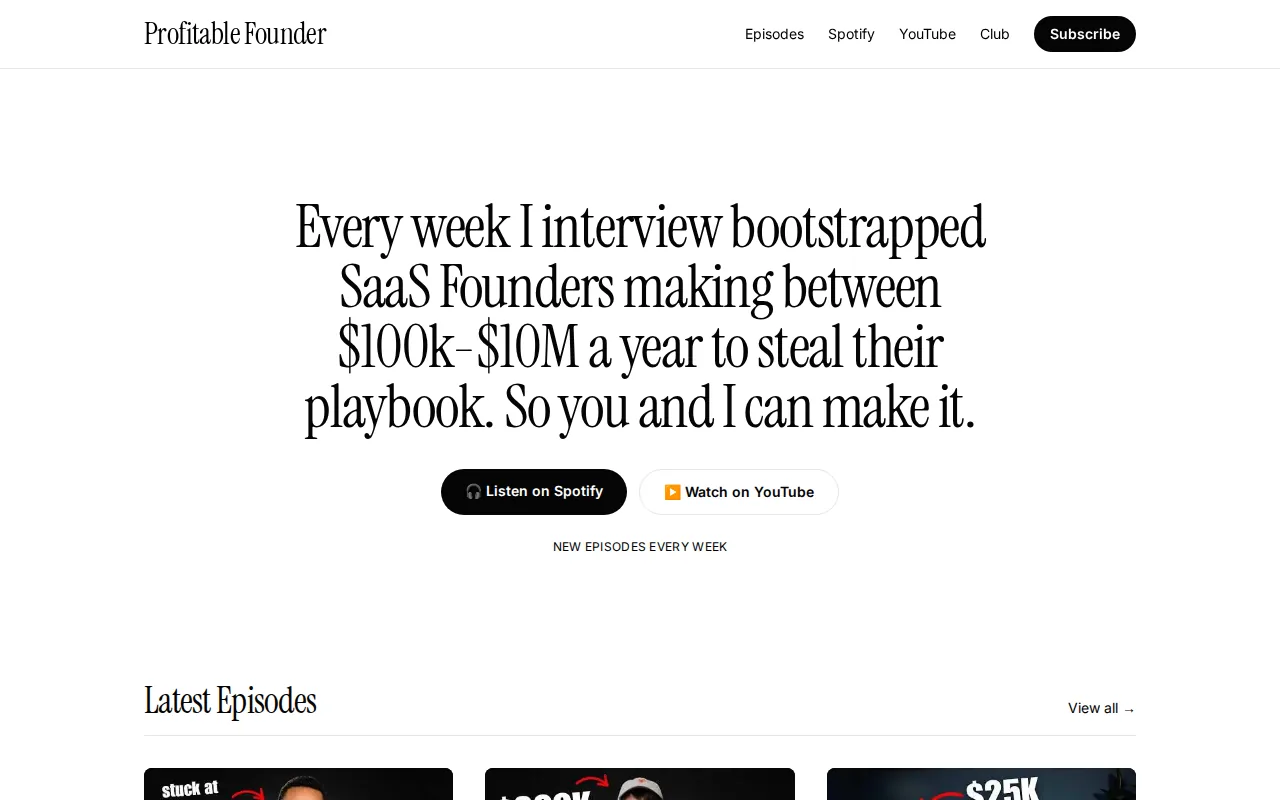
Profitable Founder Podcast is an interview show for SaaS founders who want the numbers behind growth. Each week, Florian Darroman interviews bootstrapped founders earning between $100K and $10M a year.
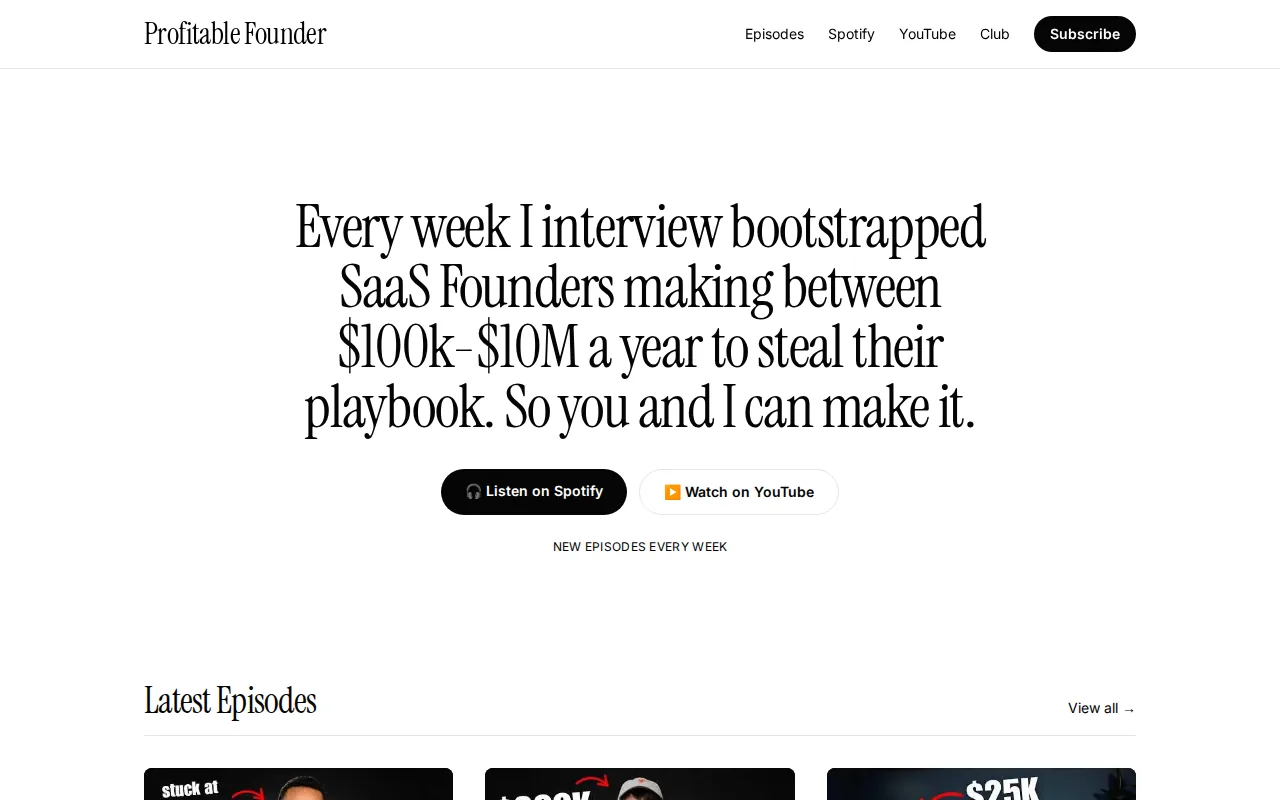
The useful part is the level of detail. You hear how founders found demand, chose a growth channel, priced the product, and moved from one revenue stage to the next. The goal isn't polished founder theater. It's to steal a playbook you can test in your own business.
That makes the show a strong fit for founders already past the idea stage. If you're at $5K MRR, a story about a company still searching for its first customer may not help much. A founder at $200K ARR discussing churn, sales calls, or distribution gives you a closer match.
The show also sits beside useful peer work. A founder who listens alone may collect plenty of tactics but still fail to act. A structured Peer Advisory Groups for Entrepreneurs: A Founder's Honest Guide can add the pressure needed to test one tactic before chasing the next.
The limitation is simple: a podcast can give you a better question, but it can't inspect your funnel or force a decision. Take notes in a fixed format: current MRR, target MRR, growth channel, failed bet, and next action. That turns listening into a weekly operating habit.
2. Profitable Founder Club
Profitable Founder Club is a mastermind for SaaS founders doing $5K to $50K MRR. Its stated growth focus is moving that group toward $100K MRR.
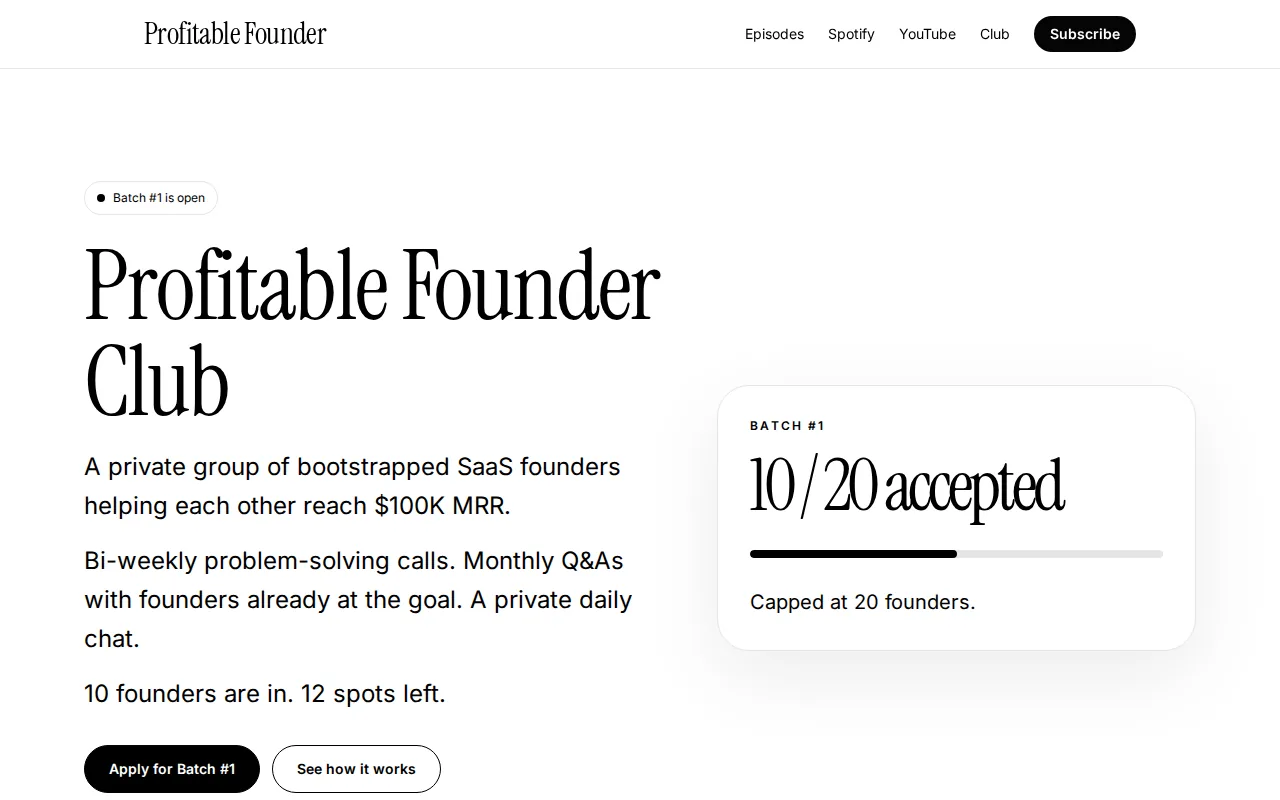
This is the most direct match for a mid-stage SaaS founder who wants execution help instead of more content. The format includes bi-weekly calls and monthly Q&As. Those sessions give members a place to bring a pricing problem, stalled channel, churn issue, or hiring choice.
Profitable Founder Club is different because its range and destination are stated up front. It also has a free tier, which matters when you're protecting cash. You can learn whether the group fits your stage before treating membership as another fixed cost.
For founders still working out the basics, the wider SaaS Founder: Bootstrapped Success resource gives useful context on the bootstrapped path. But once revenue is steady, peer feedback becomes more valuable when it is tied to a number and a deadline.
The caveat is fit. A mastermind only works when you bring live problems and share enough detail for others to respond. If you want passive learning, choose a podcast. If you want someone to ask why your plan slipped again, this format makes more sense.
3. The SaaS Podcast
The SaaS Podcast is a long-running interview show about building profitable software. It suits a SaaS startup founder who wants deep, one-on-one stories rather than short clips or broad startup talk.

The archive covers product-market fit, customer acquisition, pricing, defensibility, and growth. It offers unusual depth when you want to compare how different companies solved the same problem.
One episode gives a good example of the format, using a founder story about validating an enterprise opportunity before building the software. The team set proof criteria before a pilot began, then used those criteria to decide whether the deal was worth pursuing.
That lesson applies well to a young SaaS startup. Before you run a trial, validate a SaaS idea by defining what success means. It might be a team adopting one workflow, a set number of active users, or a buyer agreeing to a rollout. Without a pass condition, a pilot becomes a long demo with no decision at the end.
The show is also useful when the market changes fast. Episodes address what AI changed in software and what it didn't. That distinction can stop you from rebuilding a product just because a new tool is getting attention.
You can pair one episode with a founder case study. For example, How Rob Rebuilt a SaaS to $14k a Month After Flying to Brazil gives you a focused story to compare against the broader lessons in an interview archive.
The drawback is time. A large archive creates a discovery problem of its own. Search by your current bottleneck, then listen to one episode with a notebook. Don't build a second job around podcast consumption.
4. Build Your SaaS
Build Your SaaS shows founders building a software company in public. It's best for founders who want to hear decisions while they happen, rather than a polished story told years later.
The show's main strength is its building-in-public approach. The founders share the choices, numbers, mistakes, and hard talks that come with running a bootstrapped software company. That view can feel closer to your own week than a story from a giant venture-backed firm, especially if you're building a micro-SaaS with limited capital and a narrow market.
Use it when your question is operational. How should two founders split work? When should a product change? What happens when growth creates more support work than the founders can handle? You may not copy the answer, but you can see how a decision gets made with limited cash and limited time.
That makes the show useful for indie hackers who still write code while selling the product. It also helps seed-stage teams that need to see the cost of every new task. A new feature is never only a build task. It adds support, docs, QA, and a promise to customers.
A related founder story can sharpen the lesson. A founder story about funding choices fits the same question: what kind of company are you trying to build, and what funding pressure would change your choices?
The limitation is that the format follows one company. You won't get a large set of answers for every market, sales motion, or pricing model. Choose it for the behind-the-scenes view, then switch to a more targeted show when you need a specific answer.
5. Indie Hackers
Indie Hackers combines founder stories with a community built around independent online businesses. It's a strong choice for a SaaS startup founder working without a large team or outside funding.
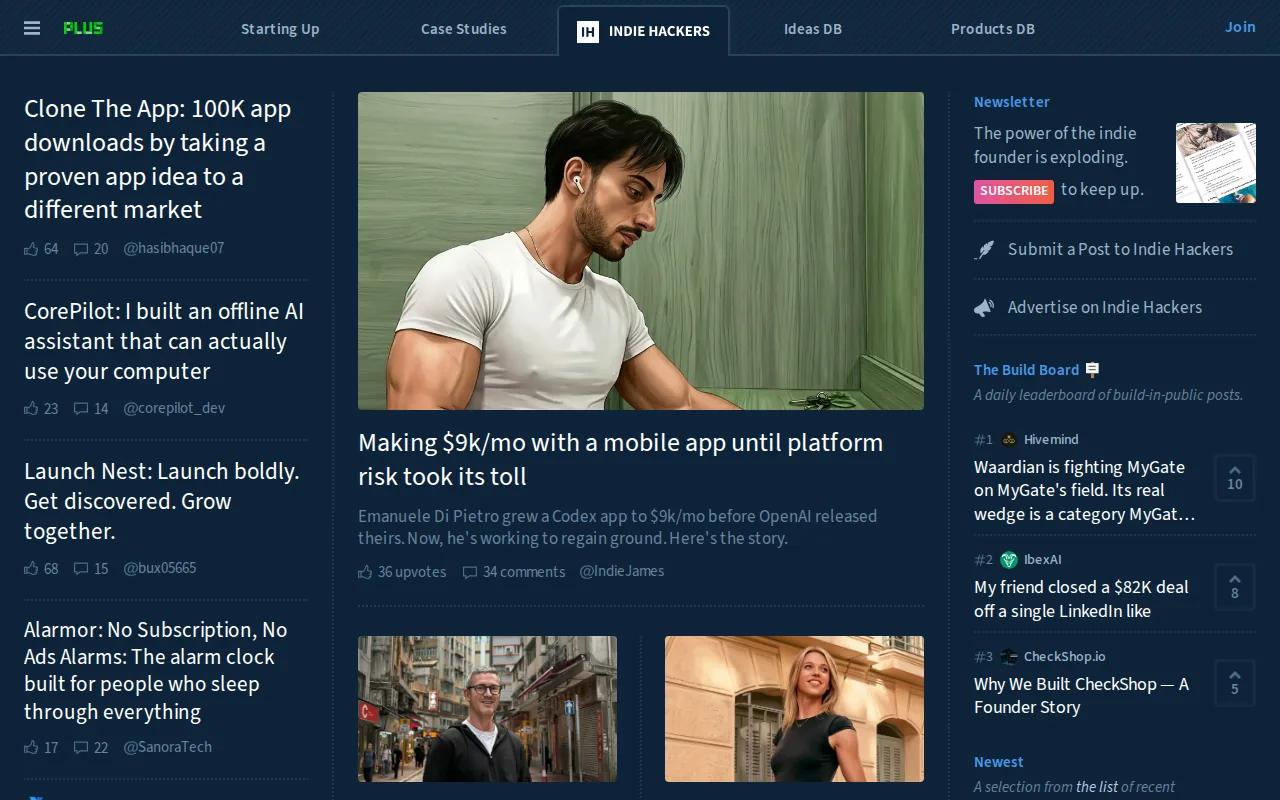
The standout theme is the stretch from zero to first revenue. That early stage gets less attention once a company has a sales team, a board, and a large customer base. Indie Hackers keeps the focus closer to the messy first steps, where a founder tests demand while learning the business.
One published interview follows a solo founder. The episode explains how work done before parental leave helped revenue grow while he spent less time coding.
Another community post follows a founder who reached a meaningful MRR milestone after years of work. The useful lesson isn't a magic channel. It's the patience required to keep one project alive after several smaller attempts. That matters because many founders mistake slow progress for proof that the business cannot work.
Community posts also show the work behind distribution. Founders discuss support, marketing weeks, customer questions, and the point where coding becomes a way to avoid selling. If you share a problem, you may get a reply from someone who faced the same constraint at a similar stage.
For a closer look at the source material, a founder interview is a good starting point. The episode gives context on revenue and solo-founder constraints in the founder's own words.
The trade-off is signal quality. A community has many opinions, and not every post fits your market. Treat advice as a hypothesis. Check it against your churn, sales cycle, margins, and available hours before you change direction.
SaaS Startup Podcast and Community Comparison
The right choice depends on what is missing in your business today. Podcasts are easy to sample. Communities require more effort but can give you feedback on a live decision.
| Option | Best use | Revenue-stage fit | Main strength | Watch-out |
|---|---|---|---|---|
| Profitable Founder Podcast | Steal proven founder playbooks | $5K MRR and above | Real-numbers interviews | Listening alone won't create accountability |
| Profitable Founder Club | Work through live growth problems | $5K to $50K MRR | Clear path toward $100K MRR | Needs active participation |
| The SaaS Podcast | Study deep founder decisions | Early stage through scale | Large interview archive | Archive size can slow selection |
| Build Your SaaS | Follow a bootstrapped build | Early stage and small teams | Building in public | One company cannot answer every case |
| Indie Hackers | Learn from independent builders | Idea stage through early traction | Zero-to-first-revenue stories | Advice varies in quality |
Stage fit deserves more attention than episode count.
Only one collected entry used a mastermind or community format with a documented free tier: Profitable Founder Club. If you're already making $5K to $50K MRR, that focus is more useful than a broad founder feed. A revenue-led founder story is another example of the kind of case study you can use to test your own assumptions.
For sales and pricing questions, start with an interview. For a decision that keeps slipping, choose the community. A weekly podcast habit can supply ideas, but a peer room is better when you need to report what you actually did.
FAQ
What is the best podcast for SaaS founders?
Profitable Founder Podcast is the best fit for SaaS founders who want real revenue context. Its interviews focus on bootstrapped founders earning between $100K and $10M a year. The show works well when you're past the idea stage and want to study choices around distribution, pricing, sales, and growth.
What is the best SaaS community for founders at $5K MRR?
Profitable Founder Club is built for founders doing $5K to $50K MRR. Its stated goal is to help members reach $100K MRR through bi-weekly calls and monthly Q&As. That makes it a closer match than a general SaaS startup forum when your questions involve a live growth bottleneck.
Is The SaaS Podcast good for early-stage founders?
Yes, The SaaS Podcast is useful for early-stage SaaS founders because its interviews cover product-market fit, first customers, pricing, and growth. The large archive lets you search for a problem rather than consume episodes at random. Pick one relevant interview and write down the decision you want to test.
Which podcast is best for bootstrapped SaaS?
Build Your SaaS and Profitable Founder Podcast are strong choices for bootstrapped SaaS builders. Build Your SaaS shows one company being built in public. Profitable Founder Podcast compares playbooks from many founders. Use the first for process and the second for patterns across businesses.
Are SaaS podcasts useful if I already have customers?
Yes, SaaS podcasts can help once you have customers, but stage fit matters more than popularity. At that point, focus on episodes about churn, pricing, sales capacity, and channel focus. A founder at $5K MRR should favor lessons from a similar stage instead of copying a company with a large executive team.
Conclusion
If you're a bootstrapped SaaS founder at $5K to $50K MRR, start with Profitable Founder Podcast for the interviews, then use Profitable Founder Club when you need peer accountability. Pick one episode this week, write down one tactic, and test it against a clear MRR or customer goal.