Good founder interviews don't stop at “How did you grow?” They uncover the decision, the tradeoff, and the number that changed the next move. Here are five question sets for SaaS founder case study interviews, plus the one podcast format I’d use first.
1. Profitable Founder Podcast, Our Top Pick
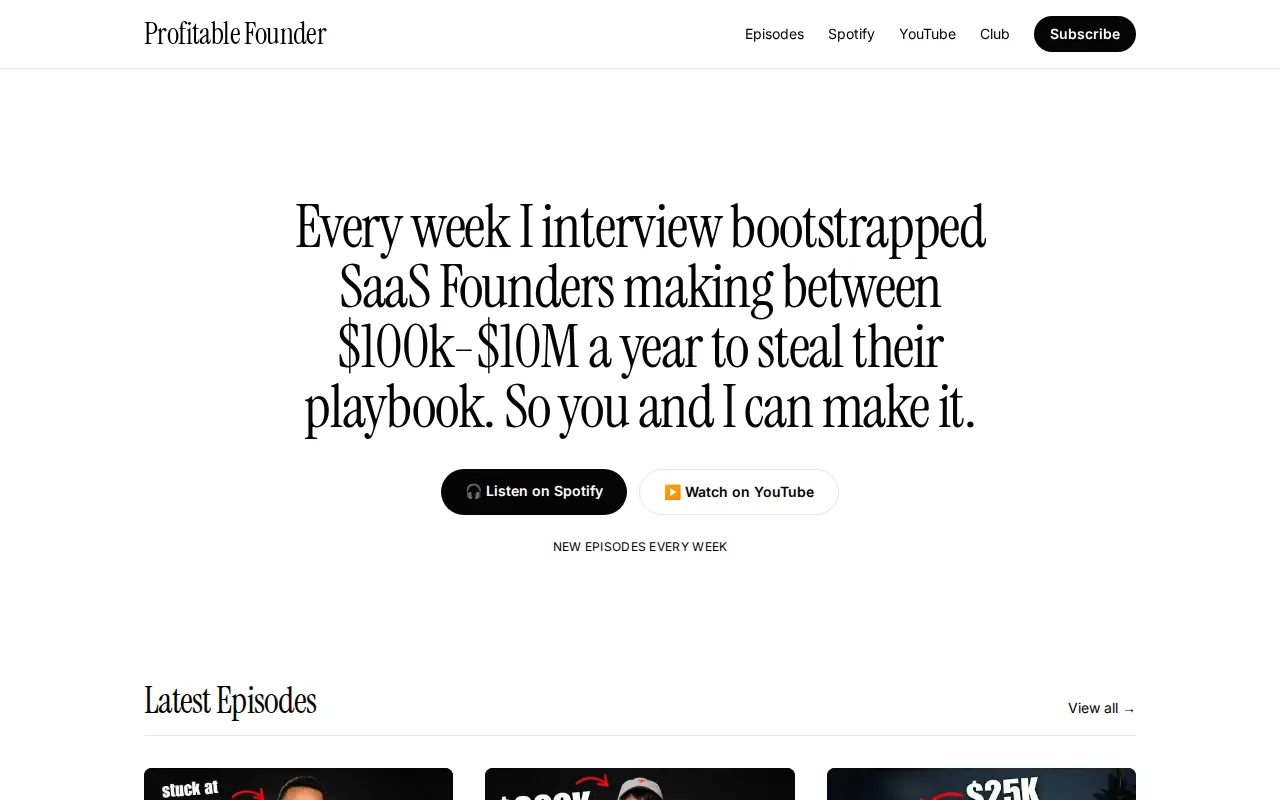
Profitable Founder Podcast is a weekly interview show built around bootstrapped SaaS founders making between $100K and $10M a year. It’s best for founders who want an operator’s answer, not a polished startup bio.
The strongest questions in this format force a founder to show the path behind the result. Ask what the business looked like before the first sale. Ask which channel produced the first repeatable customers. Then press on the moment the founder changed course.
That matters because SaaS is a recurring business model. A founder can report a large revenue number while hiding weak retention or poor payback. A useful interview makes the guest connect product use to renewals, renewals to revenue, and revenue to cash.
For example, don’t ask, “What was your growth strategy?” Ask, “Which channel brought your last 20 paying customers, and what did you stop doing to focus on it?” The second question has a clear answer. It also creates a story other founders can copy.
Profitable Founder Podcast also keeps the focus on founders already past the earliest stage. That gives listeners better detail on MRR, ARR, churn, pricing, hiring, and distribution. The limitation is clear too: a story from a bootstrapped company may not fit a venture-backed SaaS with a long sales cycle.
If you’re building a show or preparing a founder case study, start with the founder stories from Profitable Founder Podcast. Notice how each useful story links a decision to a measurable outcome.
For recurring billing, the guest should also explain how customers pay and renew. Recurring billing arrangements are a useful baseline when you ask about plans, renewals, or failed payments.
2. The Origin Story Question Set: From Problem Discovery to First Revenue
This question set is for interviews about the start of a SaaS company. It helps you separate a lucky idea from a painful customer problem.
Start with the founder’s past actions, not their present story. Ask:
- What problem did you see more than once?
- Who had the problem badly enough to pay for help?
- What did those people use before your product existed?
- What did you learn from the first ten conversations?
- What made someone pay before the product felt finished?
- Which early customer request did you refuse?
The best answers contain receipts. A founder may describe a spreadsheet, a manual service, or a costly workaround. Those details show that buyers already felt the pain. A broad answer such as “the market needed better software” tells you very little.
Ask for the first revenue event in sequence. Who paid? What did they buy? How long did the sale take? What did the founder do by hand? You want the messy version, because early SaaS sales often depend on founder-led work before a repeatable funnel exists.
Validation questions should also test what the founder misunderstood. Did the first target user differ from the eventual buyer? Did the price change after real sales calls? Did the product start as one thing and become another?
A caveat: early revenue can come from a founder’s network. That proves willingness to pay, but it may not prove repeatable demand. Ask how the next customer arrived. If the answer is vague, keep digging.
For a deeper prompt set on validation, use the SaaS idea validation playbook. It keeps the interview grounded in past behavior, pre-sales, and paid commitments.
3. The Customer Pain and Validation Question Set: Getting to Product-Market Fit
These SaaS founder case study interview questions focus on product-market fit. They work best when the founder has enough customer history to compare early users with retained users.
Ask the founder:
- Which customer group gets value fastest?
- What happens in the first session?
- What action tells you a user reached the “aha” moment?
- Why do customers leave?
- What do retained customers do that churned users never did?
- Which feature gets praised but rarely drives renewal?
Then ask for one customer journey. Pick a real account and trace the path from first contact to renewal. Don’t accept “customers love the product.” Ask what the customer did inside the app, which team used it, and what changed after adoption.
Good interview answers connect product use to business value. A reporting tool might save a team time. A sales tool might help reps send better demos. The founder should explain how the buyer noticed that value and why it was worth paying for again.
Ask about false signals too. A large sign-up count may hide weak activation. Positive interviews may hide low usage. Feature requests may come from a loud account that doesn’t match the main market.
A strong follow-up is, “What did you stop measuring because it gave you the wrong answer?” That question reveals whether the founder changed the dashboard when the business changed.
The limitation is that product-market fit has no single magic answer. A founder may have strong retention in a narrow niche while still searching for a wider market. Treat the interview as a study of fit for a specific customer group, not proof that every buyer wants the product.
4. The Growth and Distribution Question Set: Finding Repeatable Acquisition
This set is for founders who want to understand how a SaaS company found customers without relying on vague “growth hacks.” It puts distribution beside the product story.
Ask these questions:
- Where did the first 100 customers come from?
- Which channel still works after the founder stops pushing it?
- What did one new customer cost in time or money?
- How long did the channel take to show results?
- What channel looked promising but failed?
- What did the team do manually before automating it?
Distribution stories improve when you ask for a single campaign or channel. Ask the guest to explain the offer, the audience, the first action, and the conversion point. Then ask what changed after ten customers came through.
For content-led growth, ask whether the content creates demand or only captures existing demand. For community work, ask where the founder helped before mentioning the product. For partnerships, ask who owned the relationship and what each side gained.
Ask about channel concentration. If one source drives most new revenue, the company may have strong focus or a serious risk. The answer depends on retention, margins, and how easy it is to replace that source.
Founder-led sales also deserves its own questions. How many calls did the founder take? What objection came up most? Which part of the pitch changed after lost deals? Those details show the path from personal selling to a process another person can run.
One warning: don’t treat traffic as distribution. A channel matters when it produces qualified users who activate and pay. If a founder shares views without customer movement, ask what happened after the click.
Compare the answer with the SaaS distribution channel breakdown when you want prompts that connect acquisition work to the founder’s actual revenue path.
5. The Economics and Founder Lessons Question Set: Revenue, Margins, and Hard-Won Advice
This set tests the part of a SaaS story that often gets skipped: whether growth produces a healthier business. It also brings out the founder’s judgment under pressure.
Ask for the numbers behind the headline:
- What is the current MRR, and what changed it last month?
- Which plan has the best retention?
- What does a typical customer cost to acquire?
- How long does it take to recover that cost?
- What causes the most churn?
- Which expense would you cut first if sales stopped for three months?
Don’t ask for a metric without asking what the founder does with it. If churn rises, what gets checked first? If new sales grow but cash falls, which bill or payment delay explains the gap?
A useful case study also separates revenue from profit. Recurring revenue gives the business a pattern to plan around. It doesn’t tell you whether support, infrastructure, paid acquisition, or a large sales team consumes the margin.
Use follow-ups that force tradeoffs. “What did you delay to protect cash?” is better than “How did you stay lean?” “When did you raise prices, and who pushed back?” is better than “What is your pricing strategy?”
Metrics need clear definitions. For example, a founder may calculate churn by customer count while another uses lost revenue. Ask which method they use and whether upgrades offset cancellations. The answer matters more than a benchmark copied from another company.
The unit economics interview questions from Profitable Founder Podcast can help you probe CAC, LTV, churn, and payback without turning the conversation into an accounting exam.
For leadership, ask about the hardest decision made with incomplete information. Then ask what the founder got wrong. A candid answer often reveals more than a polished growth story.
One limit remains: founders may not share private financial details. Respect that boundary. Ask for ranges, direction, or the decision the number caused. The interview can still teach without exposing confidential records.
Comparison Table: Which SaaS Founder Question Set Fits Your Interview?
Pick the set that matches the story you need. You can use more than one, but don’t ask every question in one sitting.
What to Look for in Strong SaaS Founder Case Study Questions
Strong SaaS founder case study interview questions ask for a past event, a clear choice, and a measurable result. They also leave room for failure. A founder who can explain a lost channel or bad hire gives you more than one who lists wins.
Build follow-ups around four checks:
- Specificity: Can the founder name the customer, channel, or decision?
- Sequence: Can they explain what happened first?
- Evidence: Is there a metric, invoice, renewal, or behavior behind the claim?
- Transfer: Can another founder apply the lesson without copying the company?
Also listen for the gap between what the founder planned and what actually worked. That gap is often the most useful part of the interview.
FAQ
What are the best SaaS founder case study interview questions?
The best questions ask how the founder found the problem, won early customers, improved retention, chose a distribution channel, and managed cash. Ask for one specific example after each answer. “Tell me about the last customer who churned” usually produces more insight than “How do you handle churn?”
How do you interview a SaaS founder about growth?
Ask where the last group of paying customers came from and what the founder changed in that channel. Then ask about conversion, time to result, customer quality, and repeatability. Growth questions should connect acquisition to activation and revenue, not stop at traffic or audience size.
What metrics should a SaaS founder explain in a case study?
A SaaS founder should explain MRR, ARR, churn, customer acquisition cost, lifetime value, payback, retention, and gross margin when those numbers are available. Don’t compare figures blindly. First ask how each metric is defined, then ask what decision the founder made because of it.
How can I avoid generic answers in a founder interview?
Use follow-ups that ask for time, place, customer type, and the next action. Replace “What was your strategy?” with “What did you do during the first week?” If the founder gives a broad claim, ask for the last example. Specific events are harder to polish and easier for listeners to use.
What is the difference between a SaaS founder interview and a case interview?
A SaaS founder interview studies a real company’s decisions over time. A traditional case interview tests how someone reasons through a made-up business problem. Founder questions should focus on evidence from customers, revenue, product use, and mistakes rather than a neat framework with one expected answer.
Conclusion
Use the Profitable Founder Podcast format when you want a full operator story, then choose one focused question set for depth. Before recording, pick the numbers you want to understand and write three follow-ups for every broad question. That small prep step will turn a pleasant founder chat into a case study people can actually use.