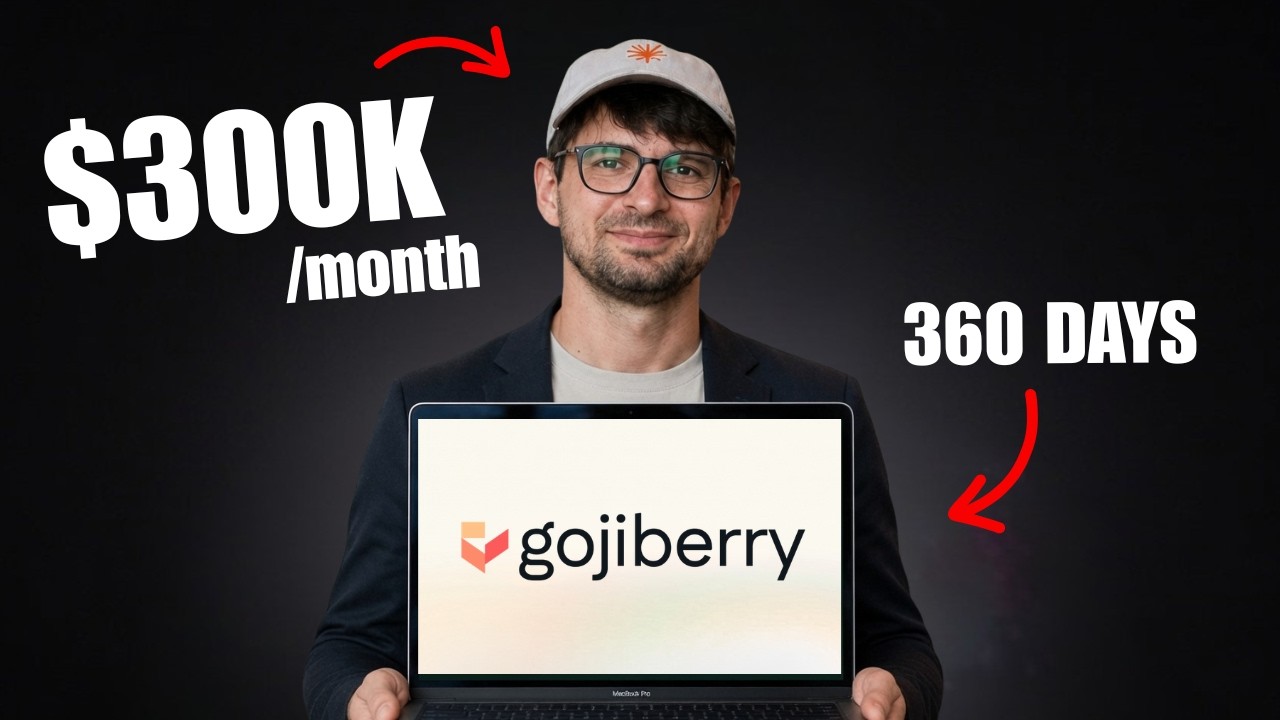
Six months after our first interview, Romàn Czerny came back with a very different Gojiberry.
In the first episode, he said the company had reached $50K MRR. In this follow-up, he told me Gojiberry had reached $300K MRR. That is his reported number, not mine, and the useful part is not the headline. It is how his distribution system changed at every stage.
Gojiberry is an AI go-to-market agent for B2B teams. It finds prospects showing intent, enriches them, runs outreach, follows up, and helps book meetings. Romàn did not grow it with one magic channel. He kept adding channels, then cut the ones that stopped paying back.
The channel changed at every revenue stage
Romàn broke the first part of the growth curve into a simple ladder:
- $0 to $6K MRR: outbound
- $10K to $25K MRR: mostly Reddit
- $25K to $75K MRR: content and free blueprints
- $75K to $150K MRR: partnerships, X, B2B creators, sponsored newsletters, and a lifetime affiliate program
The numbers and attribution are Romàn's account from the interview. The point is the sequence. A channel that gets you out of zero may not be the channel that carries you through the next plateau.
Too many founders find one thing that works and turn it into an identity. Romàn treated every channel as a job with a shelf life. When it was working, the team pushed it. When the return fell, they moved attention somewhere else.
Why Gojiberry stopped doing Reddit
Reddit helped earlier. By the time Gojiberry was around $250K MRR, Romàn said the team stopped posting there.
His reason was not that Reddit had become useless. It was opportunity cost. Getting a few extra thousand dollars in MRR took too much team time compared with B2B creators, UGC, and other channels. He also admitted the team had pushed promotion too hard and created some hate around the brand.
There was another signal that made the cut easier: customers had started discussing Gojiberry on Reddit without the team planting every post. The channel had shifted from founder execution to organic word of mouth.
A channel can still work and still be the wrong place to spend the next hour.
Test the channel yourself, then delegate the blueprint
Romàn still runs growth, but he does not execute every channel alone. His process is to test a channel himself, learn what wins, write the blueprint, and then give repeatable execution to a specialist.
He said Gojiberry uses agencies for B2B influencers, SEO, UGC, and content. Outbound is handled differently, with internal support. He still rewrites much of the founder-led content because an agency cannot know what is inside a founder's head.
This is the distinction I liked most: he does not outsource discovery. He outsources repetition after he knows what good looks like.
The creator-to-paid distribution loop
For the next stage, Romàn described a three-part paid distribution system.
- Create short-form UGC for TikTok and Instagram. When a post proves it can travel organically, turn it into a Meta ad.
- Pay B2B creators on LinkedIn to distribute useful lead magnets connected to the product.
- Use paid quote-retweets on X to amplify launches and product videos.
Romàn said his early X tests cost roughly $1,000 to $3,000 and could create a viral product video. That is his result, not a benchmark every founder should copy. His own warning at the end of the conversation was clear: this playbook fits Gojiberry, but it will not fit every SaaS.
The part worth stealing is the order. Prove a message with organic distribution first. Then pay to scale the message that already earned attention.
Blueprints were the biggest growth lever
When I asked which channel had been the most profitable, Romàn came back to free blueprints.
Gojiberry did not publish another generic guide about getting leads. The team connected its core problem to the fastest-moving adjacent topic: AI. Instead of only teaching outreach, it taught people how Claude, ChatGPT, and AI agents could help them find better leads.
That broadened the audience. AI creators had a reason to share it. Outreach operators still recognized the underlying problem. People who would never stop for another sales post became curious about the AI angle.
Romàn also named the downside. A broader audience can create more reach and more churn at the same time. Smaller teams and individual users may sign up quickly, but retention gets harder. Reach is not the same thing as customer quality.
What Y Combinator changed
Gojiberry joined Y Combinator's Spring 2026 batch. Romàn said the YC badge created exposure and credibility, but the bigger change was the environment.
He spent the batch in San Francisco with his co-founders, met other founders, worked with YC partner Andrew Miklas, and saw companies operating at a scale he had not considered normal before. His practical takeaways were much less glamorous:
- Talk to customers before building features.
- Do not spend money when the return is not there.
- Do not hire too quickly.
- Move quickly when a hire is clearly not working.
Those are basic ideas. The difference is having an experienced operator apply them to your exact company when you are moving fast.
The measurement gap he did not hide
I asked whether changing Gojiberry's homepage to an AI agent message improved conversion.
Romàn said he did not know.
Traffic sources were changing at the same time as the copy, and the company did not have the tracking in place to isolate the effect. He knew the landing page converted well. He could not honestly claim how much the positioning change caused.
That answer matters. The company had a strong growth story and he still refused to invent precision. Founders should do the same. If three variables changed at once, do not turn correlation into a case study.
The playbook, without copying it blindly
Romàn's system is not "post on LinkedIn" or "make AI content." It is an operating loop:
- Use a direct channel to learn the buyer.
- Turn what works into a repeatable blueprint.
- Expand distribution through creators and affiliates.
- Promote organic winners with paid spend.
- Cut channels when their opportunity cost gets too high.
- Keep the claim honest when tracking cannot prove causation.
At the end of the interview, Romàn refused to tell every founder to copy him. Different products need different channels. His advice was to inspect what worked for Gojiberry, reproduce only the parts that fit your market, and leave the rest.
That is the real lesson from $50K to a reported $300K MRR. Distribution is not a checklist. It is a sequence of bets, measurement, delegation, and cuts.