Most podcasters spend weeks cold-emailing SaaS founders and hearing nothing back. The faster path is a three-channel system: start with the people already in your corner, then pull inbound interest through content, and use paid ads to fill any gaps fast. Here's the exact playbook, step by step.
Step 1: Start With Your Personal Network First

Your network is the fastest pipeline you have. Not because those people are an easy "yes," but because the barrier to a reply is nearly zero. They already know you. They trust you. One personal message beats fifty cold emails every single time.
The move here is simple. Open your contacts, your LinkedIn connections, your Twitter DMs, and your email inbox. Write down every SaaS founder you've had a real conversation with in the last two years. You're looking for people already making between $5K and $10M a year, because that's the range your audience at Profitable Founder Podcast tunes in for.
Don't start with your most impressive contacts. Start with founders one level below the top of your wish list. The founder doing $30K MRR who nobody's asked yet will say yes much faster than the one with 50K Twitter followers getting pitched daily. They're also better guests. More honest. More specific. Their numbers are fresh and their lessons are recent.
Here's the ask that works. Keep it short. Something like: "30 minutes, I send you the questions in advance, you don't have to prep, and I'll cut you three vertical clips for your own socials." You're not asking for a favor. You're handing them content they'd otherwise have to make themselves.
One more thing: end every recording with one question before you hang up. "Who's one founder I should have on next?" A warm referral from a guest you just recorded with converts far better than any cold outreach. That single question, asked consistently, builds a referral chain that runs itself over time. Trust between people who already know each other dramatically increases the likelihood of a positive response, which is exactly why warm introductions outperform cold contact in guest acquisition.
Step 2: Use Content Marketing to Attract Inbound Guest Requests
The research behind this guide identifies content marketing as one of three equally effective tactics for landing podcast guests fast. The idea is straightforward: when you publish content that SaaS founders genuinely find useful, the right guests come to you. You stop chasing and start attracting.
The content that works best for this is specific. Not "5 tips for SaaS founders." More like "How this founder hit $20K MRR with zero paid acquisition" or "The retention playbook that took this bootstrapped tool from $8K to $40K MRR." Founders who see that content think one of two things: "I want to share my story like that," or "I know someone who should be on this show."
Clip every episode hard. Pull two or three short moments per guest and post them on LinkedIn and X. Tag the guest. When their followers see the clip, some will DM you asking how to get on the show. That's inbound. It doesn't cost you anything except an hour of editing.
Your show notes and episode titles matter too. Podcasting platforms function as search engines. Name your episodes with real terms founders search for, like "bootstrapped," "MRR," and "churn." Founders searching those terms find your show, listen, and sometimes reach out to pitch themselves as guests.
Beyond clips, repurpose each episode into a LinkedIn post about the best insight from that conversation. Link back to the episode. This builds a public record of the kinds of conversations you host, which signals to prospective guests exactly what they'd be signing up for. That clarity reduces hesitation. Trust between nodes in a network dramatically increases the likelihood of a warm introduction converting — which is why a visible content trail matters. You can see how one episode can feed 150 pieces of content in the breakdown inside the Profitable Founder Podcast content flywheel guide.
Content marketing works slowly at first and then compounds fast. Most hosts underestimate the lag. Plan for 60 to 90 days before inbound requests become a steady drip. But once they do, you spend almost no time recruiting guests at all.
Step 3: Run Targeted Ads to Fill Your Guest Pipeline Fast
This one surprises most hosts. Running ads to attract podcast guest requests sounds backwards. Why pay to get guests? Because it's the fastest channel of the three, and when your pipeline is empty and you need to book two episodes this week, speed matters more than cost.
The mechanic is simple. You run a short ad aimed at SaaS founders in your target MRR range, with a clear message: you're booking guests for a show that interviews bootstrapped founders, and here's what they get out of it. The call to action is a landing page where they can apply or request a booking link.
On X (formerly Twitter), you can reach the build-in-public crowd at very low cost. One-cent max CPC bids on a normal-looking post that says something like "just wrapped a 30-minute interview with a founder who went from $0 to $15K MRR in 8 months, looking for my next guest" can drive link clicks for a fraction of what LinkedIn ads cost. LinkedIn ads are more expensive but let you filter by job title and company size, which is useful if you want to target founders at specific revenue stages.
The targeting matters more than the creative. Keep the ad copy short. Founders don't read long ads. Two sentences max: what the show is, what the guest gets. Then link to the application page. The goal is meeting requests, not brand awareness.
Budget-wise, even $5 to $10 a day for two weeks can fill a pipeline of five to ten qualified applicants. You don't need to run this channel forever. Use it to fill gaps when your network and content channels are producing less than you need. Think of it as a tap you turn on and off based on how full your guest pipeline is. For a deeper look at how paid media fits into a full guest acquisition strategy, check how similar digital marketing targeting principles apply across industries, like how Google Ads management uses precise audience filters to drive appointment requests rather than general traffic.
Step 4: Craft a Guest Pitch That Gets a Yes in 24 Hours
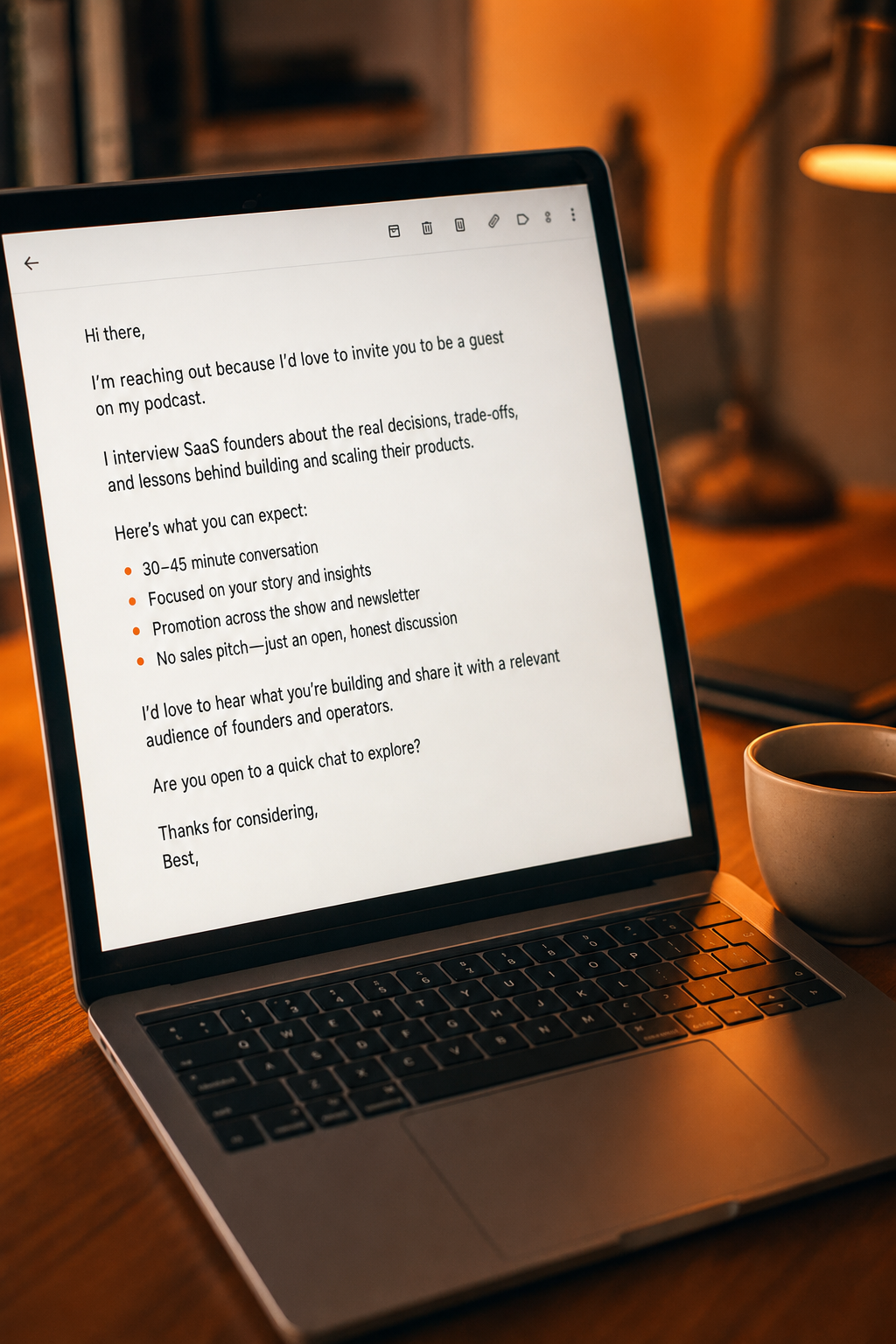
The fastest way to kill a good lead is a bad pitch. Most podcast pitches fail not because the show is wrong for the guest, but because the message is too long, too vague, or too focused on what the host wants instead of what the guest gets.
Here's the structure that gets a yes fast. Five lines. No more.
- Line 1: One specific thing about their work. Not "I love your content." Something like: "Your post about cutting churn from 8% to 3% at $25K MRR was the most honest breakdown I've read this year."
- Line 2: Who you are in one sentence. Revenue, traction, or the specific audience you serve. "I host a weekly show for bootstrapped SaaS founders between $5K and $10M ARR."
- Lines 3-4: Two or three topic angles they could speak to. Specific ones with numbers attached. Not broad themes.
- Line 5: The easy ask. "Would any of these fit? Happy to send more. You'd get three short clips for your own channels."
Keep the whole thing under 150 words. That's the constraint that forces you to be specific. If you're going over 150 words, you're explaining too much. Founders read fast and decide fast. Make saying yes a one-word reply.
The subject line matters as much as the body. Six to ten words. Include the show name or the topic angle. "30-min interview on your $0 to $25K MRR story" beats "Podcast opportunity" by a wide margin. For the full pitch framework, including exactly what to include in your media kit before you send anything, the complete guide to pitching a SaaS founder to a podcast covers the whole sequence.
Follow up once. Five to seven business days after the first message. A short note, under 50 words, that references the original pitch and adds one new angle if you have it. If there's still no reply after the follow-up, move on. Chasing a third time rarely works and damages the relationship for the future.
Step 5: Build a Repeatable System So You Never Run Out of Guests
The problem most hosts hit isn't booking the first ten guests. It's keeping the pipeline full at episode 40. That's when outreach fatigue sets in and the feed goes quiet. The fix is building a system before you need it, not after you're already behind.
Keep a simple guest tracker. A spreadsheet with four columns is enough: name, contact info, status (contacted, confirmed, recorded, published), and who referred them. Update it after every outreach session. This makes your pipeline visible. When it drops below three confirmed guests, you know to switch a channel on before you have a gap in your feed.
Set a recurring weekly block. Thirty minutes, same time each week, dedicated to outreach. During that block, send five new pitches and move any existing leads forward. That rhythm produces 20 outreach attempts a month. At a 20-30% reply rate, that's four to six conversations a month, which is more than enough to fill a weekly show.
Rotate your guest sources. One week focus on referrals from recent guests. The next, post on LinkedIn asking founders to apply. The week after, run a short ad burst. Rotating keeps each channel warm without burning any one of them out. It also means a dry spell in one channel doesn't stop the whole machine.
The Profitable Founder Podcast runs this exact multi-channel model. Personal network for the first batch of guests, content to build inbound over time, and ads as a backup when the pipeline needs a fast top-up. If you're earlier in the journey and still building your show from scratch, the full guide to booking SaaS founders on your podcast covers seven specific tactics you can layer into this system.
One last thing: make the guest experience so good that referrals happen without you asking. Send questions 24 hours in advance. Do a quick tech check before you hit record. Deliver clips within a week of the episode going live. Founders who feel respected talk about it. That word-of-mouth is the most efficient guest acquisition channel there is, and it costs you nothing but professionalism.
FAQ
How long does it take to book your first SaaS podcast guest?
If you start with your personal network, you can book your first guest within 48 hours of sending your first message. Network contacts already trust you, so the barrier to a yes is low. Cold outreach through content or ads takes longer, typically two to four weeks before you see confirmed bookings. Combining all three channels from the start gets you to a full guest schedule the fastest.
Do I need a big audience to attract good podcast guests?
No. Most SaaS founders care more about what they get from the appearance than your download count. If you offer short clips they can use for their own content, a clear and specific audience, and a professional recording experience, founders at the $5K to $50K MRR range will say yes even if your show is new. Focus on the value exchange, not vanity metrics.
How do I find SaaS founders to pitch as podcast guests?
Search X and LinkedIn for founders posting real MRR numbers using terms like "bootstrapped," "MRR," "just hit," or "indie SaaS." Check communities you're already in. Ask each guest you record with for one referral before you hang up. Running a short targeted ad on X or LinkedIn with an application link also surfaces founders who are actively interested in appearing on shows.
What should I offer a SaaS founder to get them to say yes?
Three things work: send questions in advance so they don't have to prep cold, keep the recording to 30 minutes or less, and deliver three to five short video clips they can post to their own channels within a week. Founders are busy. When you reduce friction and hand them content they'd otherwise have to create themselves, the yes comes fast.
How many outreach messages should I send per week?
Five is a good weekly baseline. At a 20-30% reply rate, that produces one to two conversations per week, which is enough to fill a weekly show with some buffer. If you're launching a new show and need to build a backlog fast, bump it to ten per week for the first month. After that, drop back to five and let referrals and inbound content fill the gaps.
Conclusion
The fastest path to a full guest pipeline combines all three channels: your personal network for quick wins, content marketing for long-term inbound, and targeted ads when you need to move fast. Start this week by writing down ten founders in your network and sending all ten invites before Friday. That one action puts you ahead of most shows still waiting for guests to magically appear.