They were stuck in Bali with a few thousand dollars left and not even enough cash to buy plane tickets home.
So they gave themselves one last shot. One product. One channel. If it didn't work, they'd quit the industry for good.
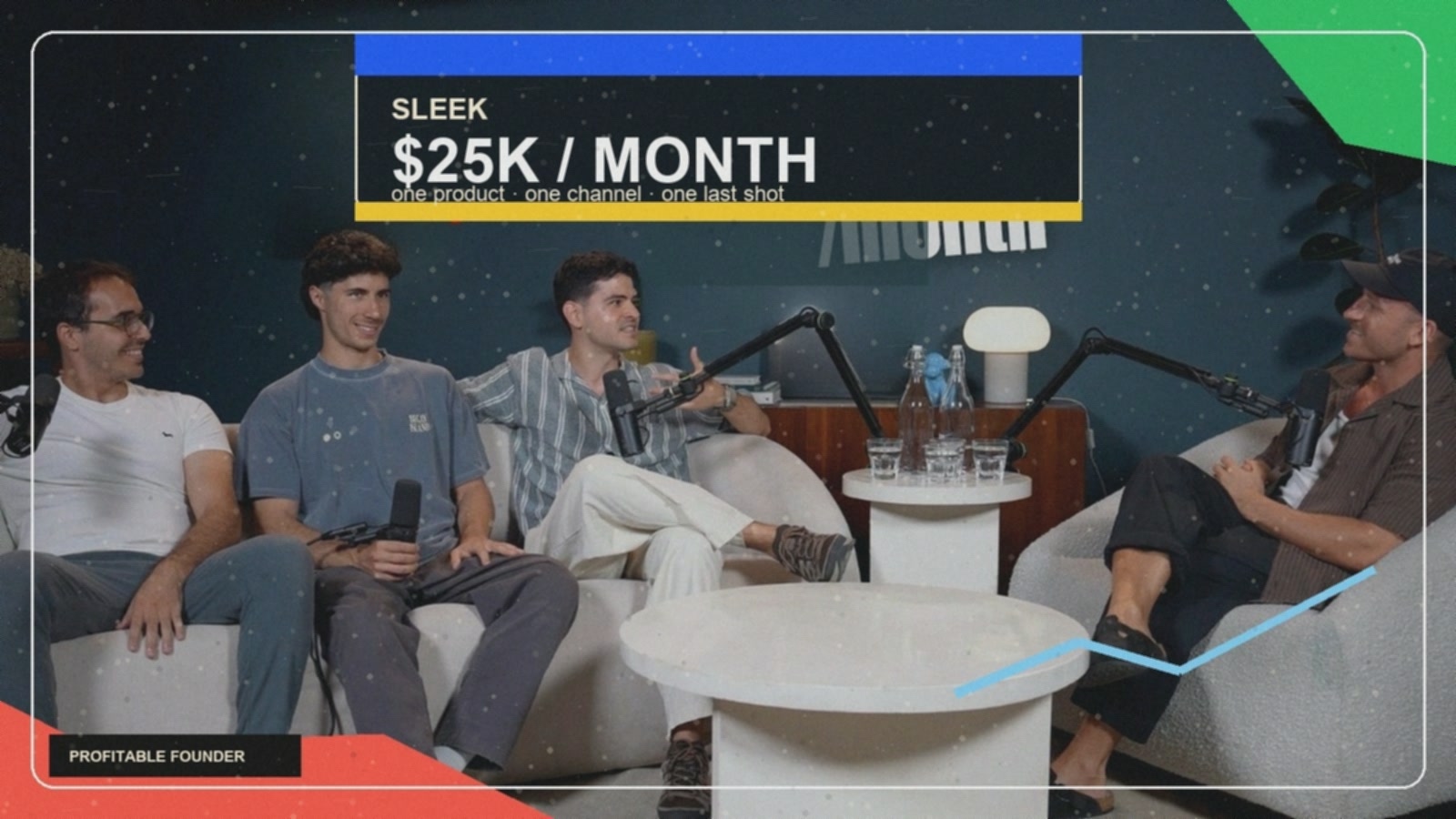
Six months later, that product, Sleek, was doing $25,000 a month. It hit $10K MRR in four weeks. And about 80% of the revenue came from a single place: X.
Oh, and along the way they turned down an acquisition offer from Vercel.
I sat down with the three founders of Sleek on the Profitable Founder Podcast. Here's the full playbook.
Before Sleek, there was a year and a half of failure
This was not an overnight success. (I wish it was, they told me.)
Their first product was Reweb, a visual editing tool for Next.js. Think Framer. It got some early traction. Then the AI wave hit.
Lovable. v0. Cursor. All launching around the same time. And Reweb had no real AI features.
So they pivoted. They listened to every user. Built features for devs. Built features for designers. Built features for non-technical people.
The product was cool. But it wasn't made for anyone specifically. So nobody truly loved it.
The expensive lesson: build for one person
They burned through versions. Reweb 1.0. A short-lived landing page builder (they bought the sleek.design domain here and spent more on it than they made). Then Reweb 2.0, "Cursor meets Figma."
That Cursor-meets-Figma tweet went viral. Traffic poured in. Conversions didn't.
The root problem never changed → no clear ICP. People didn't feel it was built for them.
This is the scary part most founders skip. Targeting one person feels like leaving money on the table. But going broad is exactly why nobody was converting. If you're wrestling with the same fear, this is the core idea behind learning how to build a micro-SaaS that someone actually loves.
The last shot: niche all the way down to mobile
Broke in Bali, they did the opposite of everything before. They sat down first and asked: who is this for?
They even posted it on Hacker News. "This is our last shot. Sleek, a mobile app design tool. We gave ourselves until the end of the year."
Here's how they narrowed it:
→ From general design tool (web, mobile, apps) to mobile only
→ Mobile apps were trending, everyone's friends were building them
→ Almost nobody made design tools just for mobile
→ Then narrowed again to non-technical founders
→ The kind using vibe-coding tools that ship great backends but ugly design
The full ICP in one sentence: Sleek helps non-technical founders with no design background get beautiful mobile app designs from a few prompts, before they even launch.
That sentence changed everything. Once you know exactly who you're targeting, you know exactly what content to make.
One channel: how they went systematically viral on X
The plan was simple. Spend their last few thousand dollars paying creators, then see what happens.
But first they launched on X. The mechanic: replies feed the algorithm, so they engineered comments.
The product was already live in their bio. But the tweet said "comment 'sleek' to get access" with a catchy hook ("the fastest way to vibe design mobile apps") and a slick demo video.
People flooded the replies asking for access. Then they revealed it was already public. That launch tweet pulled around 600K impressions and made roughly $2K MRR in the first 48 hours.
The conversion trick: a tiny free trial with a real wow moment. Your design generates piece by piece, live. Two screens shown, two locked (already generated behind the scenes, you could even un-blur them in the inspector). Wow effect plus curiosity.
Their repeatable X templates:
→ "Comment your mobile app idea, we'll design it free" (done manually, project handed back in Sleek)
→ Post a design with the prompt in the comments (people bookmark these for later)
→ Compare designs across models (ChatGPT, Gemini, Grok) every time a new model drops, riding its launch virality
→ "One of these is by AI, one by a real designer, guess which"
When virality backfires (and when it pays off)
One model-comparison post got reposted, then Elon Musk reposted it asking about Grok. It hit over 1.5 to 2 million impressions.
And it converted the worst ever. (When Elon retweets you, you're reaching everyone except your ICP.)
But virality opens doors money can't. Creators made Instagram Reels about Sleek without being paid. And Starter Story reached out to feature them in a build tutorial.
That video now has around 120K views. The angle was genius: not a 10-minute product demo, but a full workflow, idea to finished app, with Sleek as the design step. To a beginner, that makes you the go-to tool.
Their estimate: 100 to 150 customers from that one video. Roughly $4-5K MRR.
They're now eyeing SEO and AI search (Reddit, getting cited by ChatGPT) as the channel to break past X's ceiling, since X tops out and burns brand reach on the wrong audience.
I interview founders like this every week → Watch the Podcast
Frequently Asked Questions
What is Sleek and who is it for?
Sleek (sleek.design) is an AI mobile app design tool for non-technical founders without a design background. You type a prompt and get beautiful mobile app screens generated in real time, which you can take to your favorite vibe-coding tool or open in Figma to keep refining.
How much money does Sleek make?
Sleek went from zero to $10K MRR in about four weeks and reached roughly $25,000 a month within six months of launch. Around 80% of that revenue came from organic distribution, mostly X, with no spend on ads.
Did Sleek's founders really turn down an acquisition?
Yes. About a year before Sleek took off, their earlier product Reweb got an acquisition offer from Vercel, only three or four months in. It was effectively an acqui-hire, and the three founders decided they didn't want to work for a company. They kept going instead.
The lesson: stop building for everyone, pick one person, then pour everything into one channel until it works.