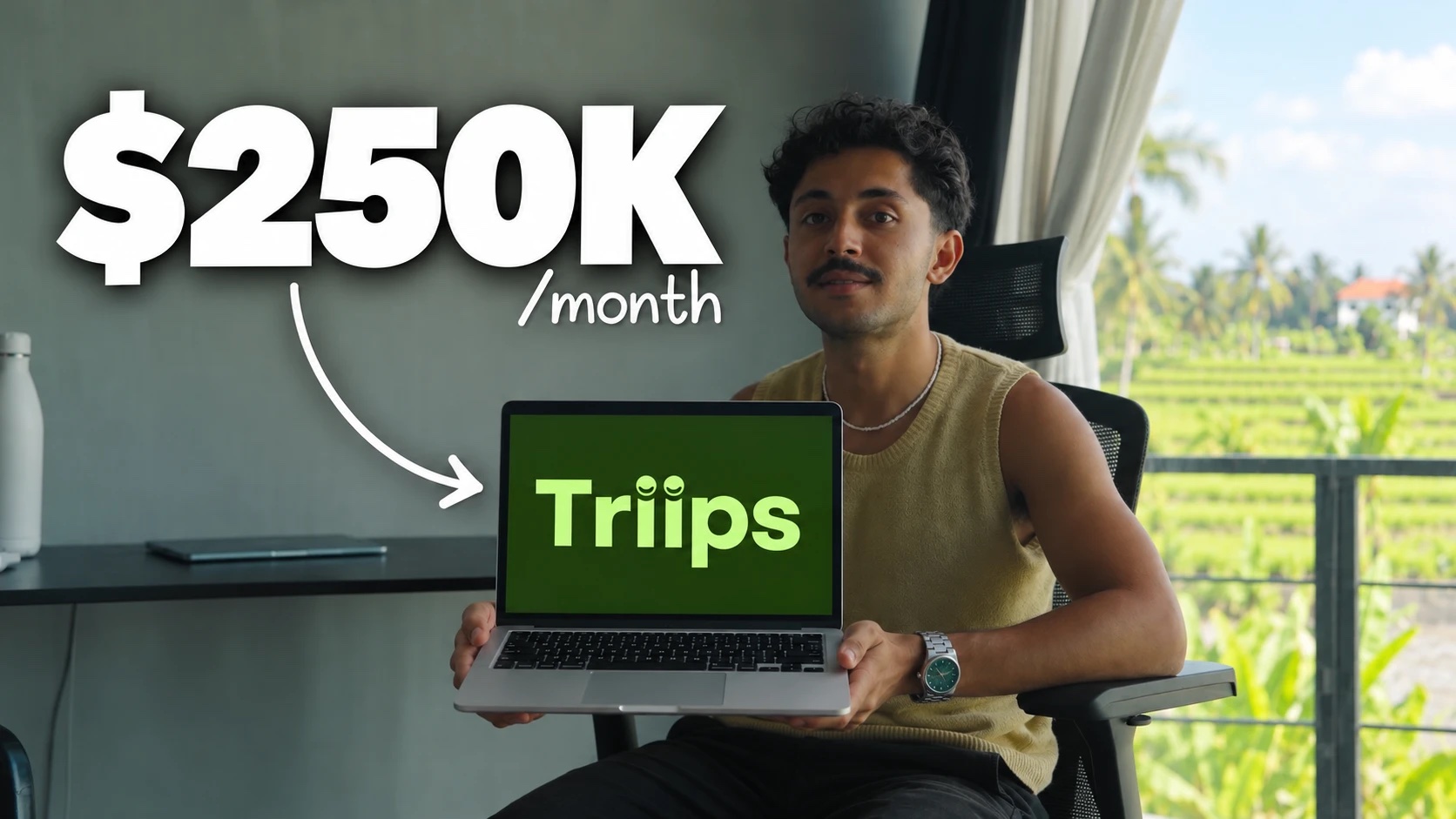
Last week I had dinner with a guy in Bali.
When I got home, I felt like I'd been slapped in the face.
He's 10 years younger than me. And he makes 10 times more.
His name is Omar Boukhabrine. He's 24, ex-BCG, and he runs Triips, a paid newsletter business that emails people cheap flights from their home airport. It does around $250K a month. Two founders. Zero employees. No investors.
So I spent a full day with him to understand how he went from $0 to $3M ARR in about 18 months.
Here is everything I took from it.
Want the full breakdown in one place? I turned the whole conversation into a free playbook: the month-by-month revenue ladder, the reels machine, the comment trick and the churn fixes. Get Omar's Triips playbook here.
What Triips actually is
You give Triips your home airport. A couple of times a week, it emails you a flight that is really cheap from that airport, with the dates you can book and the link to book it.
That's the whole product. Omar calls it "a very simple kind of one feature product that is also very cheap." Today it's $59 a year after a 7-day free trial.
The customer is the flexible traveler: price-sensitive, open to going anywhere, happy to let a good deal pick the destination. Triips runs a statistical model to decide what counts as a real deal, then tracks what each member clicks so it can send them more of what they like.
The idea wasn't new. Omar had it in mind for seven or eight years. He kept seeing local players doing it city by city, by hand, often for free on blogs. His edge: at BCG he worked with airlines on pricing projects. He knew how tickets get priced, when the drops happen and the psychology behind it.
His bet was simple. Do what the local players do, at a much larger scale, and it becomes a real company.
He quit BCG and told no one
Omar joined BCG around 20 and made six figures from the start. He planned to leave from day one.
Why the two-year mark? Because that's when they double your salary. He didn't want the golden handcuffs.
He did a 10-day trek in Argentina, completely disconnected, to make the call. Came back to a Canadian January, snow and dark at 4pm, and started building.
Then he told nobody. Not his friends. Not his parents. Only his girlfriend knew. Everyone thought he was still going to his old job.
"I think creating with a pressure free environment is really important because you can make the decisions you can pivot."
Triips was profitable after its first month. He only started talking about it at month six, when it hit $100K a month.
Start manual, in one city
Triips launched in Toronto with zero technology.
Omar's words: they made it look "like a real SaaS kind of product but it was all manual behind the scenes." He found the deals himself, using what he knew about airline pricing.
To get the first users, he went to the University of Toronto and put stickers and flyers everywhere with a QR code to a viral Instagram contest. To enter, you shared it on your story and tagged friends.
Once one city worked, they rolled out to the rest of Canada, then the US, then Europe, and turned the manual process into software that runs on its own.
The revenue ladder, from Omar:
- Month 1: profitable, a couple hundred members
- Month 2: $10K
- Month 6: $100K a month
- A few months later: $180K to $200K a month
- 2026: consistently $200K+ a month, and one month over $500K when a couple of videos went viral
Find your distribution edge first
This is the part I keep thinking about.
Omar doesn't start with "what's my skill?" He starts with "what do I have access to that makes distribution easier for me than for anyone else?"
"I think nowadays, especially with AI, I think you should think about what's gonna be your advantage in distribution."
For him, it was airports. He was flying every week for consulting, so he could film inside airports and planes, a setting most creators never get. He started posting before he even left his job.
Then he went all in: five faceless videos a day on the Triips Instagram. No face. Just his laptop in an airport.
The first video that popped did around a million views and barely converted. The next one did 2 to 3 million views and drove far more traffic, because he positioned the product better inside the video. After a month or two, the account was doing 10 to 20 million views a month.
Today the Triips Instagram has 450K+ followers. A two-person company that looks huge.
"Being able to make the videos yourself is the number one biggest lever you can pull simply because you can iterate."
His reasoning: as the founder, you can post 20 trial reels in a day, change the hook 20 times, and repost to TikTok and Facebook. Nobody to manage. Nobody to pay.
The comment trick
Views don't pay the bills. Omar's rule one: the video can't look like an ad. It should look like someone found a trick and is showing it.
Then he engineers the comment section.
- Friends' accounts comment "what's the website?" and "where did you find this?" Six or seven of them, from legit-looking accounts.
- He likes and pins those comments.
- A random person scrolling sees a pile of people asking for the site, and goes looking for it too.
- Real conversations start. Someone says the site didn't work, the team answers. A member chimes in that they've loved it for two months.
"I would recommend being really intentional with comment sections and engineering them."
On X, Omar shared how far they pushed it: "We posted over 500 videos on social media everyday for over a year on hundreds of accounts, and got our main account to comment on all of them."
Scale the format with creators
Once a format works, you don't need to be the one filming it. Omar standardized the winning videos and taught them to creators running more accounts. One person getting 10 million views becomes 10 people doing it.
He laid out the exact sequence on X:
- Post organically yourself.
- Test until a format gets 10K+ views consistently (trial reels help).
- Hire 3 to 5 UGC creators and teach them the format.
- Pay fixed plus performance.
- Make your best creator the manager and scale to 10 to 20 creators.
- Run Spark ads on TikTok winners and partnership ads on Meta for Instagram winners.
- Add a referral program directly in your onboarding.
Word of mouth is now one of Triips' biggest acquisition channels.
If this sounds familiar, it's close to what Romàn did with Gojiberry: prove a message organically, then pay to scale the winners. I broke that down in how Romàn grew Gojiberry from $50K to $300K MRR. And for another founder who skipped paid ads entirely, read how a 17-year-old built a $600K/month SaaS with zero paid ads.
Stop filling a leaky bucket
Here's what surprised me most. Omar says Triips doesn't get many more views now than last year. It makes a lot more money.
The difference is everything below the top of the funnel.
"Getting people into a leaky bucket is just a waste of time."
- A/B test everything. Open Triips from different countries and you'll probably see different versions. They constantly test wording, price points and offers.
- Friction on purpose. Right after purchase, members have to set up their profile and preferences. Omar calls it one of the biggest moves they ever made for churn.
- Save the failed cards. In B2C, a big part of churn is cards that expire or fail. Email sequences that get people to update their card recover that revenue.
- Fight for the renewal. Engagement emails outside the deals, and whatever it takes at renewal time, even a discount.
He learned none of this from a mentor. Every big lesson came from a problem in the numbers, followed by two or three weeks of monk mode until it was fixed.
Margins over vanity revenue
"The number one biggest thing is don't scale something that doesn't work at a small scale."
Before adding creators or ads, Omar wanted to know his numbers while it was just him making videos: views, traffic, sign-ups, conversions, refunds, renewals. What is one customer worth?
He says they could make three times as much money with lower margins. They chose to keep margins strong. On X he put it this way: "We're now at $3M ARR with 0 employees and 70% margins."
Investors reached out more than once. He said no. His philosophy is to reverse engineer the life he wants (Dubai, Euro summer, Bali in the fall) and keep full control. No investor calls. No one to report to.
The team is Omar as CEO on strategy and marketing, his co-founder Arnaud as CTO, and a few contractors for support and creator management. They had two developers at one point. Then, in Omar's words, Claude "just got so good" that they ended the contracts.
What to steal from Omar
→ Pick an idea where you have a distribution edge, not just a skill.
→ Launch in one tiny market and deliver it by hand behind a real-looking product.
→ Make the videos yourself first. Volume and variations beat polish.
→ Engineer the comment section so viewers ask for your link.
→ Plug the funnel before you pour more in: onboarding, failed cards, renewals.
→ Don't scale anything that doesn't work small.
→ Build in silence. Talk about it once it works.
FAQ
Who is Omar Boukhabrine?
Omar Boukhabrine is the 24-year-old co-founder of Triips.com. He left a strategy consulting job at BCG, where he worked on airline pricing, to build Triips with his co-founder Arnaud. He splits his time between Dubai, Europe and Bali, and posts about building Triips on X as @omaruecos.
How much does Triips make?
Omar says Triips makes around $250K a month ($3M ARR) with about 70% margins. In 2026 it has done between $200K and $300K most months, with one month above $500K after a few viral videos. These are Omar's own numbers.
How much does Triips cost?
Triips is $59 a year after a 7-day free trial, with a refund if you don't save at least $500 in your first year. There is no free tier.
How did Triips get its first customers?
Omar put stickers and flyers around the University of Toronto with a QR code to a viral Instagram contest, then posted five faceless videos a day from airports on the Triips Instagram. Organic short-form video, not paid ads, drove the early growth.
Can you start a paid newsletter business without an audience?
Omar did. He launched Triips in one city with no audience, validated it by hand, and built the audience on a brand-new company Instagram account. His advice is to find the channel where you have an unfair advantage and master it yourself before hiring anyone.
Get the full Triips playbook
Omar built a $250K a month business with one feature, one channel he mastered himself, and an obsession with plugging leaks. None of that needs funding.
I put everything from our day together into a free playbook: the revenue ladder, the reels machine, the comment trick, the churn fixes, and his 3-phase plan if you're starting today.
