Entrepreneur First pays you a monthly stipend to go find a co-founder. Sounds like free money until week 12, when an internal investment committee decides if your brand-new team gets funded. The teams that pass hand over 8% for $125K. Everyone else goes home with nothing but the stipend.
I dug into the best Entrepreneur First alternatives because EF only fits a very specific person: technical, pre-idea, free for 6 months full time, and able to live in London, Bangalore or San Francisco. Acceptance runs between 1% and 3%. I broke down the full deal in my honest review of Entrepreneur First.
If that's not you (wrong city, wrong stage, or you already have revenue), here are 7 alternatives, from a $97 founder club to YC's $500K deal.
Entrepreneur First alternatives at a glance
| Program | You get | You give up | Best for |
|---|---|---|---|
| Profitable Founder Club | Peer group + weekly calls | $97, 0% equity | Bootstrapped SaaS with revenue |
| Antler | Residency in 25+ cities | ~10% | Pre-idea founders outside EF's 3 hubs |
| Y Combinator | $500K | 7% + uncapped SAFE | Teams with something built |
| Techstars | $220K + mentor network | 5% + uncapped SAFE | Teams that want warm intros |
| TinySeed | $120K to $220K, remote | 10 to 12% | SaaS with MRR, no relocation |
| On Deck (ODF) | Co-founder pool + SF week | A fee, 0% equity | Co-founder search without dilution |
| Founder Institute | Part-time structure | $399 to $1,649 + ~2.5% pledge | Idea stage, keeping the day job |
1. Profitable Founder Club: the $97 option for founders who already have customers
Full disclosure: this one's mine.
Here's why it's first. EF's $125K for 8% prices your two-person, zero-revenue company at about $1.56 million. Fair price for a hunch. Terrible price if you already have paying customers.
Because at that point you don't need a talent investor to manufacture your company. It exists. What you're missing is the room: founders at your stage who tear your hardest problem apart every week and make sure you actually ship the fix.
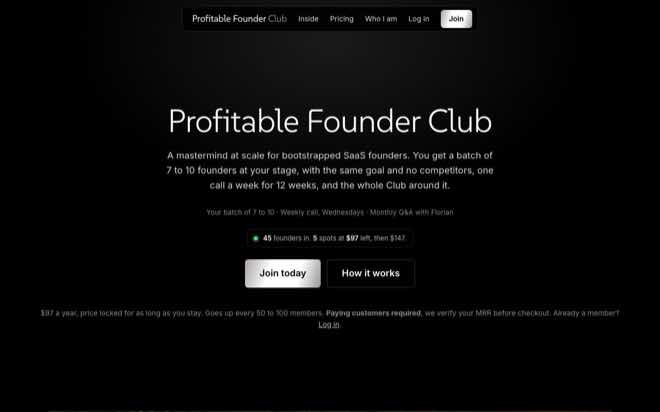
That's what the Profitable Founder Club is. $97 a year. Batches of 7 to 10 bootstrapped SaaS founders at your stage, no competitors in your batch, one call a week, plus a monthly Q&A with founders already past $100K MRR. Paying customers required (we verify MRR before you're in).
I know the price of that room because I once paid $13,000 for it. I was stuck at $15K to $20K a month, joined a mastermind, and hit $75K a month six months later. The Club is my attempt to sell the same room for $97 instead of $13,000, and for 0% instead of 8%.
→ Keep in mind: there's no check here. If you need funding to survive the year, look at TinySeed or YC below.
Join the Profitable Founder Club →
2. Antler: the same talent-investor model in 25+ cities
EF and Antler sell the same core product: show up alone and pre-idea, leave with a co-founder and a check. The usable difference is geography. EF runs 3 hubs (London, Bangalore, San Francisco). Antler runs residencies in 25+ cities, from Sydney to Nairobi to Austin.
The trade-offs are real though. Antler generally pays no stipend during the search phase, so you self-fund 6 to 12 weeks of your life. And the terms are heavier: around $150K for 10% in Singapore, £125K for 8.5% in the UK with a £40K service fee baked into the check. EF pays you to search and prices at 8%.
In Antler's first Singapore cohort, 1,400 people applied and 13 walked out funded. EF's committee is just as brutal. Either way, plan for the scenario where you leave with nothing. I put the two side by side in my Antler vs Entrepreneur First breakdown.
→ Pick Antler over EF if: you can't move to one of EF's 3 hubs, or you're a commercial founder (EF skews hard toward deep-tech engineers; Antler casts wider).
3. Y Combinator: 4x the cash for less equity
YC's standard deal is $500K: $125K for 7%, plus $375K on an uncapped SAFE with an MFN clause. Every company in the batch gets the same published terms, wherever they come from.
Put it next to EF's core check and it's not close. EF gives $125K for 8%. YC gives $125K for 7% and stacks another $375K on top.
The catch: YC funds teams, usually with something built. EF funds individuals before the idea exists. So YC isn't a replacement for EF's co-founder matching. It's where you go after you've solved that problem (plenty of EF-style pairings apply to YC later anyway).
→ Pick YC over EF if: you already have a co-founder and a prototype. Acceptance is around 1%, but the application alone forces clarity. Apply even if you think you won't get in.
4. Techstars: mentor density for teams that already exist
Techstars invests $220K: $20K for 5%, plus $200K on an uncapped SAFE. It's a 13-week sprint, and the opening stretch (they call it mentor madness) packs your calendar with back-to-back meetings with operators and investors.
On paper, $20K for 5% looks rough. You're really paying that equity for the $200K SAFE and the rolodex that comes with it.
Where it beats EF: you join with your existing team and idea, there's no investment-committee lottery halfway through, and the city-specific programs (often run with corporate partners) can drop you straight into your target industry. Healthcare in one city, energy in another.
→ Pick Techstars over EF if: you have a team, you want warm intros more than cash, and a vertical program matches your market.
5. TinySeed: funding for SaaS founders who won't relocate
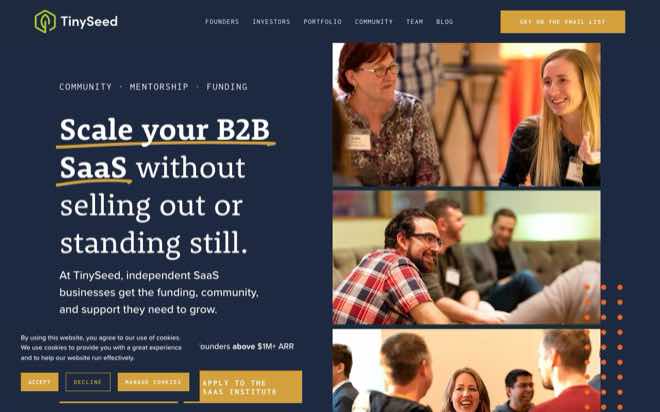
TinySeed is the anti-EF. You don't relocate, you don't rehearse for a demo day, and nobody expects you to raise a Series A afterward. It invests $120K to $220K for 10 to 12%, runs fully remote for a full year, and explicitly lets you use the check to pay yourself a salary.
That salary detail is the whole philosophy. TinySeed assumes you're building a profitable company you intend to keep, so the money buys you runway to compound it from wherever you already live.
You need revenue to get in. It's built for B2B SaaS founders with real MRR, not ideas. Which makes it the natural landing spot if you looked at EF, realized you're too far along, and still want a check plus a peer group.
→ Pick TinySeed over EF if: you have MRR, you won't move cities for an accelerator, and you want investors who are fine with you never raising again.
6. On Deck (ODF): the co-founder pool without the 8%
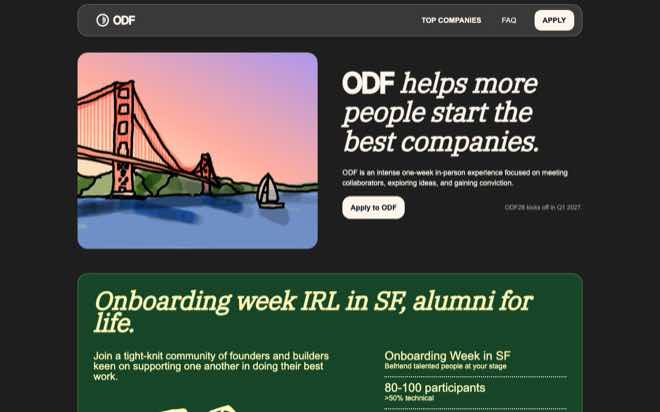
If you only want one thing from EF, it's probably the co-founder pool. On Deck Founders sells that pool on its own, and it doesn't take equity for access.
The current format: a one-week in-person onboarding in San Francisco with 80 to 100 people actively starting companies (over half technical), then an alumni community that sticks around for life. You pay a program fee, you keep 100% of your equity, and nobody votes on whether your team deserves to exist.
That last part matters. One EF alum from the London Summer 2024 cohort compared the matching phase to Love Island: rumors, team breakups, and a public score on your odds of passing the committee. ODF has no committee. You find your person and get to work.
There's also no check, so this only works if you can fund yourselves through the early months.
→ Pick ODF over EF if: the only EF feature you want is the co-founder pool, and 8% feels like an absurd price for an introduction.
7. Founder Institute: test the idea while your salary still hits
EF demands you quit your job and show up full time for 6 months before you know if the committee will fund you. Founder Institute flips that bet.
FI is a part-time, roughly four-month program built for the idea stage. You pay a fee ($399 to $1,649 depending on when you enroll) and contribute about 2.5% into a shared equity pool with your cohort. In exchange you get weekly deadlines, real feedback, and a forced march to incorporate, validate and launch.
You're buying deadlines, basically. And since everything runs alongside a day job, you can test whether the idea survives contact with reality before you quit anything. EF structurally can't offer that.
→ Pick FI over EF if: you're pre-idea or pre-validation and not ready to bet 6 months of savings on a committee's maybe.
The bottom line
Entrepreneur First isn't a scam. 600+ companies worth $16 billion+ came out of the machine, and EF itself raised $200 million at a $1.3 billion valuation in March 2026. The model works. The question is whether it works for you.
The decision tree:
→ Technical, pre-idea, can live in London, Bangalore or SF: stay with EF.
→ Pre-idea but in the wrong city, or not deep-tech: Antler.
→ Team and prototype: Y Combinator first, Techstars second.
→ SaaS with MRR, no relocation: TinySeed.
→ Just want the co-founder pool: On Deck.
→ Idea stage with a day job: Founder Institute.
→ Paying customers and you need the room, not the check: that's what I built the Profitable Founder Club for. $97, zero equity, 7 to 10 founders per batch.
FAQ
Is Entrepreneur First worth it in 2026?
For a technical solo founder with no co-founder, no idea and no network, yes: EF is one of the only structured on-ramps that exists, and it pays you a stipend while you search. For anyone with an existing company or revenue, no. You'd give up 8% for a $125K check and 6 months you don't need.
What is the difference between Entrepreneur First and Antler?
Both back individuals before the company exists. EF pays a stipend during the search phase, runs 3 hubs (London, Bangalore, San Francisco) and invests $125K for 8%. Antler runs in 25+ cities, usually pays nothing until the investment lands, and takes around 10% with service fees deducted from the check in some regions.
Can you join Entrepreneur First if you already have a startup?
No. EF backs individuals, then forms teams and companies inside the program. If you already run a company, you're past their entry point. With a prototype, look at Y Combinator or Techstars. With revenue, look at TinySeed for funding or the Profitable Founder Club for the peer group.
Which Entrepreneur First alternatives don't take equity?
Three on this list. The Profitable Founder Club is $97 a year for a peer group of revenue-stage SaaS founders. On Deck Founders charges a program fee for its co-founder community. Founder Institute charges $399 to $1,649, though it adds a roughly 2.5% contribution to a shared cohort pool, so it's low-equity rather than zero.