Skool is everywhere right now.
Hormozi bought in, the Skool Games turned it into a competitive sport, and every creator on X is suddenly a "community builder". I wrote up whether Skool is worth it and what the Skool Games actually are, so I won't rehash all of it here.
The short version: Skool Pro is $99/month plus a 2.9% cut of every sale. There's a newer $9/month Hobby tier, but it takes 10% of your revenue, which stops being cheap the moment you charge anyone anything.
And the gamification that makes Skool famous (points, levels, leaderboards) is also the thing a lot of founders quietly hate. If your members are grown adults paying real money, leaderboard-brained engagement can feel like a classroom.
I run a paid founder community myself, so I've spent real hours inside most of these platforms deciding where to host it. Here are the 7 Skool alternatives I'd actually consider in 2026, with the real prices and the real fees.
The math nobody does before buying
Platform fees look tiny until you multiply them.
Say your community does $5,000/month in membership revenue. Here's roughly what each option takes in monthly cost plus platform fees, before card processing:
→ Skool Hobby: $9 + 10% = $509. The "cheap" plan is the most expensive thing on this page.
→ Skool Pro: $99 + 2.9% = $244.
→ Circle Professional: $89 + 2% = $189.
→ Mighty Networks Launch: $79 + 2% = $179.
→ Whop: $0 + about 3% on gated access = $150.
→ Heartbeat Build: $49 + 5% = $299.
→ Podia Shaker: $84 + 0% = $84.
→ Discord: $0.
Run your own numbers before you pick. At $500/month in revenue the ranking flips completely, and at $20K/month it flips again.
1. Circle: the serious one
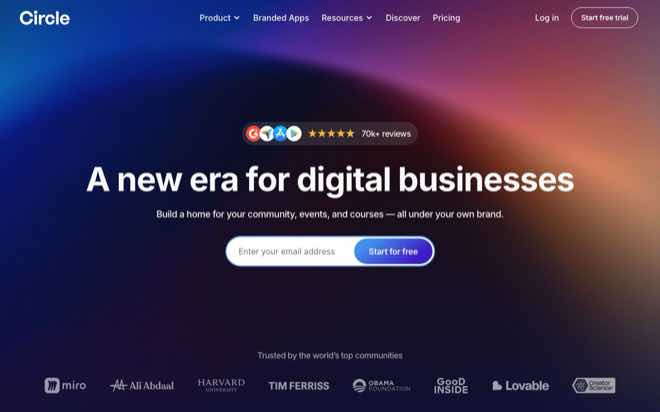
Circle is what most people mean when they say "a professional Skool alternative".
The Professional plan is $89/month with a 2% transaction fee. Business is $199/month and drops the fee to 1%. You get a custom domain, white-labeling, branded mobile apps on the higher tiers, courses, events, paywalls, the whole stack.
The design is the opposite of Skool. No leaderboards screaming at you. Clean spaces, clean threads, looks like something a B2B company would be proud to put its name on.
→ Best for: paid communities where the brand matters and members expect polish.
The catch: it's easy to start at $89 and end up at $199 because the feature you want (lower fees, API, white-label) always lives one tier up.
2. Mighty Networks: the engagement machine
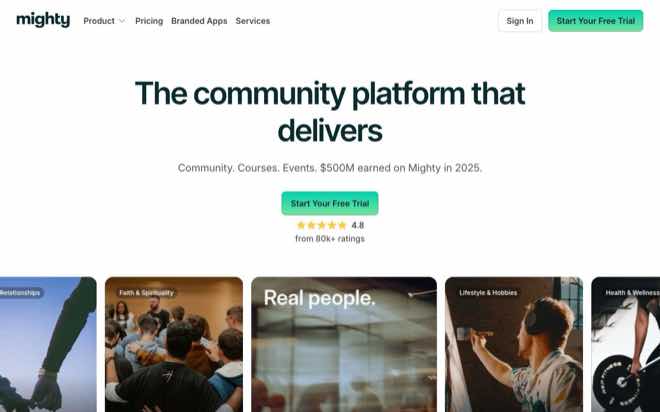
Mighty Networks starts at $79/month (Launch plan, 2% transaction fee). Scale is $179/month at 1%.
Where Skool bets on leaderboards, Mighty bets on programming: icebreakers, polls, native events, cohort-based courses. Their whole pitch is that the software creates the engagement for you.
It works, mostly. Communities on Mighty feel alive in a way a dead Circle space doesn't.
→ Best for: cohort courses and communities where you want structured activity, not just a feed.
The catch: the interface does a lot. Some members find it busy, and you'll spend a weekend learning where everything lives.
3. Whop: the no-monthly-fee one
Whop flips the model. No monthly fee at all.
You pay roughly 2.7% + 30¢ in card processing when you sell, and a 3% platform fee if you're gating access through Discord or Telegram. So you only pay when money moves.
The underrated part is the marketplace. Whop has actual buyer traffic browsing for communities and digital products, which means it can send you customers. Skool's discovery page exists, but Whop's marketplace is a real acquisition channel in some niches.
→ Best for: monetizing fast with zero fixed cost, especially if your community already lives on Discord.
The catch: Whop is a storefront and access layer, not a community experience. The community itself still has to live somewhere.
4. Discord: the free one (where everyone already is)

Here's my bias up front: the community side of my own club runs on Discord.
It's free. Your members already have it installed. Voice rooms, screen sharing, threads, bots for everything. For developers and SaaS founders specifically, there's zero adoption friction (I keep a list of the best Discord servers for entrepreneurs if you want to see how the good ones are run).
Pair it with Whop for payments and you've rebuilt 80% of Skool for the price of the transaction fees.
→ Best for: founder and dev audiences, free communities, or paid ones gated through Whop.
The catch: no native courses, notifications are chaos unless you configure them ruthlessly, and a quiet Discord looks very, very dead.
5. Heartbeat: the small-community sweet spot
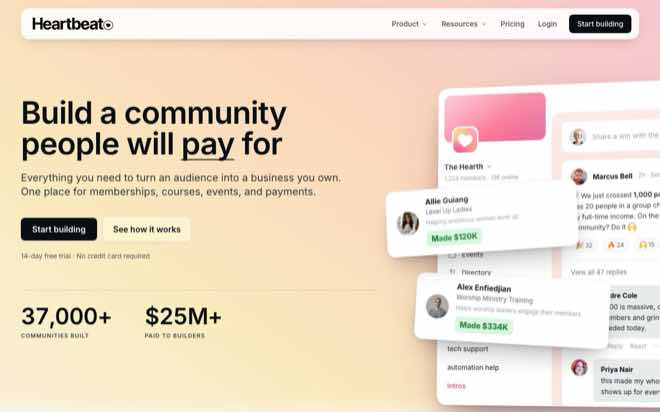
Heartbeat is the one most people haven't tried.
The Build plan is $49/month ($40 if you pay yearly) for up to 350 members, with a 5% transaction fee. Grow is $149/month for up to 5,000 members at 2.5%.
It's an all-in-one: threads, events, courses, docs, payments, all in a clean interface that feels closer to Notion than to a forum. For a community under a few hundred people, it covers everything without making you duct-tape five tools together.
→ Best for: small paid communities that want one tidy tool and don't need a mobile-app empire.
The catch: that 350-member cap on Build. Succeed and you're on the $149 plan sooner than you planned. And 5% is a real fee.
6. Podia: community plus everything else you sell

Podia starts at $42/month (Mover, billed annually) with a 5% transaction fee. The Shaker plan at $84/month drops the fee to zero.
Community is included on every plan, next to courses, digital downloads, coaching, and email. If you sell three different things to the same audience, Podia puts them under one roof for less than Skool's Pro plan.
→ Best for: creators with a product mix (course + templates + community) who want one simple bill.
The catch: the community features are the thinnest on this list. It's a storefront with a community attached, not the other way around.
7. Kajabi: the expensive all-in-one
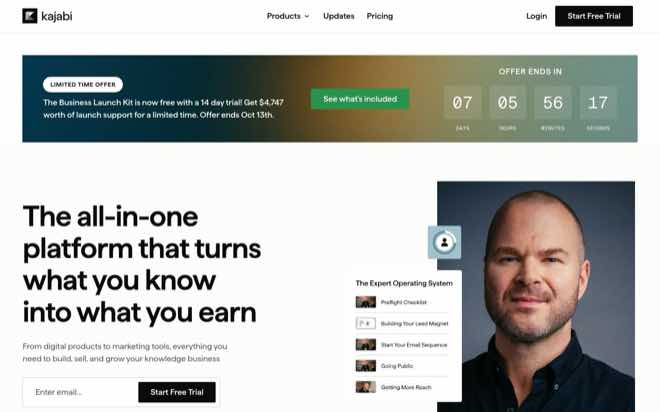
Kajabi starts at $179/month ($143 if you pay annually) and goes up to $499/month.
What you're actually buying is the marketing machine: funnels, email automations, landing pages, podcast hosting, and communities bolted into one system. Card processing runs around 2.9% + 30¢ on the Basic plan and gets cheaper as you go up.
→ Best for: info businesses doing six figures where the community is one piece of a bigger funnel.
The catch: if all you want is a community, Kajabi is paying for a truck to deliver a pizza.
Wait. Do you actually need to build one?
Quick gut check before you buy any of this software.
Half the founders I talk to who are "starting a community" don't have a community problem. They have a loneliness problem. They want people at their level to talk to, and building a whole paid community is the hardest possible way to get that.
If that's you, join one instead.
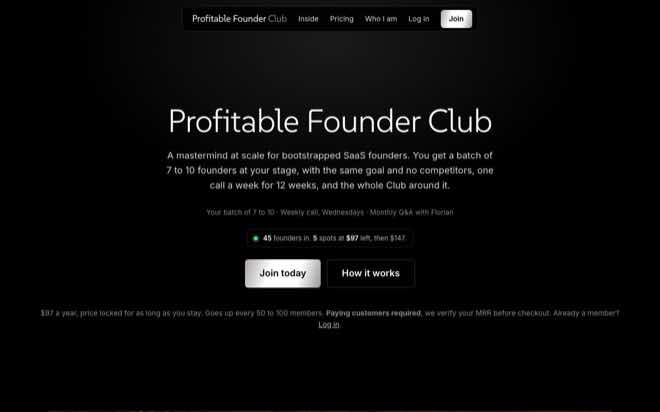
Full disclosure: this one's mine. I run the Profitable Founder Club, a private mastermind for SaaS founders between $5K and $50K MRR pushing toward $100K. Bi-weekly calls where we solve 3 member problems per session, monthly Q&As with founders already past $100K MRR, batches capped at 20 so nobody lurks.
I paid $13,000 for my first mastermind when I was doing $15K to $20K a month. Six months later I was at $75K. That's why I built one.
Apply to the Profitable Founder Club
How to pick (the 30-second version)
→ Want polish and brand control: Circle ($89/mo).
→ Want the software to drive engagement: Mighty Networks ($79/mo).
→ Want zero fixed costs: Whop (fees only).
→ Your audience is devs or founders: Discord (free) + Whop for payments.
→ Under 350 members, want one clean tool: Heartbeat ($49/mo).
→ Sell courses and downloads too: Podia ($42/mo).
→ Running a full info business: Kajabi ($179/mo).
And if the honest answer is "I just need smarter people around me", skip the software aisle entirely.
FAQ
Is Skool worth $99 a month?
If you're running a high-volume, gamified community in the Hormozi style, yes, the flat $99 plus 2.9% is simple and fair. If your community is small, premium, or allergic to leaderboards, you're paying for features that work against you. I break down the full math in my Skool review.
What's the cheapest Skool alternative?
Discord is free. Whop has no monthly fee and only charges when you sell (about 2.7% + 30¢ processing, plus 3% on gated Discord or Telegram access). Among the full platforms, Podia's $42/month Mover plan is the lowest fixed price on this list.
Does Skool have a free plan?
No. The cheapest way in is the $9/month Hobby plan, and it takes a 10% transaction fee. The moment you're selling memberships, that 10% makes the $99 Pro plan (2.9% fee) the better deal surprisingly fast.
Can I move an existing community off Skool?
You can export your member list and email everyone a move-in date, but course content and post history need rebuilding by hand on the new platform. Expect to lose some lurkers in the move. Active members follow you; passive ones were already gone.
Which Skool alternative is best for SaaS founders?
For hosting your own: Discord plus Whop, because your users already live there. For joining one: a small, vetted mastermind beats a 5,000-member feed every time. That's the entire reason the Profitable Founder Club is capped at 20 per batch.