
Most co-founders pick an equity split at the kitchen table and never revisit it. That's how resentment starts. These nine frameworks give you a concrete starting point , from the flat 50/50 most founders default to, all the way to structured vesting schedules designed to protect everyone long-term.
1. Profitable Founder Podcast (Our Top Pick) — Real Equity Conversations From SaaS Founders Already Earning $5K–$50K MRR
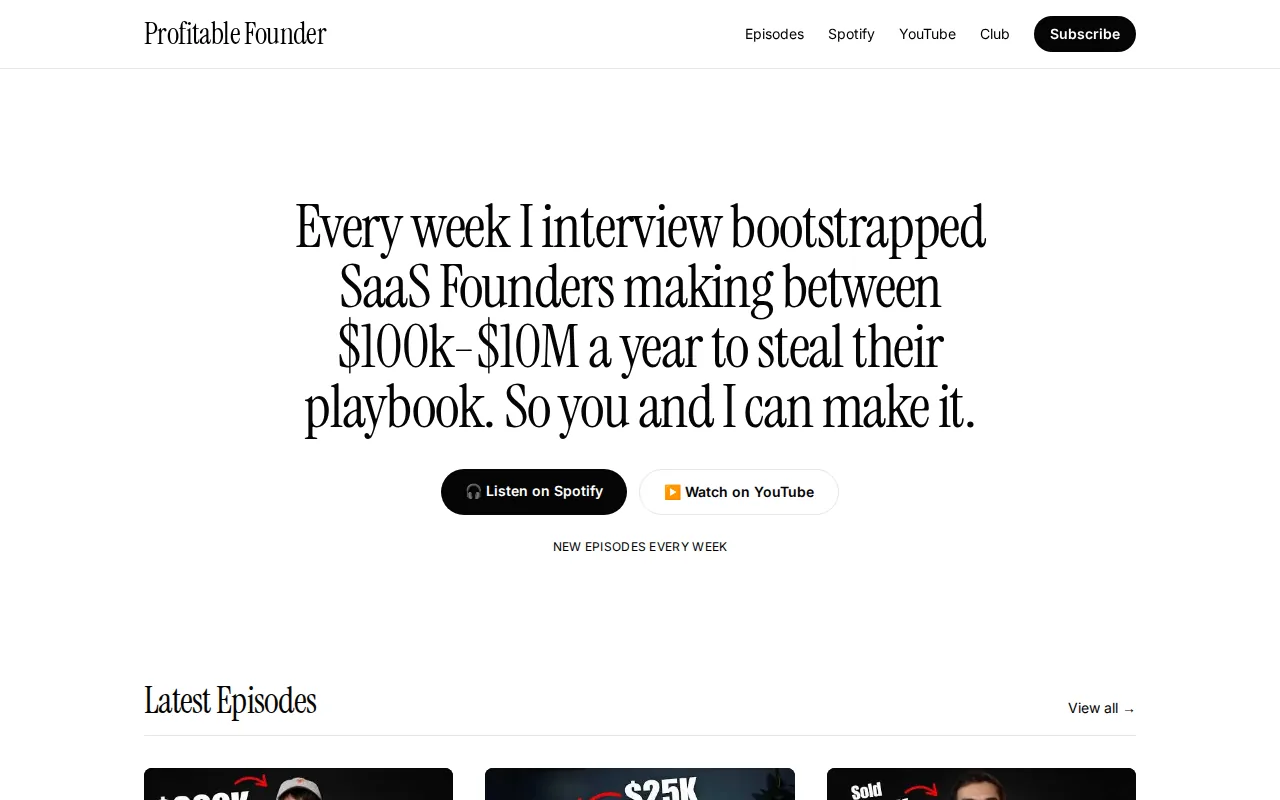
The Profitable Founder Podcast is a weekly show where host Florian Darroman interviews bootstrapped SaaS founders making between $100K and $10M a year. Every episode is a stolen playbook. But the most valuable asset isn't the public podcast , it's the Profitable Founder Club, a private mastermind built for SaaS founders doing $5K to $50K MRR who want to reach $100K.
Why does this matter for equity splits? Because the conversations inside the Club happen between founders at the same revenue stage. When you're at $12K MRR and trying to bring on a co-founder, the advice you get from someone who just handled that exact negotiation at $8K MRR is worth more than a generic YouTube tutorial. Publicly shared equity split frameworks commonly omit trigger conditions — no guidance on what happens when one founder stops pulling weight or the company hits a specific milestone. The Club fills that gap with peer pressure and real accountability.
This is also the only mastermind in the data that names a specific MRR window as its entry criteria. That revenue-fit signal matters. A founder at $2K MRR and a founder at $80K MRR face completely different co-founder dynamics. Lumping them together produces advice that fits neither.
If you're deciding how to structure equity right now, the most useful thing you can do is talk to three or four founders who made that call six months ago. That's what the Club exists for. You can read the SaaS mastermind success stories from founders in the $5K, $50K MRR range to see what that looks like in practice.
2. Default 50/50 Split — The Equal Partnership Starting Point
The 50/50 split is where most co-founder conversations begin. Both founders own half the company, paired with a 4-year vesting schedule and a 1-year cliff. It's the default because it's the easiest to agree on and the hardest to argue with at the start.
It works best when two founders are genuinely equal , same time commitment, similar skill sets that are equally hard to replace, and both taking the same financial risk. Think two technical co-founders building a B2B SaaS tool together, both working full-time from day one, neither bringing outside cash.
The honest caveat: equal splits rarely stay equal in practice. One founder typically emerges as the operational driver within the first year. When that happens, resentment builds fast if the split doesn't reflect reality. Equity ownership represents a claim on residual value , meaning what looks fair today may feel very different once revenue starts flowing and one person is doing 70% of the work.
The 50/50 split is a reasonable starting point, but it should come with a written agreement that spells out decision-making authority and what happens if one founder wants out.
3. Time-Based Split (66.7% / 33.3%) — When One Founder Commits More Hours
This split acknowledges a basic reality: if Founder A is working full-time and Founder B is working part-time, equal ownership isn't actually equal. The 66.7% / 33.3% framework ties equity directly to committed hours, giving the majority stake to whoever is all-in.
It pairs with a 4-year vesting schedule and a 1-year cliff, same as the default split. The difference is the starting ratio. If Founder A is working 40 hours a week and Founder B is contributing roughly 20 hours, doubling the equity weight toward Founder A reflects that gap.
This model shows up most often in early-stage SaaS where one founder keeps a day job while the other builds full-time. It's not a judgment call on who's more valuable — it's a math problem. Time is the scarcest resource at zero revenue, and the person spending more of it is taking more risk. Many founders who default to 50/50 report wishing they'd used a time-weighted split early on, instead of renegotiating painfully later.
One thing to watch: if the part-time founder's hours are expected to increase once they leave their day job, build that expectation into the agreement explicitly. Otherwise you're creating a future renegotiation you don't want to have.
4. Cash-Adjusted Equal Split — Balancing Money and Sweat Equity
Sometimes both founders contribute equally in time, but one puts in cash and the other doesn't. The cash-adjusted equal split keeps the headline ratio at 50/50 while acknowledging that cash contribution should be recognized , usually through a founders' loan or a delayed equity adjustment rather than a permanent ownership change.
The vesting schedule stays standard: 4 years with a 1-year cliff. What changes is the accounting around the cash contribution. Let's say one founder puts in $20K to cover early infrastructure costs. Rather than adjusting the ownership split immediately, a common approach is to treat that $20K as a convertible loan that gets repaid before the company distributes profits, or that converts to a small equity adjustment at a pre-agreed milestone.
This model is best for co-founders who are equally committed in terms of time and vision, but where one happens to have more liquidity. It avoids the messiness of a lopsided split while still recognizing the financial contribution.
The risk is that "we'll figure it out later" framing. If the cash contribution isn't documented with a clear repayment or conversion mechanism, it becomes a source of conflict the moment the company starts generating real revenue. Get it in writing before the money moves.
5. Cash Contribution 10% for $50K — Buying In Without Full Co-Founder Status
This is a specific formula worth knowing: a $50K cash contribution earns approximately 10% equity, with the remaining 90% split among the founding team. It's a way to bring in a financial contributor without giving them co-founder-level ownership or decision-making authority.
This structure works when a founder-adjacent person , a friend, early advisor, or angel-style contributor , wants skin in the game but isn't joining the company full-time. The 10% for $50K benchmark gives both sides a reference point for negotiation. It's not arbitrary. At a $500K implied valuation, $50K for 10% is a clean, defensible number.
The remaining 90% typically vests on the standard 4-year schedule for the core founding team, while the 10% cash contribution stake may or may not have vesting attached depending on whether the contributor has an ongoing role. If they're purely financial with no operational duties, some teams grant the 10% immediately without a cliff.
The limitation here is valuation. That $500K implied number only makes sense at very early stage. If the company has already hit $10K MRR and is growing, $50K for 10% is probably underpriced. Adjust the formula to match your current stage. You can see how other founders have handled similar early-stage structures in this SaaS mastermind case study on hitting $10K MRR.
6. TOC Framework (Time, Opportunity Cost, Cash) — The Structured Formula for Fair Splits
The TOC framework is the most rigorous model in this list. Instead of agreeing on a gut-feel percentage, each co-founder scores their contribution across three dimensions: Time (hours committed per week), Opportunity Cost (what they're giving up to do this), and Cash (money put into the company). The equity split reflects the weighted total.
It pairs with a 4-year vesting schedule and a 1-year cliff , the most common combination across all publicly available frameworks. But the starting ratio is earned through math, not negotiation vibes.
Here's why this matters. Let's say Founder A is a senior engineer leaving a high-paying salary to build full-time. Founder B is a part-time marketer keeping their consulting work. Under a 50/50 split, you're saying those contributions are equal. Under TOC, you're forced to actually compare them. Founder A's opportunity cost alone might justify 60% or 65% before you even factor in hours worked.
A common gap across equity frameworks is the absence of trigger conditions — no clause for what happens if one founder's contribution changes. TOC is the model most naturally suited to adding triggers, because the same formula you used to set the initial split can be rerun annually to check whether ownership still reflects reality.
7. Standard 4-Year Vesting With 1-Year Cliff — Protecting All Parties Long-Term
Five of the nine frameworks in this article use a 4-year vesting schedule with a 1-year cliff. That's not a coincidence , it's the standard that the SaaS industry has converged on, and for good reason.
Here's how it works. No equity vests for the first 12 months (the cliff). At month 12, 25% of your total grant vests at once. Then the remaining 75% vests monthly or quarterly over the next 3 years. If a co-founder leaves before the cliff, they walk away with nothing. If they leave after the cliff, they keep what's vested.
This protects the company. It also protects the co-founder who stays. The 1-year cliff filters out people who aren't serious. The 4-year total timeline is long enough to cover the period when most SaaS companies are figuring out product-market fit and early distribution , typically the most critical 3 to 4 years of a company's life.
For founders in the $5K to $50K MRR range, this schedule makes particular sense. You're past the idea stage but still years away from a potential exit. Locking in long vesting keeps everyone motivated and aligned.
8. 3-Year Vesting With 1-Year Cliff — Faster Equity for Leaner SaaS Teams
The 3-year vesting with a 1-year cliff is a compressed version of the standard. Same cliff, shorter runway. At month 12, one-third of the total grant vests. The remaining two-thirds vest over 24 more months.
This model fits small founding teams that move fast and expect major milestones , revenue targets, product launches, or acquisition conversations , within a 2 to 3 year window. It's also common in bootstrapped SaaS where there's no institutional investor pushing for the longer 4-year standard.
The downside is retention risk. A co-founder who is fully vested at year 3 has less financial reason to stay engaged in years 4 and 5. If your SaaS product requires ongoing technical maintenance and your CTO co-founder vests out early, you may find yourself renegotiating equity all over again at a much higher company valuation. Plan for what happens after full vesting before you choose the shorter timeline.
9. 3-Year Vesting No Cliff — Maximum Flexibility for Early-Stage SaaS
Remove the cliff entirely and equity starts vesting from day one. On a 3-year schedule with no cliff, a co-founder who leaves after 6 months has still earned a portion of their grant proportional to time served. That's the trade-off: you get maximum flexibility, but you give up the protection the cliff provides.
This structure makes sense in one specific scenario: when both co-founders already have a strong track record together and the cliff would feel insulting rather than protective. Think two founders who've shipped a product before, know how each other operates under pressure, and want an equity structure that reflects mutual trust from the start.
It's the minority model in this list , and in the broader data, 3-year schedules appear far less often than 4-year ones. But for the right founding pair, it removes an early friction point that can make new co-founder relationships feel transactional before they've even started. Use it carefully, and document the monthly vesting cadence in writing so there's no ambiguity if the relationship changes.
How to Choose the Right Equity Split for Your SaaS
The right split depends on three things: how much time each founder is actually committing, who's putting in cash, and what your expected company timeline looks like. Here's a simple decision matrix to narrow it down.
One factor missing from every publicly available equity split example: trigger conditions. None of the frameworks in this list specify what happens when one founder's contribution drops, the company misses a milestone, or one party wants to exit early. Before you sign anything, add a clause that answers those questions. Many experienced SaaS founders regularly flag this as the single most overlooked piece of any co-founder agreement. You can explore how different mastermind SaaS mastermind revenue models handle founder incentive structures for additional context on aligning equity with growth targets.
FAQ
What is the most common equity split for SaaS co-founders?
The most common split is 50/50, paired with a 4-year vesting schedule and a 1-year cliff. Across publicly available SaaS founder frameworks, the 50/50 ratio appears most often, and five out of nine documented structures use the 4-year vesting standard. It's the default because it's simple to agree on , not necessarily because it's optimal for every founding team.
Should co-founders always use a vesting schedule?
Yes. Skipping vesting is one of the most common early-stage mistakes. If a co-founder leaves in year one without a vesting schedule in place, they walk away with their full equity stake but none of the future work. A 4-year schedule with a 1-year cliff is the baseline protection for both parties. Even high-trust founding teams benefit from having vesting documented before they need it.
What is the TOC framework for equity splits?
TOC stands for Time, Opportunity Cost, and Cash. Each co-founder scores their contribution across those three dimensions, and the equity split reflects the weighted totals. It's the most structured approach in this list and the one most suited to unequal founding teams. Unlike gut-feel splits, the TOC model can be rerun annually to check whether ownership still reflects each founder's actual contribution.
What are trigger conditions and why do equity split examples rarely include them?
Trigger conditions are clauses that define what happens when a specific event occurs , a founder stops working, the company hits or misses a revenue milestone, or one party wants to exit. Publicly shared equity split frameworks rarely include them, which creates real legal and operational risk. Any co-founder agreement should include at least a basic trigger clause covering departure, performance, and exit scenarios before both parties sign.
How does a SaaS mastermind help with equity decisions?
A mastermind gives you access to founders who just made the same decision six to twelve months ago. Generic equity split advice rarely accounts for your specific revenue stage, technical stack, or founding team dynamics. Communities built for SaaS founders at $5K to $50K MRR give you peers who can stress-test your proposed split and flag the clauses you forgot to include.
Conclusion
If you're sitting on a co-founder conversation right now, start with the TOC framework , it forces the right discussion before anyone gets attached to a number. Then layer on a 4-year vesting schedule with a 1-year cliff and add a trigger condition clause before you sign. And if you want to pressure-test the whole thing with founders who've been through it, the Profitable Founder Podcast and its private Profitable Founder Club are built exactly for that conversation.