Podcast sponsorship rates can swing from a small flat fee to thousands of dollars per spot. For SaaS founders, the useful number isn’t a universal average. It’s the value of reaching the right listeners, in a format you can measure and sell with a straight face.
Here’s how CPMs work, what changes a quote, and how to judge a sponsorship before you spend.
Podcast Sponsorship Rates: CPM Benchmarks and What They Mean
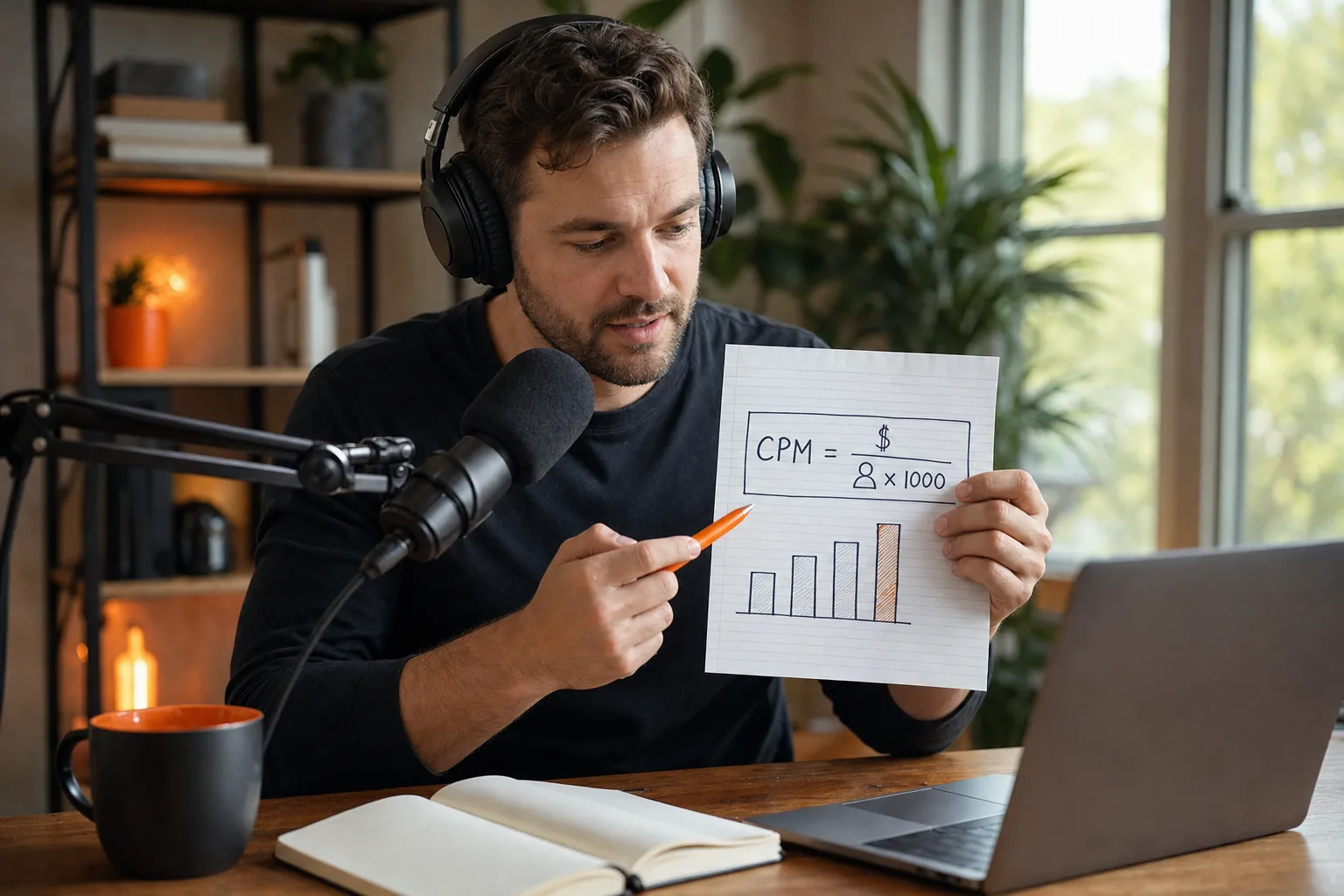
A podcast sponsorship rate is the price a brand pays to reach a show’s audience through an ad or sponsored segment. Many deals use CPM, or cost per thousand eligible downloads. The basic math is downloads divided by 1,000, multiplied by the CPM.
A CPM calculation provides a media-value baseline for one placement. That’s a starting point, not a required invoice. It doesn’t account for the host’s work, audience fit, or any rights the sponsor wants to buy.
Published guidance gives a sense of the range. Acast’s 2026 benchmarks put pre-recorded ads at $15 to $30 CPM and host-read sponsorships at $25 to $40. Business and finance shows may reach $40 CPM or more. Separately, MillionPodcasts’ pricing guidance recommends a $300 to $500 flat fee for shows with fewer than 1,000 downloads per episode.
Those numbers aren’t interchangeable. A CPM calculation might value an 800-download placement at just a few dozen dollars, while a flat fee prices the sponsor’s access to a specific audience and the work of delivering the ad. For a small show, a flat fee can make a first deal worth coordinating.
Be careful with averages. A few large deals can pull an average rate far above what a typical show charges, so don’t treat a published mean as a rate card for your show.
Profitable Founder Podcast interviews bootstrapped SaaS founders making $100K to $10M a year. That focus gives sponsors a clearer audience story than a broad claim about “business listeners.”
How Podcast Ad Formats and Pricing Models Affect the Fee
The format changes what a sponsor is buying. A supplied ad read by a voice actor takes less host time than a custom endorsement. A baked-in ad stays in the episode file, while dynamic ad insertion can place or replace ads based on campaign settings. Those choices affect control, shelf life, and reporting.
Placement matters too. Pre-roll runs near the start, mid-roll sits within the episode, and post-roll comes at the end. Mid-roll often costs more because it reaches listeners who have already started the show. Post-roll may cost less because some listeners leave before the episode ends.
A host-read sponsorship lets the host deliver the message in their own voice. A pre-recorded ad uses advertiser-supplied creative. Sponsored segments and branded content involve a wider role for the sponsor, so define the work and review rights rather than pricing them like a short spot. Paid interviews need special care: the audience should know when a conversation is paid for.
| Pricing choice | Best fit | Who carries the main risk? | What to agree on |
|---|---|---|---|
| CPM | Consistent delivery and comparable ad slots | Seller, if delivery falls short | Eligible downloads, measurement window, and make-good rule |
| Flat fee | Small shows or a focused audience | Sponsor, if response is weak | Episode, placement, flight dates, and expected delivery |
| Affiliate or bonus | A first test when both sides want conversion data | Seller, if few listeners act | Commission basis, attribution method, and payout timing |
| Hybrid | A guaranteed base plus performance upside | Shared | Base fee, qualifying action, and reporting rules |
For mid-size shows, MillionPodcasts recommends starting with affiliate or bonus structures before moving to flat rates. Larger shows may have room to charge an exclusivity premium, since a sponsor is asking the show to hold back other advertisers.
Don’t hide extra work inside a higher CPM. Quote production, category exclusivity, outside use of the host’s recording, and added channels as separate parts of the scope. When a buyer has a smaller budget, reduce the deliverables before cutting the value of the core placement.
What Drives Podcast Sponsorship Rates Up or Down
Audience size is easy to see, but it’s only one part of the quote. A show with 3,000 downloads from SaaS decision-makers may suit a software sponsor better than a much larger general-interest show. Buyers pay for access to people who might need the product, not a download count in isolation.
Category can shift the benchmark. Libsyn’s published baked-in host-read category table puts Business at $30 CPM. That’s a useful reference point for a SaaS show, but it doesn’t guarantee a $30 rate. Your audience details and campaign scope still matter.
Engagement can support a higher ask when you can show it. Share a consistent delivery window and use evidence such as listener survey answers, relevant audience roles, or response to past offers. Don’t call a single strong episode proof of what every episode will deliver.
Other factors that can move the fee include:
- Ad format: A custom host read asks more of the host than a supplied recording.
- Placement: A mid-roll may command more than a post-roll.
- Targeting: Narrow geography or audience traits can raise costs for a campaign.
- Exclusivity: Blocking competing sponsors has an opportunity cost.
- Reporting: A custom survey or added analysis takes work beyond a standard delivery report.
Trust matters, too. If a sponsor’s product fits the show and the host can explain it accurately, the read can feel natural. But don’t claim you’ve tested a product if you haven’t. A sponsor’s budget doesn’t make a weak or unsupported claim safe to repeat.

Think of the rate card as a set of reasons a buyer can repeat to a teammate. “Our audience is engaged” is vague. “We reach bootstrapped SaaS founders who are choosing tools for their businesses” gives the buyer a sharper reason to consider the slot.
Estimate the Value of a Podcast Sponsorship for a SaaS Business
Start with the show’s likely delivery, then compare the fee with the economics of your SaaS offer. Use recent episodes that resemble the one you’re buying. A breakout guest or timely news episode can inflate the average, so use a median when episode performance varies.
Ask what a flat fee covers. It may include a custom host read, a valuable niche audience, or added production work. Compare the fee with your own goals rather than relying on the quoted price alone to judge whether the deal offers good value.
Now compare that fee with your own funnel. Estimate how many listeners might visit a landing page, start a trial, become paid customers, and stay long enough to cover acquisition cost. Treat each step as an assumption until your campaign data tests it. For B2B SaaS, the listener may hear the ad while away from a screen, then search for the brand later.
Use a memorable URL or a campaign-specific landing page. A unique promo code can help, especially if it gives the listener a reason to act. Add a post-signup question such as “Where did you first hear about us?” so your team can capture people who search directly instead of using the link.
Keep separate records for delivered downloads, page visits, trial starts, paid conversions, and customer value. Downloads show delivery, not that every person heard the full message or bought the product. The measurement limits matter when you compare a sponsorship with paid search or another channel.
Small shows with a well-matched audience can win renewals that a download count alone would not predict. Audience fit and renewal can matter more than reach.
Before signing, write down the result that would make you renew. For one SaaS team, that may be trial volume. For another, it may be qualified demo requests or branded searches over a longer window. A SaaS podcast sponsorship ROI calculator can help organize the assumptions, but your own conversion data should decide whether the spend works.
Negotiating a Sponsorship and Measuring Results
Make the first quote easy to judge. State the expected delivery, the format, the placement, and the fee. If you’re pricing a flat package, put the fee first, then explain the audience and scope behind it. MillionPodcasts recommends leading with a flat rate for smaller shows; that anchors the discussion around a real package instead of a tiny CPM calculation.
If the sponsor pushes back, ask what needs to change: price, reach, or scope. Don’t discount the same package without a reason. Offer fewer episodes, a shorter read, or an affiliate component instead. A useful SaaS founder podcast sponsor deck should make the audience, inventory, and reporting plan clear enough to support that conversation.
Before recording, put the deal terms in writing. Name the episode and placement. Set approval deadlines, payment timing, cancellation terms, and any make-good if delivery misses the agreed level. Define category exclusivity carefully, including which competing products count.
Also set the limits on reuse. A podcast placement doesn’t automatically give the sponsor the right to run the host’s voice in paid social or another channel. Spell out the channels, time period, edits, and approval process if the sponsor wants those rights.
Disclose the paid relationship in the ad itself. Make the disclosure clear and hard to miss. A note in show notes alone may not reach listeners who never open them.
After the campaign, report delivery separately from response. Send the promised download count with its source and time window. Then show tracked visits, code use, or trial starts as separate results. Those fields answer different questions, and mixing them makes a renewal harder to judge.
For a closer look at sponsor prospecting and pricing your own inventory, how to sell ad space on a SaaS founder podcast is a useful next step. Profitable Founder Podcast takes a similar operator-first view: define the audience, make the offer clear, then track what happened.
Podcast Sponsorship Rates FAQ
How much does a podcast sponsorship cost?
A podcast sponsorship can cost from a small flat fee to thousands of dollars, depending on audience size, format, and scope. Published CPM guidance puts pre-recorded ads around $15 to $30 per thousand downloads and host-read ads around $25 to $40. Smaller shows may use flat fees instead, since CPM math can produce a very small invoice.
What is a good CPM for a podcast ad?
A good CPM depends on the show’s category and the ad unit. Published guidance places host-read spots around $25 to $40 CPM, while business-focused shows may reach higher rates. Compare the quote with eligible downloads, placement, and audience fit. A higher CPM can still make sense if the listeners match your SaaS buyers.
Should a small podcast charge a flat fee or CPM?
A flat fee often works better for a show with fewer than 1,000 downloads per episode. At that size, CPM arithmetic can create a fee too small to cover coordination and production. State the expected delivery beside the flat price so the sponsor can see the implied CPM and understand what the package includes.
How do I measure whether a podcast sponsorship worked?
Measure delivery and business response separately. Track eligible downloads for the agreed period, then watch a unique landing page, promo code, trial starts, and customer conversions. Add a post-signup survey to catch listeners who searched for your brand later. No single measure captures the full effect, so agree on the signals before the ad runs.
Conclusion
Use CPM to set a fair starting point, then price the audience fit and work the sponsor actually wants. If you’re buying a spot for a SaaS product, pick one clear outcome and run a small, trackable test before committing to a longer deal. Profitable Founder Podcast is built around the founder lessons that make those choices easier to assess.
