Founder Institute wants two things from you: an entrance fee between $399 and $1,649 depending on your city, and a pledge of 2.5% of your future company to their Equity Collective.
For a part-time program you attend while keeping your day job.
I get why people pause at that. 2.5% of nothing is nothing, sure. But 2.5% of the company you spend the next ten years building is real money for 10 sessions of curriculum.
And to be clear, I'm not against paying for help. I paid $13,000 for a mastermind when my SaaS was doing $15-20K a month. Six months later I was at $75K a month. Best money I ever spent.
I'm against paying for the wrong kind of help at the wrong stage.
So before comparing logos, answer one thing: what do you need right now? Structure, money, a co-founder, or peers? Each alternative below solves a different one of those.
Here are the 7 options worth your time in 2026, sorted by what they solve. (Yes, I ranked my own community first. I explain why, and you can judge.)
Founder Institute alternatives at a glance
| Program | The deal | Equity | Best for |
|---|---|---|---|
| Profitable Founder Club | $97 a year | 0% | SaaS founders with revenue |
| TinySeed | $120K-$220K, 1 year remote | 10-12% | Bootstrapped B2B SaaS |
| Y Combinator | $500K, 3 months | 7% + MFN SAFE | All-in teams |
| Techstars | $220K, 3 months | 5% + MFN SAFE | Teams that need mentors |
| Antler | ~$250K (US), residency | ~10% | Pre-idea, full-time |
| Entrepreneur First | $125K, 6 months | 8% | Solo technical founders |
| On Deck (ODF) | ~$1,000 suggested | 0% | Network seekers |
1. Profitable Founder Club: peers instead of curriculum
Full disclosure: this one's mine. I built it because programs like Founder Institute didn't fit founders like me.
Here's the gap. FI teaches you how to start. Nobody tells you what to do at $4K MRR when churn eats every new signup and you've been alone with the problem for 8 months.
The Club is a mastermind at scale for bootstrapped SaaS founders. You get a batch of 7 to 10 founders at your stage, with the same goal and no competitors. One call a week for 12 weeks. Then the whole Club around it: monthly Q&A with me, a member directory, founder build logs, feedback whenever you post your numbers.
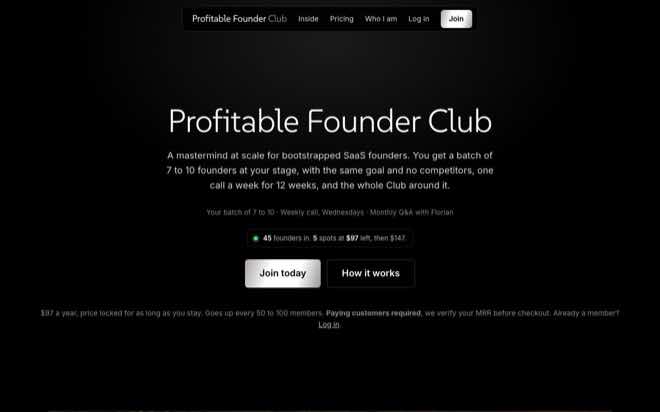
The deal: $97 a year. Not a month. A year, price locked for as long as you stay. It goes up every 50 to 100 members (45 founders are in as I write this, 5 spots left at $97, then it's $147).
Equity: 0%. Compare that to pledging 2.5% of your company to a collective.
One hard filter: you need at least one paying customer. We verify MRR before checkout (a read-only Stripe key, or a screenshot of your revenue page I check by hand). Pre-revenue founders honestly get more from FI's structure than from a room debating churn.
→ Pick the Club over FI if: you have revenue, and your bottleneck is decisions and accountability, not a syllabus.
2. TinySeed: funding without the unicorn script
If FI appeals to you because you want support, but the equity pledge bothers you, flip the trade: take real money for real equity instead.
TinySeed is a 1-year accelerator, fully remote, built for B2B SaaS founders who want a profitable company instead of a seed-round treadmill. They invest $120K to $220K for 10 to 12%, on terms modeled after the deal Rand Fishkin used for SparkToro. 15 to 20 companies per batch.
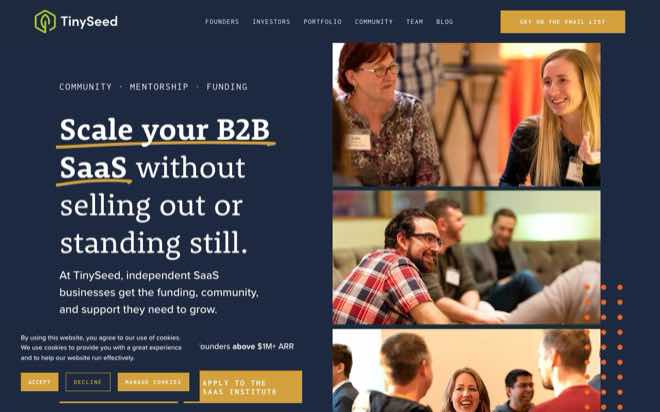
The catch: you need a live product with revenue. TinySeed funds businesses, not ideas. And 10 to 12% is a real slice. You're just getting $120K+ and a year of structured support for it, instead of a lecture series.
I interview bootstrapped SaaS founders every week on the podcast, and the pattern from accelerator alumni is consistent: the check mattered less than the 15 other founders in the batch.
→ Pick TinySeed over FI if: you have MRR and 12 months of runway would change your trajectory.
3. Y Combinator: the opposite bet
FI says: keep your job, test the idea part-time. YC says: quit everything, move for 3 months, go.
The deal is $500K. $125K buys 7%, and another $375K comes on an uncapped MFN SAFE that takes the terms of your next round. Acceptance hovers around 1 to 2%.
If you get in, take it. The badge still opens doors nothing else opens, and $500K at idea stage beats any curriculum ever written.
But be honest about the path. YC companies are built to raise. If your plan is $30K MRR, profitable, no investors (my plan, for the record), the YC machine is pointed somewhere else. I broke down the full list in my Y Combinator alternatives guide if that's the fork you're standing at.
→ Pick YC over FI if: you can go full-time today and you want the venture path, not the lifestyle one.
4. Techstars: mentors on tap
Techstars invests $220K: $20K for 5%, plus $200K on an uncapped MFN SAFE. Three months, in person, and the whole model is mentor density. Dozens of operators circle each batch, many from your exact vertical.
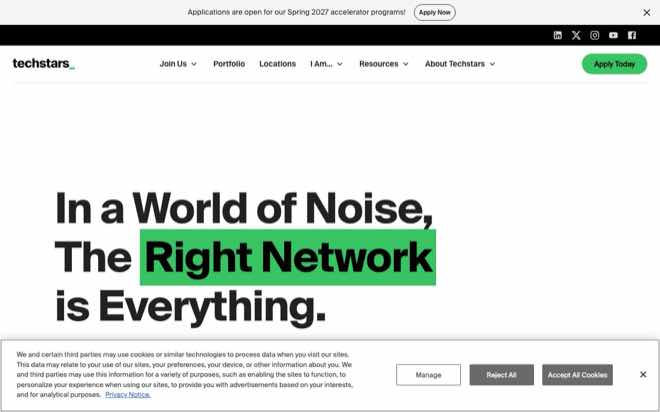
Where FI hands you a syllabus, Techstars hands you 20 coffee chats a week that reshape your roadmap. They run programs year-round across cities, and their site banner already shows Spring 2027 applications open.
The complaint you'll hear from alumni: $20K cash for 5% is expensive, and the other $200K dilutes you later. True. You're paying for the network, not the check.
→ Pick Techstars over FI if: you already have a team and a prototype, and warm intros are your bottleneck.
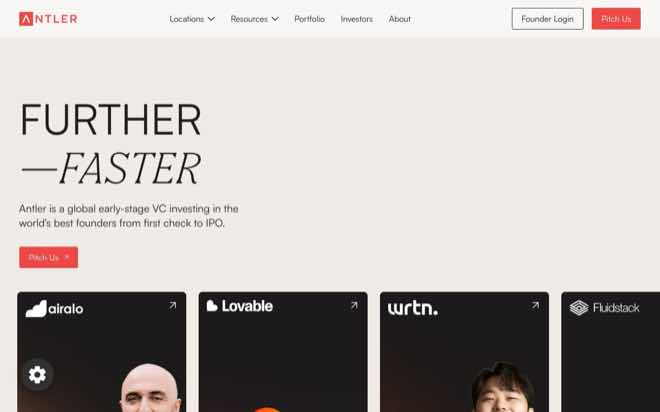
5. Antler: FI's premise, funded properly
Antler starts exactly where FI starts: before the idea. The difference is they pay you to be there instead of charging you.
It's a full-time residency in 25+ cities. You join solo, test co-founders in structured sprints, and pitch an investment committee. In the US, the current Disrupt deal totals $400K: $250K for 10%, plus $150K on an uncapped MFN SAFE, wired at the end of week 4. Terms vary a lot by city (Nairobi is $100K for 10%, for example), so check your location's page.
The trade: you quit your job on day one, and most people in any Antler cohort walk away without funding. FI's keep-your-salary model is genuinely safer. Antler's is faster.
→ Pick Antler over FI if: you're ready to go full-time now and you need a co-founder more than a curriculum.
6. Entrepreneur First: for solo technical talent
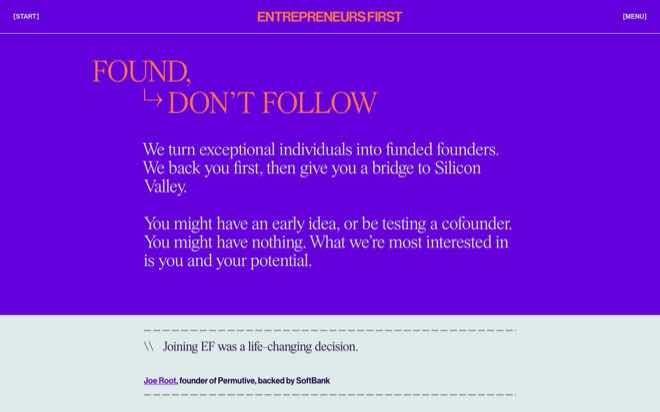
EF doesn't fund companies. It funds individuals it believes will build one.
You apply alone. They drop you into a cohort, you speed-date co-founders (80% match within 8 weeks, by their numbers), and if your new team passes the Investment Committee, EF puts in $125K for 8%, with an optional extra $125K on an uncapped MFN SAFE. Acceptance runs 1 to 3% depending on the hub.
Six months, full-time, in person. It's the deepest version of the co-founder bet, and the most selective thing on this list after YC.
→ Pick EF over FI if: you're exceptional at something technical, have nobody to build with, and can afford 6 months all-in.
7. On Deck (ODF): the network, nothing else
ODF stripped itself down to the thing people actually stayed for: the people.
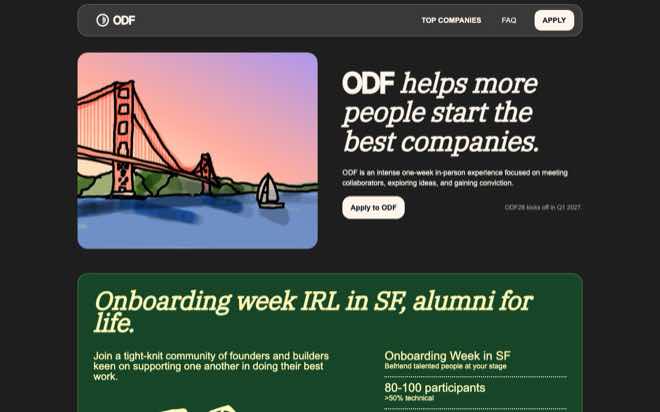
The current format is a one-week onboarding in San Francisco, 80 to 100 people per cohort, more than half of them technical. After that you're in the alumni community for life, 3,000+ members. Pricing is pay-what-you-can with a suggested $1,000 contribution. No equity, ever. ODF28 kicks off in Q1 2027 per their site.
No curriculum, no demo day, no committee. If what pulled you toward FI was "being around people who are actually doing it", ODF sells exactly that and skips the homework.
→ Pick ODF over FI if: you want serendipity and a network, and you'll build your own structure.
How to actually pick
Forget rankings. Match the program to your stage:
→ You have paying customers: Profitable Founder Club for peers, or TinySeed if a $120K+ check changes your year.
→ You have an idea and a day job you're keeping: FI is a fair option, that's its exact niche. ODF if you want the people without the syllabus.
→ You have nothing but ambition and you're ready to quit: Antler or EF. They pay you to figure it out.
→ You have a team and a prototype: YC first, Techstars second.
The worst move is paying for structure you've outgrown. The second worst is pledging equity for answers a $97 peer group would have given you by Thursday.
FAQ
Is Founder Institute still worth it in 2026?
For one specific person, yes: idea stage, keeping the day job, needs deadlines to make progress. The 2026 "Agentic" rebrand cut the program to 10 sessions plus a Funding Day, and you should plan on 15 to 20 hours a week. I wrote a full breakdown in is Founder Institute worth it, including what graduates say about chapter quality.
What does Founder Institute actually cost?
The entrance fee varies by chapter: $399 in some cities, up to $1,649 in Silicon Valley if you miss the early deadline. On top of that comes the 2.5% Equity Collective pledge. It only activates if you raise a qualified financing, and it dissolves if the company fails, but it's still 2.5% of the upside you're building.
Which Founder Institute alternative is the cheapest?
On Deck's suggested $1,000 contribution (it's pay-what-you-can), or Profitable Founder Club at $97 a year if you already have revenue. Both take 0% equity. Every funded program on this list costs more in dilution than any fee FI charges.
Do all accelerators take equity?
The ones that write checks do: YC takes 7%, Techstars 5% upfront, Antler around 10%, EF 8%, TinySeed 10 to 12%. The communities don't. The Club and ODF take nothing and charge a flat fee instead. Decide which currency hurts less at your stage: cash now or ownership later.
