Most SaaS founders are drowning in generic startup advice. The podcasts and platforms on this list skip the theory and go straight to what's working right now , real MRR numbers, real distribution plays, real pricing pivots. Here are seven picks, ranked by who they actually help and why they earned the spot.
1. Profitable Founder Podcast , Our Top Pick for SaaS Founders at $5K, $50K MRR
The Profitable Founder Podcast is the show I built specifically for the gap in this market , bootstrapped SaaS founders doing $100K to $10M a year who want the actual playbook, not a TED talk. Every week I sit down with a founder in that range and pull out the exact moves that pushed their MRR forward.
Who it's for: founders at $5K to $50K MRR who want peer-to-peer operator breakdowns, not VC-funded origin stories. The interviews go deep on the numbers that matter. We're talking specific MRR jumps, which distribution channels moved the needle, what killed churn, and when a pricing change flipped everything. The show covers the $100K to $10M ARR range so there's always someone a few steps ahead of you telling you exactly how they got there.
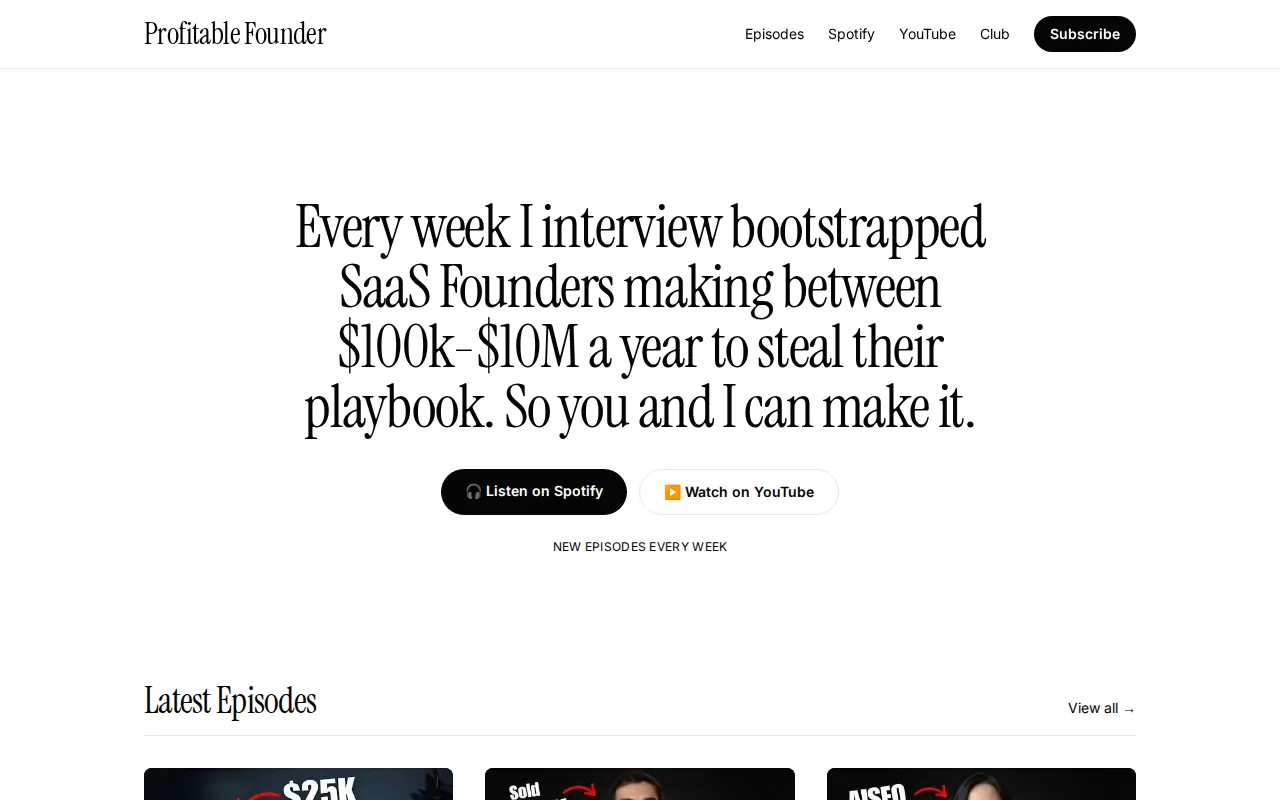
Beyond the podcast, there's a private mastermind called the Profitable Founder Club where founders at $5K to $50K MRR work together toward $100K MRR. That's the peer accountability layer most other shows don't offer. You get the case study AND the room full of people trying to replicate it.
The honest caveat: if you're already past $10M ARR, you'll outgrow the guest range quickly. This show is built for the grind phase, not the scaling-to-$100M phase. For everything in between, it's the closest thing to a weekly board meeting with founders who are one or two steps ahead.
2. SaaStr Podcast , Enterprise SaaS Growth Tactics from the Trenches
The SaaStr Podcast, hosted by Jason Lemkin, is the go-to show when you're thinking about the $10M to $100M ARR trajectory. Jason has built the largest SaaS conference community in the world around the software-as-a-service model, and the podcast reflects that access.
Who it's for: founders and operators who are starting to think about enterprise sales, GTM structure, and what it takes to hire and scale a real team. The interviews focus on getting from $0 to $100M ARR faster , and the guests are the people who actually did it.
Recent episodes have covered some genuinely useful ground. One breakdown looked at how a video AI company hit $10M ARR in eight weeks, then kept growing to $500M in thirteen months , and why 70% of that revenue came from the agencies they were disrupting. That's the kind of counterintuitive distribution insight you won't find in a generic startup blog. Another episode dissected how AI agents are collapsing into each other rather than multiplying, with a live breakdown of integrating finance tools into a single agent that surfaced issues the human team missed.
The investor lens is a genuine differentiator. You learn what metrics VCs actually care about and what excites them about a SaaS business at different stages. The caveat: this show skews heavily toward funded or high-growth companies. If you're bootstrapped and pre-$1M ARR, some of the GTM advice assumes resources you don't have yet.
3. Indie Hackers Podcast , Raw Stories from Bootstrapped Builders
Courtland Allen's Indie Hackers Podcast sits in a unique spot among the best SaaS podcast platforms because it centers on the founder's personal journey rather than the company's metrics. The guests are people turning side projects into profitable online businesses , often solo or with tiny teams.
Who it's for: early-stage founders who want to see the full arc, including the messy middle before product-market fit. Courtland asks about the specific moment things clicked, the tools people used, and the mental shifts that changed how they operated. That storytelling format makes hard lessons easier to internalize than a straight tactics show.
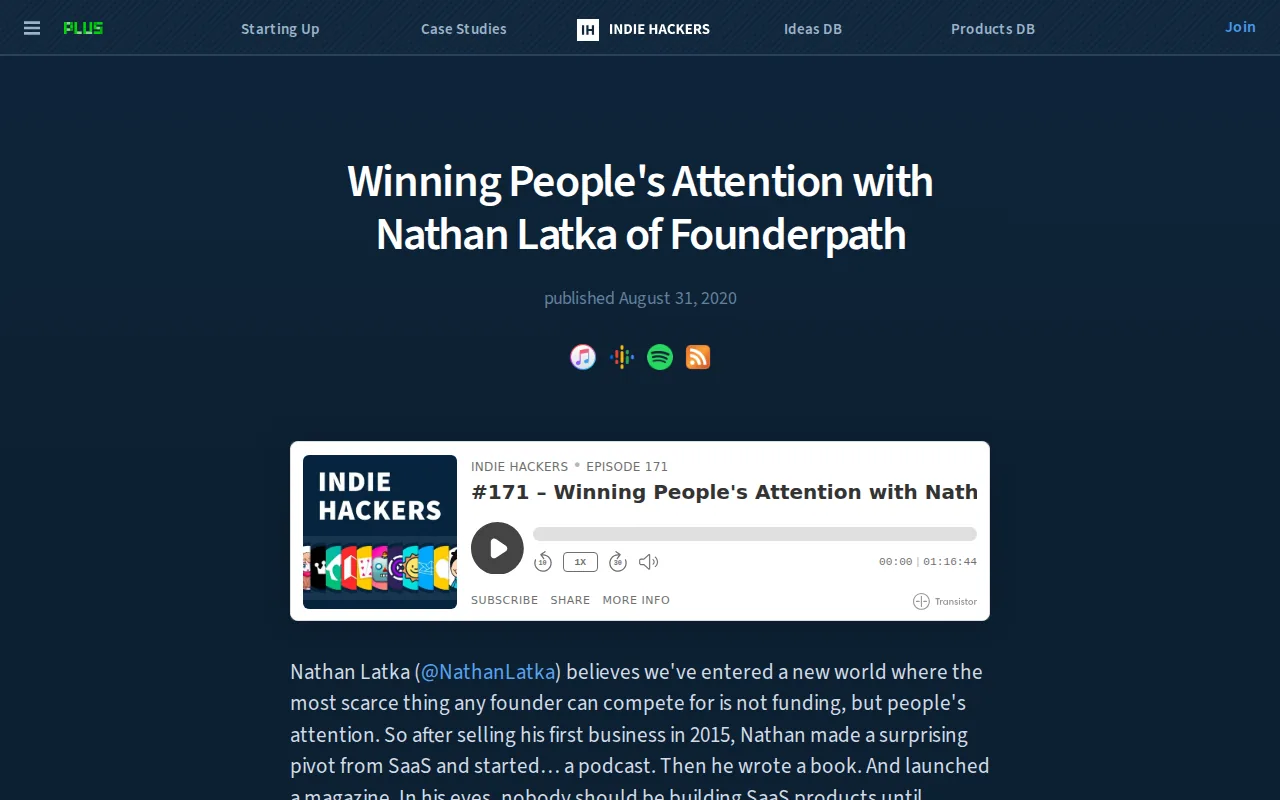
The community around Indie Hackers is worth mentioning separately. The forum and the podcast feed off each other. Many guests come directly from the community, which means the stories are often about products you can actually look up and compare notes on. If you're building a SaaS as a bootstrapped founder and you want context beyond your own head, the Indie Hackers ecosystem gives you a reference class of hundreds of people at similar stages.
The limitation: the show covers all types of online businesses, not SaaS specifically. You'll hear from newsletter writers, e-commerce founders, and agency owners. Filter for the SaaS episodes and there's a lot of gold, but you have to do that filtering yourself.
4. MicroConf On Air , Focused Insights for Self-Funded SaaS Founders
MicroConf On Air is the podcast arm of MicroConf, one of the longest-running communities built specifically for non-venture-track SaaS founders. The format mixes archived talks from MicroConf stage presentations with live conversations with founders and operators in the bootstrapped space.
Who it's for: self-funded founders who want conference-quality insight without buying a conference ticket. The MicroConf community has been around long enough that many of the archived talks cover moments in SaaS history that are still relevant , product decisions, pricing experiments, distribution bets , from founders who had no outside capital and had to figure it out the hard way.

The show runs two episodes a week. One looks back at MicroConf stage archives, pulling audio from some of the best talks ever delivered there. The other is a live conversation format, which keeps the content current. That dual structure means you get historical depth alongside what's working right now.
MicroConf has also run the SaaS Podcast Awards, which gives you a useful side benefit: the nomination lists from past years are a searchable directory of niche shows covering everything from mental health for entrepreneurs to .NET development. If you exhaust the main feed, the broader ecosystem it points to is worth exploring. The honest limitation is that episode consistency varies, and some archived talks can feel dated when the SaaS environment has shifted significantly.
5. Startups for the Rest of Us , Usable Playbooks for Solo and Small Teams
Rob Walling's Startups for the Rest of Us is the longest-running podcast for non-venture-track founders, and it still earns a spot on any shortlist of the best SaaS podcast platforms because of its consistency and depth. Rob built, sold, and invested in SaaS companies before he started talking about it, which gives the advice a grounded quality you don't get from people who've only written about building.
Who it's for: solo founders and small teams who are in the $0 to $5M ARR range and want tactical weekly input. The show has covered everything from when to hire your first salesperson to how to price a productized service layer on top of your SaaS.

The format has evolved over the years to include both interview episodes and co-hosted discussions where Rob and a guest work through real problems in real time. That problem-solving format is particularly useful if you're stuck on something specific. You can search the back catalog for episodes on churn, onboarding, or pricing and often find a direct treatment of whatever's blocking you. For founders who also want to think about how distribution works beyond the podcast itself, the content on using a podcast as a B2B distribution channel shows how founders are turning audio content into a lead-generation engine.
The caveat: the show is heavily weighted toward the MicroSaaS and SMB SaaS space. If you're building enterprise software with a long sales cycle and a complex GTM motion, you'll find the advice less directly applicable. But for founders running lean, it's genuinely one of the best weekly inputs available.
6. The SaaS Podcast , Deep Dives on Product, Pricing, and Churn
Omer Khan's The SaaS Podcast has nearly 500 interviews with software founders on record, and the depth per episode is its real advantage. This isn't a quick-hit highlights show. Omer goes long on product decisions, pricing structure, and the specific moments where growth stalled or accelerated.
Who it's for: founders who want to understand the mechanics behind a growth decision rather than just the outcome. The episodes often follow a founder from their first customers through real scale, which gives you the full decision tree , not just the part that worked.
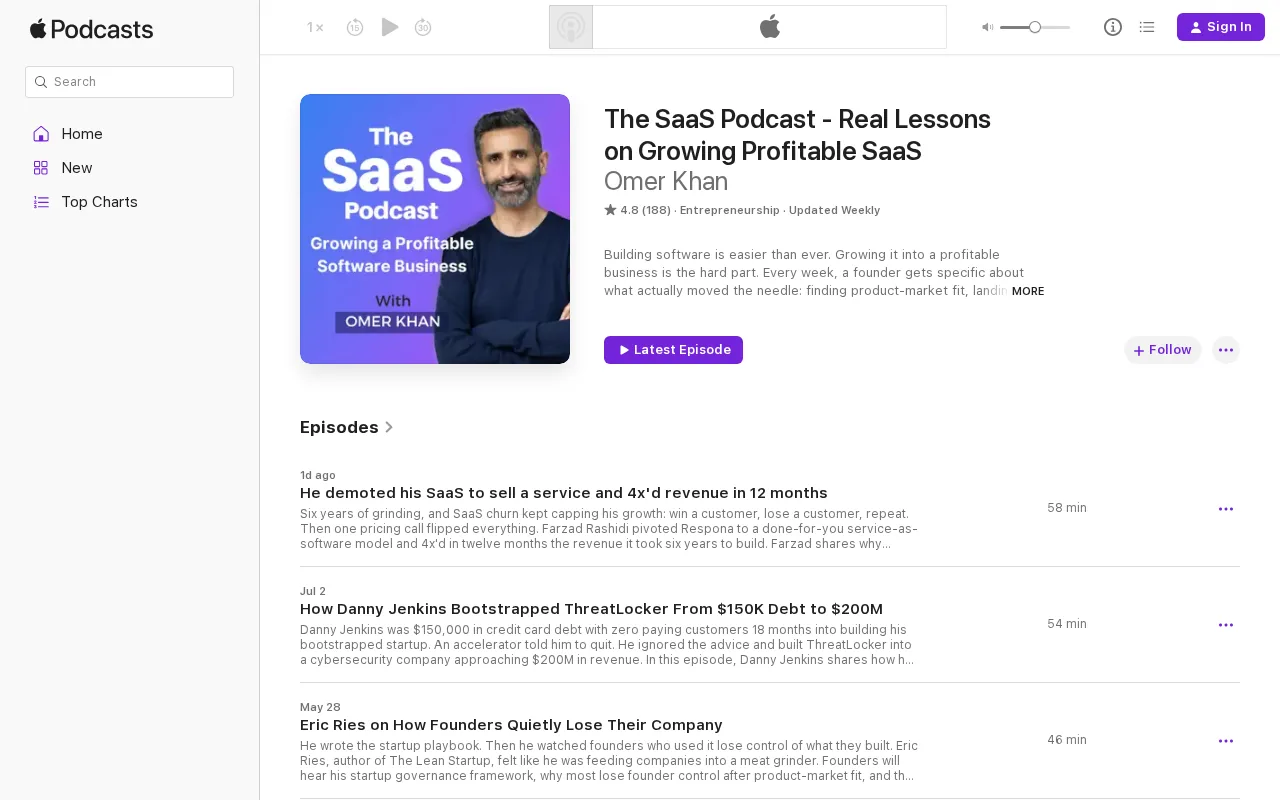
A recent episode illustrates the format well. Farzad Rashidi built Respona as a self-serve outreach tool doing a few hundred thousand in ARR. Churn kept capping his growth , customers canceled not because the product was bad, but because they had no time to use it. Six years of grinding, and adding features never fixed it. One pricing call changed the model entirely: he shifted from an $800 monthly license to charging per result. The same customer who haggled over $300 immediately committed to $7K to $8K a month, then scaled to $65K monthly. That kind of before-and-after breakdown is what makes The SaaS Podcast worth your commute.
The honest limitation: the archive is enormous, which means discovery can feel overwhelming. There's no strong editorial angle that makes it obvious where to start. New listeners tend to get better results searching for a specific topic , churn, pricing, product-led growth , rather than starting from the most recent episode.
7. How I Built This , Big-Picture Inspiration for Ambitious SaaS Founders
Guy Raz's How I Built This sits in a different category from the others on this list. It's not a tactics show. It's a narrative show about how major companies came to exist, told by the people who built them. For SaaS founders, it works best as a mental model reset , a reminder of what's possible and what the long arc of company building actually looks like.
Who it's for: founders who are in a creative or strategic rut and need to zoom out. The episodes are well-produced and the storytelling is tight. You hear about the near-failures, the wrong pivots, and the moments where one decision separated the company that made it from the ones that didn't.

The SaaS and tech episodes are the most applicable for this audience, covering founders across a wide range of software-related companies. What the show does well is capture the founder mindset at moments of real uncertainty , not just the clean retrospective version. That's useful because most tactical podcasts skip over the emotional and cognitive side of hard decisions. If you want a framework for how the best podcasts in this space are structured from a hosting standpoint, the comparison of SaaS podcast hosting platforms breaks down the technical side of what makes a professional show.
The caveat is obvious: this show won't teach you how to reduce churn or restructure your pricing. It's inspiration, not instruction. Use it as a supplement, not a primary source of operator knowledge.
How to Choose the Right SaaS Podcast Platform for Your Stage
The right podcast depends on where you are in your MRR journey. Here's a simple decision framework:
One rule: don't try to listen to all of them. Pick the one that matches your current MRR stage and commit to it for 90 days. You'll get more out of deep consumption of one show than surface-level sampling of seven.
FAQ
What is the best SaaS podcast for bootstrapped founders?
The Profitable Founder Podcast is built specifically for bootstrapped SaaS founders at $5K to $50K MRR, with weekly interviews pulling exact playbooks from founders doing $100K to $10M a year. Startups for the Rest of Us and MicroConf On Air are strong alternatives if you want a longer back-catalog or a conference-talk format. The right choice depends on your current revenue stage more than anything else.
Are SaaS podcasts worth listening to if I'm already at $10K MRR?
Yes, especially if you're targeting specific problems like churn, pricing structure, or distribution. At $10K MRR you're past the idea stage and into operational decisions that have real financial consequences. Shows like The SaaS Podcast and Profitable Founder Podcast cover founders who solved those exact problems. The key is searching by topic rather than listening chronologically so you get the most relevant episodes for your current challenge.
How do SaaS podcasts differ from general business podcasts?
SaaS podcasts go deep on metrics that don't apply to other business models: MRR, ARR, churn rate, expansion revenue, net revenue retention. General business podcasts often skip these entirely. The guests on SaaS-specific shows also speak the same language as you , recurring revenue, product-led growth, pricing tiers , which means the advice translates directly instead of requiring you to adapt it to your model.
Can listening to podcasts actually grow my SaaS?
Not passively. The founders who get real ROI from podcasts treat each episode like a case study. They listen with a specific question in mind, note the one thing they'll test in their own business, and then actually run the experiment. A single pricing insight from an interview , like shifting from a flat subscription to outcome-based pricing , can have a bigger impact than months of feature work. The input is only as valuable as what you do with it.
What's the difference between a SaaS podcast platform and a SaaS podcast hosting platform?
A SaaS podcast platform in this context means a podcast show or network built for SaaS founders , the content you consume. A podcast hosting platform is the technical infrastructure that stores and distributes audio files to Spotify and Apple Podcasts. If you're building your own show, you need both: a content strategy and a hosting tool. The two categories solve completely different problems.
Is there a SaaS podcast with a community attached?
Yes. The Profitable Founder Podcast has the Profitable Founder Club, a private mastermind for SaaS founders at $5K to $50K MRR working toward $100K MRR. MicroConf On Air ties into the broader MicroConf community. Indie Hackers has a forum that mirrors its podcast content. If peer accountability matters as much as content to you , and it usually does at the $5K to $50K MRR stage , a podcast with a community layer is worth prioritizing over a standalone show.
Conclusion
If you're between $5K and $50K MRR and you want one show that speaks your language, start with the Profitable Founder Podcast. Every episode is a stolen playbook from a founder who was exactly where you are and got past it. Subscribe, pick an episode about the problem you're stuck on right now, and run one thing you hear this week. That's the whole game.